Does Full Coverage Insurance Cover Rental Cars?
does-full-coverage-insurance-cover-rental-cars
Does Full Coverage Insurance Cover Rental Cars?
You arrive at the rental-car counter.
The employee hands you the keys and then asks:
“Would you like to purchase our insurance?”
You already have full coverage on your own car.
So now you are wondering:
Does full coverage insurance cover rental cars?
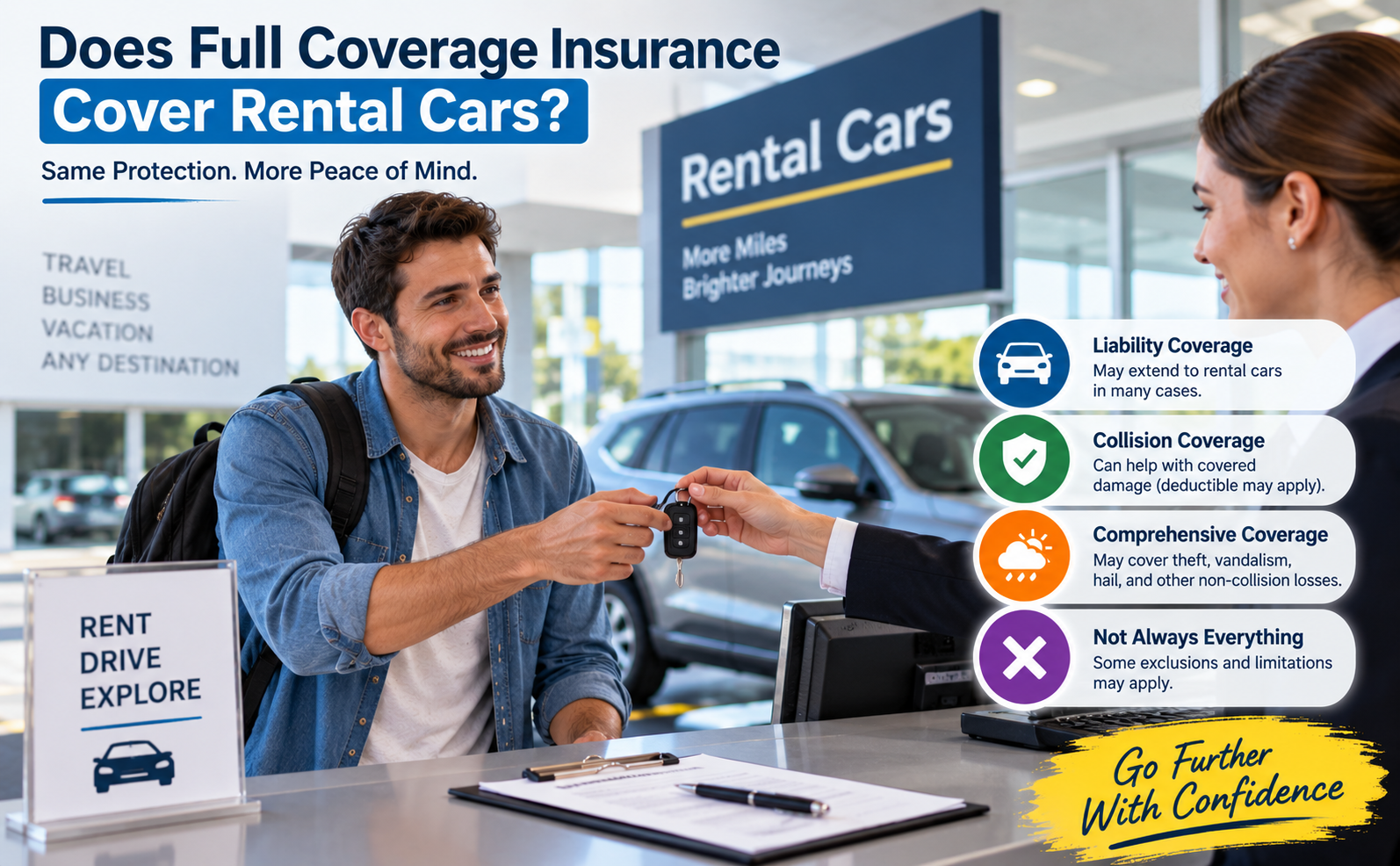
In many situations, your personal auto insurance may extend some of the same coverage you have on your own vehicle to a temporary rental car.
For example, if your personal policy includes liability, collision, and comprehensive coverage, those protections may also apply when you rent a standard vehicle for personal use.
But there is an important warning:
“Full coverage” does not guarantee that every rental-car expense is covered.
Your policy may have exclusions.
Your deductible may still apply.
Certain rental-company charges may not be fully covered.
International rentals can work differently.
And business use, unusual vehicles, or long-term rentals may create additional restrictions.
Before declining coverage at the rental counter, you should understand what your own policy actually provides.
What Does “Full Coverage” Mean?
“Full coverage” is a common phrase, but it is not one standardized insurance product.
Most people use the term to describe a policy containing:
- Liability insurance
- Collision coverage
- Comprehensive coverage
A policy may also include:
- Uninsured motorist coverage
- Medical Payments
- PIP
- Roadside assistance
- Rental reimbursement
- Other optional protection
Two people can both say they have “full coverage” while having very different policies.
That is why the correct question is not only:
“Do I have full coverage?”
It is:
“Which parts of my policy extend to a rental car?”
If you want a broader explanation of policy types, read What Does Auto Insurance Cover?
Does Liability Insurance Cover a Rental Car?
Your personal auto liability insurance may extend to a rental vehicle in many situations.
Liability coverage helps when you are legally responsible for causing injuries or property damage to other people.
Imagine you rent a vehicle while on vacation.
You accidentally cause a crash.
Another person's car is damaged, and they are injured.
If your personal auto policy extends liability protection to the rental, your liability insurance may respond according to its limits and terms.
Your normal liability limits generally remain important.
Renting another vehicle does not automatically increase them.
Example of Liability Coverage on a Rental Car
Suppose your personal auto policy includes:
Bodily injury liability: $100,000/$300,000
Property damage liability: $100,000
You rent a car for a weekend trip.
You cause a covered accident.
Your personal liability coverage may extend to the rental-car situation according to your policy.
But remember:
Your policy limits still apply.
If an accident creates damages above those limits, additional financial exposure may remain.
If you want to understand injury liability more clearly, read What Is Bodily Injury Liability Coverage?
Does Collision Coverage Protect a Rental Car?
It often can.
If your personal auto policy includes collision coverage, that coverage may extend to a temporary rental vehicle used for personal purposes.
Collision coverage generally helps with covered damage caused by events such as:
- Hitting another vehicle
- Hitting a guardrail
- Hitting a pole
- Hitting another object
- Certain single-car crashes
Your normal collision deductible may still apply.
For example:
Rental-car damage: $5,000
Your collision deductible: $500
Potential covered amount after deductible: $4,500
This is only a simplified example.
The actual claim depends on your policy and circumstances.
Check Below,,https://bestcarandautoinsurance.com/does-getting-auto-insurance-quotes-affect-credit-score
Does Comprehensive Coverage Protect a Rental Car?
Comprehensive coverage may also extend to a rental car in many situations.
It can potentially protect against certain non-collision losses such as:
- Theft
- Vandalism
- Hail
- Fire
- Falling objects
- Certain weather damage
Suppose someone steals your rental vehicle while you are staying at a hotel.
If your personal comprehensive coverage extends to the rental, it may help with the covered loss according to your policy.
Your comprehensive deductible may still apply.
For more information, read Collision vs Comprehensive Insurance: What’s the Difference?
Does Full Coverage Mean You Can Decline Rental Car Insurance?
Not automatically.
Even when your personal policy extends liability, collision, and comprehensive coverage to a rental car, there may still be gaps.
Rental companies can offer products that address risks your personal policy may not cover completely.
Examples can include:
- Loss-of-use charges
- Administrative fees
- Diminished value
- Certain towing expenses
- Deductible exposure
- Other contractual charges
So before saying no at the counter, ask your own insurer what is covered.
A five-minute phone call before your trip can prevent a much larger surprise later.
What Is a Collision Damage Waiver?
Rental companies commonly offer a product called a:
Collision Damage Waiver
or
Loss Damage Waiver
It may be shortened to:
CDW
or
LDW.
Technically, this is often a contractual waiver rather than traditional insurance.
If you purchase it, the rental company may agree not to hold you financially responsible for certain damage or theft, subject to the rental agreement.
This can reduce the need to make a claim against your personal collision or comprehensive insurance in certain situations.
But the waiver can have exclusions.
Read the agreement carefully.
Is a Rental Car Damage Waiver Necessary?
Not always.
If your personal auto insurance already provides strong collision and comprehensive protection for rental vehicles, you may decide that the waiver is unnecessary.
But consider several questions first:
What is your collision deductible?
What is your comprehensive deductible?
Does your insurer cover loss of use?
Does your insurer cover administrative fees?
Does your insurer cover diminished value?
Would filing a rental-car claim affect your insurance history?
Do you want to avoid dealing with your insurer after rental-car damage?
The answer can depend on your priorities.
What Is Loss of Use?
This is one of the most important possible gaps.
Imagine you damage a rental vehicle.
It spends ten days in a repair shop.
The rental company may argue that it lost money because it could not rent that vehicle to other customers during those ten days.
It may charge you for that lost rental income.
This is commonly called:
loss of use.
Your personal auto policy may not always cover the full amount the rental company demands.
Ask your insurer specifically about this before declining the rental company's damage waiver.
What Is Diminished Value?
Suppose a rental vehicle is worth $30,000 before an accident.
It is properly repaired.
But because the vehicle now has an accident history, the rental company believes it is worth only $27,000.
The company may claim that it lost:
$3,000 in value.
That difference is called diminished value.
Your personal auto policy may not necessarily cover every diminished-value charge made by a rental company.
This is another reason to check coverage before renting.
What Are Administrative Fees?
A rental company may charge administrative costs connected with handling a damaged vehicle.
These could be separate from the physical repair bill.
Your personal insurance may or may not cover all such charges.
If your rental agreement allows these fees, you could face a bill even when most vehicle damage is insured.
Does Your Deductible Apply to a Rental Car?
Usually, if your personal collision or comprehensive coverage extends to the rental, your existing deductible may also apply.
For example:
Rental vehicle damage: $3,500
Collision deductible: $1,000
Your deductible could leave you responsible for $1,000 of the covered vehicle damage.
The rental company's damage waiver may operate differently.
This is one reason some travelers purchase the waiver even when they already have personal full coverage.
If you need a detailed explanation, read What Is a Car Insurance Deductible and How Does It Work?
Does Rental Car Coverage Apply If You Have Liability-Only Insurance?
This is where the situation changes significantly.
Suppose your own vehicle has liability-only insurance.
You rent a car.
Your liability protection may potentially extend to the rental according to your policy.
But you have no collision or comprehensive coverage on your personal vehicle.
That may mean your personal policy does not provide physical-damage protection for the rental car either.
If you damage the rental vehicle, you could face significant costs.
Drivers with liability-only policies should pay particularly close attention to the protection offered by the rental company.
Does Full Coverage Protect a Rental Car From Theft?
Potentially, yes.
If your comprehensive coverage extends to the temporary rental car, theft may be covered according to the policy.
Suppose your rental vehicle disappears from a hotel parking lot.
You should:
Contact police.
Contact the rental company.
Contact your insurer.
Follow the claim instructions.
Your comprehensive deductible may apply.
Does Full Coverage Protect Against Hail or Flood Damage to a Rental?
Potentially.
Hail, flooding, falling objects, and certain other weather-related losses are normally associated with comprehensive coverage.
If your comprehensive insurance extends to the rental vehicle, qualifying weather damage may be covered.
But rental-company fees can still create additional issues.
If you want to understand flood-related vehicle insurance, read Does Auto Insurance Cover Flood Damage to a Car?
Does Full Coverage Cover a Rental Car Windshield?
Potentially, depending on your comprehensive or glass coverage.
Imagine a rock strikes the rental vehicle's windshield.
The crack requires replacement.
If your personal comprehensive coverage applies to the rental vehicle, the windshield loss may be covered according to your policy and deductible.
Special glass benefits that apply to your own car may not necessarily work identically on a rental vehicle.
Ask your insurer.
For more information, read Does Car Insurance Cover Windshield Replacement?
Does Your Insurance Cover a Rental Car After an Accident?
This phrase can mean two different things.
Situation 1: You Are Renting a Car and Crash It
Your personal auto policy may extend liability, collision, and comprehensive protection to the rental.
Situation 2: Your Own Car Was Damaged and You Need a Temporary Rental
That is a completely different coverage called:
Rental reimbursement coverage.
Rental reimbursement helps pay the cost of a temporary rental while your own insured car is being repaired after a covered loss.
It does not mean the same thing as insurance protection for damage to the rental vehicle itself.
For the complete explanation, read What Is Rental Reimbursement Coverage?
Full Coverage vs Rental Reimbursement
This distinction is very important.
Full Coverage on a Rental Car
Can refer to your personal liability, collision, and comprehensive insurance extending to a rental vehicle.
Rental Reimbursement Coverage
Helps pay for a temporary rental when your own vehicle is unavailable after a covered claim.
They solve completely different problems.
You can have strong physical-damage coverage on a rental vehicle and still have no rental reimbursement benefit when your own car is in the shop.
What If Another Driver Hits Your Rental Car?
Suppose another driver causes an accident while you are driving a rental.
Their liability insurance may be responsible for covered damage.
However, fault can be disputed.
The other driver may be uninsured.
Their insurer may delay the claim.
Your personal collision coverage may potentially provide another way to handle rental-car damage while responsibility is being resolved.
Your deductible may initially apply.
What If an Uninsured Driver Hits the Rental Car?
Your own policy may contain uninsured motorist coverage, collision coverage, or both.
Which coverage applies depends on:
- State
- Policy
- Damage type
- Driver
- Fault
- Coverage purchased
If uninsured motorists concern you, read What Is Uninsured Motorist Coverage and Do You Need It?
Does Full Coverage Apply to Someone Else Driving the Rental Car?
This can become complicated.
Rental agreements usually identify authorized drivers.
Your personal insurance may also have rules about who qualifies as an insured driver.
Do not allow another person to drive the rental simply because you believe your full coverage will protect them.
The rental company may require that person to be listed as an authorized driver.
If someone who is not authorized crashes the vehicle, insurance and contractual problems can arise.
Can Your Spouse Drive the Rental Car?
Possibly, depending on:
- Rental company's rules
- Rental agreement
- State
- Your insurance policy
- Whether your spouse is listed or otherwise permitted
Do not assume your spouse is automatically authorized everywhere.
Ask the rental company when picking up the vehicle.
What If You Rent a Car for Business?
Personal auto insurance may have restrictions when a rental vehicle is used for business purposes.
A basic work trip can be different from:
- Commercial delivery
- Rideshare
- Transportation services
- Regular business use
If your employer rents the vehicle or the trip is primarily business-related, commercial or employer insurance may also become relevant.
Check before the trip.
Does Personal Auto Insurance Cover a Moving Truck?
Do not assume it does.
Rental moving trucks can be much larger and heavier than ordinary passenger vehicles.
A personal auto policy may exclude or limit coverage for certain truck sizes or vehicle types.
If you rent:
- Box truck
- Large moving van
- Commercial-style truck
ask your insurer specifically whether your policy applies.
Do not rely on the same answer you received for a normal rental sedan.
Does Full Coverage Protect a Rental Motorcycle?
Not necessarily.
A personal auto policy covering a passenger car may not automatically provide the same protection for:
- Motorcycles
- Scooters
- ATVs
- Recreational vehicles
- Exotic vehicles
Rental vehicle type matters.
Ask before renting something different from a normal private passenger car.
What About Luxury or Exotic Rental Cars?
Some personal auto policies may limit coverage for certain high-value, exotic, or specialty vehicles.
Imagine your normal vehicle is worth $25,000.
You rent a $200,000 exotic car.
Do not assume your ordinary personal policy will automatically cover the full risk in the same way.
Contact the insurer before renting high-value vehicles.
Does Your Insurance Cover a Rental Car in Another State?
Personal auto insurance generally follows you when driving within the United States, subject to policy terms.
Policies can adjust to certain state-required minimum limits when you cross state lines.
But unusual rentals or special circumstances can still create restrictions.
For domestic travel, confirm your policy if you have concerns.
Does U.S. Car Insurance Cover Rentals in Canada?
Some U.S. personal auto policies may extend certain coverage into Canada.
But you should confirm this before traveling.
Ask:
Does my liability coverage apply?
Does collision apply?
Does comprehensive apply?
Are there special documents I need?
Do not assume international travel works exactly like driving within the United States.
Does U.S. Car Insurance Cover Rentals in Mexico?
Do not assume it does.
Mexico has its own insurance requirements, and U.S. personal auto coverage may not provide adequate or legally accepted protection.
Travelers driving into Mexico often need specific Mexican auto insurance.
If you plan to cross the border, arrange proper coverage before doing so.
Does Full Coverage Protect Rental Cars Overseas?
Usually, you should not assume your U.S. personal auto policy provides the same protection outside the United States and Canada.
International rental rules vary greatly.
When renting overseas, check:
- Local insurance requirements
- Rental-company coverage
- Credit-card benefits
- Travel insurance
- Your personal policy
Never decline rental protection overseas simply because your own U.S. car is fully insured.
Can a Credit Card Cover Rental Car Damage?
Some credit cards provide rental-car protection when you use the card to pay for the rental and meet the program's requirements.
This can potentially cover certain vehicle damage or theft.
But credit-card coverage varies significantly.
It may be:
Primary
or
Secondary.
It may exclude:
- Luxury vehicles
- Trucks
- Long rentals
- Certain countries
- Liability
- Personal property
- Certain fees
Read the card's current benefits before relying on it.
Primary vs Secondary Rental Car Coverage
This distinction matters.
Primary Coverage
May pay eligible rental-car damage without first requiring you to make a claim against your personal auto policy.
Secondary Coverage
May pay certain eligible amounts after your personal insurance has handled the claim.
For example, secondary credit-card coverage might help with your deductible or certain remaining costs.
Program terms vary widely.
Does a Credit Card Provide Liability Insurance?
Often, rental-car benefits from credit cards focus mainly on damage or theft of the rental vehicle rather than liability you create by injuring another person or damaging their property.
Do not assume your credit card replaces auto liability insurance.
Check the actual benefit guide.
What Insurance Does a Rental Company Offer?
Rental companies may offer several separate products.
Collision or Loss Damage Waiver
Helps address damage or theft of the rental vehicle according to the rental agreement.
Supplemental Liability Protection
Can provide additional liability protection.
Personal Accident Insurance
May provide certain injury-related benefits.
Personal Effects Coverage
May cover certain belongings.
These are separate products.
You do not necessarily need all of them simply because they are offered.
Compare them with insurance you already have.
Does Health Insurance Replace Rental Car Insurance?
No.
Health insurance can help with your medical expenses.
It does not repair the rental vehicle.
It does not provide auto property-damage liability.
It does not automatically protect you from claims made by other drivers.
Different insurance products cover different risks.
What Happens If You Damage a Rental Car?
If an accident occurs:
Make Sure Everyone Is Safe
Call emergency services if needed.
Contact Police When Appropriate
Follow local requirements.
Notify the Rental Company
Do not wait until returning the car.
Contact Your Insurer
Report the accident if your personal policy may apply.
Document Everything
Take photographs of:
- Rental vehicle
- Other vehicles
- Accident scene
- Damage
- License plates
Keep the Rental Agreement
It contains important information about your financial obligations.
Should You Report Small Rental Car Damage?
Yes, follow the rental agreement and reporting requirements.
Do not simply attempt to repair damage secretly before returning the car.
The company may have specific procedures.
Your insurance company may also need timely notice.
Minor damage can sometimes become more expensive once the vehicle is professionally inspected.
Can a Rental Car Claim Increase Your Premium?
Potentially.
If you make a collision claim under your personal auto policy after damaging a rental vehicle, it may become part of your claims history.
Whether it increases your premium depends on:
- Fault
- Claim amount
- State
- Insurer
- Previous history
- Accident forgiveness
- Other factors
For more information, read Does Filing a Car Insurance Claim Increase Your Premium?
Will a Rental Car Accident Stay on Your Insurance Record?
It can.
The fact that you were driving a rental vehicle does not automatically make the accident disappear.
An at-fault accident can potentially become part of your driving and claims history.
For a detailed explanation, read How Long Does an Accident Stay on Your Car Insurance Record?
Do You Need Rental Company Insurance If You Already Have Full Coverage?
Maybe not, but check for gaps first.
Before declining the rental company's protection, confirm:
- Liability coverage
- Collision coverage
- Comprehensive coverage
- Deductibles
- Loss-of-use protection
- Diminished-value protection
- Administrative fees
- Rental vehicle restrictions
- Geographic limits
Then check any credit-card rental protection you may have.
Only after understanding all three layers should you decide what rental-company coverage you want.
Questions to Ask Your Insurer Before Renting a Car
Call your insurance company and ask:
Does my liability coverage extend to a rental car?
Does my collision coverage extend?
Does comprehensive coverage extend?
What deductible applies?
Is theft covered?
Are loss-of-use charges covered?
Is diminished value covered?
Are administrative fees covered?
Are additional drivers covered?
Are luxury cars covered?
Are moving trucks covered?
Does coverage apply in Canada?
Does coverage apply in Mexico?
How long can I rent before it is no longer considered temporary?
These questions can give you a much clearer answer than simply asking whether you have “full coverage.”
Questions to Ask at the Rental Counter
Before signing the agreement, ask:
Who is allowed to drive?
What happens if the vehicle is damaged?
What does the damage waiver cover?
What does it exclude?
Are loss-of-use charges waived?
Are administrative fees waived?
What liability coverage is included?
What is the fuel policy?
What happens after theft?
What should I do after an accident?
Read the agreement before leaving.
Inspect the Rental Car Before Driving Away
Before you leave the parking area, inspect the vehicle.
Look for:
- Scratches
- Dents
- Cracked glass
- Wheel damage
- Bumper damage
- Interior damage
Take photographs or a short video.
Make sure existing damage is documented.
This can help prevent disputes when the vehicle is returned.
Does Full Coverage Pay for Your Rental Car Cost?
Be careful with the wording.
Your collision and comprehensive insurance may protect the rental vehicle itself.
That does not mean your personal policy automatically pays the daily cost of renting the car.
Those are different issues.
If your own car is damaged and you need help paying for a temporary rental, the coverage you are looking for is rental reimbursement.
Read What Is Rental Reimbursement Coverage? for that situation.
Frequently Asked Questions
Does full coverage insurance cover rental cars?
In many situations, liability, collision, and comprehensive coverage from a personal auto policy may extend to a temporary rental car used for personal purposes. Policy exclusions, deductibles, rental vehicle type, and location can affect coverage.
Does collision insurance cover a rental car?
It often may when your collision coverage extends to temporary rental vehicles. Your normal deductible can still apply.
Does comprehensive insurance cover rental cars?
It may protect against qualifying theft, vandalism, weather, and other non-collision losses if the coverage extends to the rental.
Do I need rental-car insurance if I have full coverage?
Not necessarily, but your personal policy may not cover every rental-company charge. Check loss of use, diminished value, administrative fees, and other potential gaps first.
Does liability insurance cover a rental car?
Personal auto liability may extend to a rental car in many situations, subject to your policy and limits.
Does full coverage pay the daily rental cost?
Not automatically. Paying for a temporary rental while your own vehicle is being repaired generally requires rental reimbursement coverage.
Does a credit card cover rental-car damage?
Some cards offer rental vehicle protection, but limits, exclusions, countries, vehicle types, and whether coverage is primary or secondary vary.
Does personal insurance cover rental cars overseas?
Do not assume it does. Personal U.S. auto coverage may have significant geographic limitations, especially outside the United States and Canada.
Does insurance cover a rental moving truck?
Not necessarily. Large trucks and commercial-style vehicles may be excluded or limited under personal auto policies.
Does a rental-car claim affect your personal insurance?
It can if your own policy pays the claim. The future premium impact depends on fault, claim history, insurer, state, and other factors.
Does Full Coverage Insurance Cover Rental Cars? The Bottom Line
So, does full coverage insurance cover rental cars?
In many situations, it can.
If your personal auto policy includes liability, collision, and comprehensive insurance, those protections may extend to a temporary rental vehicle used for normal personal travel.
But there is no universal guarantee.
“Full coverage” is only an informal phrase.
Your actual policy determines what is protected.
Before declining rental-company coverage, confirm:
Your liability limits.
Whether collision and comprehensive extend to the rental.
Your deductible.
Whether loss of use is covered.
Whether diminished value is covered.
Whether administrative fees are covered.
Whether your rental vehicle type is eligible.
And whether your policy covers the country where you are driving.
Also remember the important difference:
Coverage for damage to a rental car is not the same as rental reimbursement coverage.
Rental reimbursement helps pay for temporary transportation when your own car is unavailable after a covered loss.
Understanding that distinction can prevent one of the most common rental-car insurance mistakes.
For more information, read What Is Rental Reimbursement Coverage?, Collision vs Comprehensive Insurance: What’s the Difference?, What Is a Car Insurance Deductible and How Does It Work?, and Does Filing a Car Insurance Claim Increase Your Premium?