What Does Auto Insurance Cover? A Beginner’s Guide
A starter outline for a comprehensive educational guide.
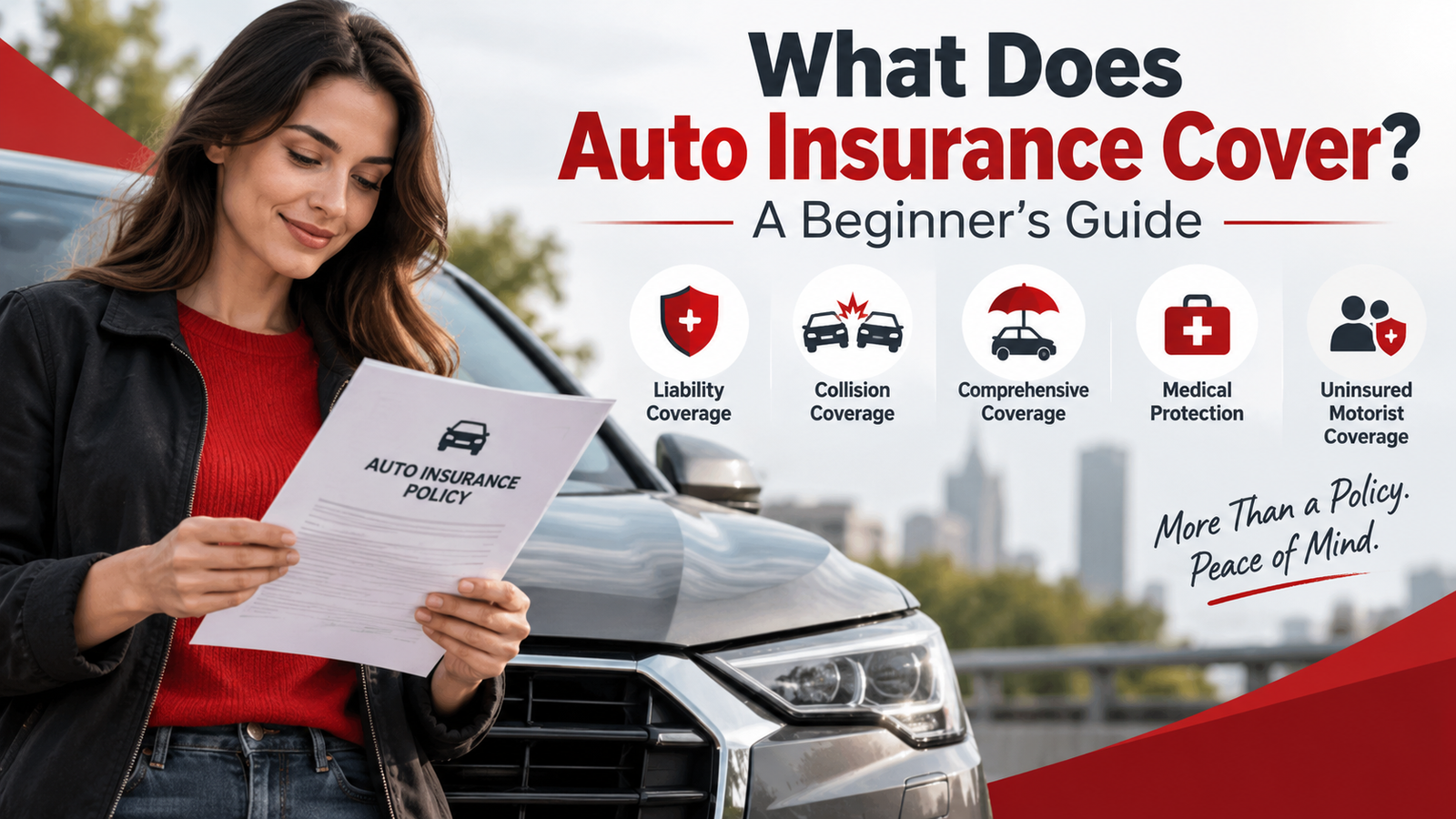
What Does Auto Insurance Cover? A Beginner’s Guide
Auto insurance can look complicated when you are buying a policy for the first time. Terms such as liability, collision, comprehensive, deductible, PIP, and uninsured motorist coverage can make a simple decision feel confusing.
The basic idea is much easier to understand.
Auto insurance helps protect you financially when certain covered events happen involving your vehicle. Depending on your policy, it may help pay for injuries, damage to another person’s property, damage to your own vehicle, theft, weather damage, medical expenses, and other covered losses.
However, no auto insurance policy covers everything.
What your insurance pays depends on:
- The coverage you purchased
- Your coverage limits
- Your deductible
- Your state’s insurance laws
- The circumstances of the accident or loss
- Your insurer’s policy terms and exclusions
This guide explains the main types of auto insurance coverage in simple English so you can better understand what your policy may protect.
What Does Auto Insurance Cover?
An auto insurance policy usually contains several different types of coverage.
Some coverage protects other people if you cause an accident. Other coverage protects your own vehicle. Certain types of insurance can also help with medical expenses or losses caused by an uninsured driver.
The most common types of auto insurance coverage include:
- Bodily injury liability
- Property damage liability
- Collision coverage
- Comprehensive coverage
- Uninsured motorist coverage
- Underinsured motorist coverage
- Personal injury protection
- Medical payments coverage
You may also be able to add optional coverage such as:
- Rental car reimbursement
- Roadside assistance
- Gap coverage
- Enhanced glass coverage
- Custom equipment coverage
The exact options available depend on your state and insurance company.
1. Bodily Injury Liability Coverage
Bodily injury liability coverage helps protect you when you are legally responsible for injuring another person in a covered auto accident.
For example, imagine that you fail to stop at a traffic light and crash into another vehicle. The other driver is injured and requires medical treatment.
Your bodily injury liability coverage may help pay eligible expenses up to the limits of your policy.
Depending on the situation and policy, it may help with costs such as:
- Medical expenses
- Rehabilitation expenses
- Lost income claims
- Certain legal costs
- Other damages for which you are legally responsible
Bodily injury liability is mainly designed to protect you against claims made by other people.
It normally does not pay for your own injuries.
2. Property Damage Liability Coverage
Property damage liability helps pay for damage you cause to another person’s property.
This can include damage to:
- Another vehicle
- A fence
- A mailbox
- A garage
- A building
- A utility pole
- Other property
For example, suppose you accidentally hit another person’s parked vehicle.
If you are responsible for the accident, your property damage liability coverage may help pay for repairs to the other vehicle, up to your policy limit.
Property damage liability generally does not pay to repair your own vehicle.
3. Collision Coverage
Collision coverage helps pay for covered damage to your own vehicle after a crash.
It may apply when:
- You hit another vehicle
- Another vehicle hits your car
- You hit a tree
- You hit a guardrail
- You hit a wall or another object
- Your vehicle rolls over
Collision coverage usually comes with a deductible.
A deductible is the amount you are responsible for paying toward a covered claim.
For example:
- Vehicle repair cost: $4,000
- Collision deductible: $500
- Possible insurer payment: $3,500
This is only a simple example. Actual payments depend on your policy and the details of the claim.
4. Comprehensive Coverage
Comprehensive coverage generally protects your vehicle against certain types of damage that are not caused by a typical collision.
It may cover events such as:
- Theft
- Vandalism
- Fire
- Hail
- Flooding
- Windstorms
- Falling objects
- Tree damage
- Animal strikes
- Certain types of glass damage
For example, imagine that your vehicle is parked outside during a severe hailstorm and the hood and roof are damaged.
If you have comprehensive coverage, your policy may help pay for covered repairs after your deductible.
Another common example is hitting a deer. Animal strikes are generally handled under comprehensive coverage rather than collision coverage.
Collision vs. Comprehensive Insurance
Collision and comprehensive coverage protect your vehicle in different situations.
Here is a simple way to understand the difference.
Collision may apply when:
- You hit another vehicle
- You hit a tree
- You hit a guardrail
- Your car rolls over
Comprehensive may apply when:
- Your car is stolen
- Hail damages your car
- A tree branch falls on your car
- Your vehicle is vandalized
- Your car is damaged by a flood
- You hit a deer
A simple rule to remember is:
Collision usually deals with crashes.
Comprehensive usually deals with certain non-collision events.
The exact coverage always depends on your policy.
5. Uninsured Motorist Coverage
What happens if another driver causes an accident but does not have insurance?
Uninsured motorist coverage may help protect you in this situation.
For example, suppose another driver runs a red light and hits your car. You are injured, but the other driver has no auto insurance.
If your policy includes applicable uninsured motorist coverage, your own insurer may help with eligible losses.
Coverage rules vary by state.
Depending on your policy, uninsured motorist coverage may help with:
- Bodily injuries
- Medical expenses
- Certain property damage
- Other eligible accident-related losses
6. Underinsured Motorist Coverage
Underinsured motorist coverage may apply when the driver who caused an accident has insurance, but their liability limits are not enough to cover eligible losses.
For example, another driver causes a serious accident and has only a small amount of liability coverage.
If your losses exceed the amount available from that driver’s insurance, underinsured motorist coverage may provide additional protection depending on your policy and state.
7. Personal Injury Protection
Personal injury protection is commonly called PIP.
Depending on the state and policy, PIP may help pay certain expenses after an auto accident.
These may include:
- Medical treatment
- Hospital expenses
- Rehabilitation
- A portion of lost income
- Certain essential services
- Funeral expenses
PIP rules are different from state to state.
Some states require it, while others offer it as an optional form of coverage.
8. Medical Payments Coverage
Medical payments coverage is often called MedPay.
It may help pay certain medical expenses for you and other covered passengers after an auto accident.
Possible covered expenses may include:
- Ambulance services
- Hospital treatment
- Doctor visits
- X-rays
- Surgery
- Other eligible medical treatment
MedPay is different from bodily injury liability.
Bodily injury liability generally helps with injuries you cause to other people.
MedPay may help with eligible medical expenses for you and covered passengers.
What Does Full Coverage Auto Insurance Mean?
You may hear insurance companies, dealerships, or drivers use the term “full coverage.”
It is important to understand that full coverage does not mean every possible loss is covered.
“Full coverage” is an informal term.
It commonly refers to a policy that includes:
- Liability coverage
- Collision coverage
- Comprehensive coverage
Your policy may also contain:
- Uninsured motorist coverage
- PIP
- MedPay
- Rental reimbursement
- Roadside assistance
- Other optional protections
Always check your actual policy instead of assuming that “full coverage” protects you against everything.
Does Liability Insurance Cover Your Own Car?
Generally, no.
Liability insurance is mainly designed to cover eligible injuries or property damage you cause to other people.
If you cause an accident and your own vehicle is damaged, liability insurance normally will not pay to repair your car.
Collision coverage may help pay for covered crash damage to your own vehicle.
Comprehensive coverage may help with covered theft, weather damage, vandalism, and certain other non-collision losses.
What Does Auto Insurance Usually Not Cover?
Auto insurance can provide important financial protection, but it does not cover every vehicle-related expense.
Common situations that may not be covered by a standard personal auto policy include the following.
Normal Wear and Tear
Insurance generally does not pay for normal vehicle aging or routine maintenance.
Examples include:
- Worn tires
- Worn brake pads
- Routine oil changes
- Faded paint
- Normal engine wear
These expenses are normally the responsibility of the vehicle owner.
Mechanical Breakdown
If your engine or transmission fails because of a normal mechanical problem, standard auto insurance generally does not work like a vehicle warranty.
Some insurers may offer separate mechanical breakdown coverage.
Intentional Damage
Insurance generally does not cover losses that a policyholder intentionally causes.
Certain Business Use
A personal auto insurance policy may not provide full protection when a vehicle is being used for certain business activities.
This may be important for people who use their vehicle for:
- Rideshare work
- Food delivery
- Package delivery
- Commercial transportation
- Other business activities
Tell your insurer how you use your vehicle so they can explain whether additional coverage is needed.
Losses Above Your Policy Limits
Every insurance policy has coverage limits.
If a covered liability claim is larger than your available limit, your insurer may not pay the amount above that limit.
What Are Auto Insurance Limits?
A coverage limit is generally the maximum amount your insurer will pay under a specific part of your policy for a covered claim.
Liability limits are especially important because serious accidents can result in large financial losses.
Your state may require a minimum amount of liability coverage.
However, the legal minimum may not provide enough protection for every driver.
When choosing liability limits, consider:
- Your income
- Your assets
- Your savings
- Your financial responsibilities
- Your potential liability exposure
- How much risk you can personally afford
What Is an Auto Insurance Deductible?
A deductible is the amount you generally pay toward a covered claim before your insurer pays its share.
Deductibles commonly apply to:
- Collision coverage
- Comprehensive coverage
For example:
Your vehicle suffers $2,500 in covered comprehensive damage.
Your deductible is $500.
In a straightforward claim:
- Total covered damage: $2,500
- Your deductible: $500
- Possible insurer payment: $2,000
A higher deductible can sometimes reduce your premium, but it also means you may have to pay more out of pocket after a claim.
What Auto Insurance Is Required by Law?
Auto insurance requirements vary by state.
There is no single insurance requirement that applies exactly the same way across the entire United States.
Most states require drivers to meet some type of financial responsibility requirement.
Liability insurance is commonly required.
Depending on the state, drivers may also be required to carry coverage such as:
- Personal injury protection
- Uninsured motorist coverage
- Underinsured motorist coverage
- Other state-specific protection
Always check your current state insurance requirements.
What Coverage Can a Lender Require?
If your vehicle is financed or leased, your lender or leasing company has a financial interest in the vehicle.
Because of this, they may require you to carry:
- Collision coverage
- Comprehensive coverage
- Certain deductible limits
These requirements are separate from your state’s legal insurance requirements.
After you pay off your vehicle, you may have more flexibility to decide whether you want to continue collision and comprehensive coverage.
Does Auto Insurance Cover a Stolen Car?
Liability insurance alone generally does not cover theft of your own vehicle.
Comprehensive coverage may cover vehicle theft.
If your car is stolen and you have comprehensive insurance, your insurer may investigate the claim and determine the amount payable under your policy.
Remember that personal belongings stolen from inside your car may be treated differently.
Certain personal property losses may fall under homeowners or renters insurance rather than auto insurance.
Does Auto Insurance Cover Weather Damage?
Comprehensive coverage may help with many types of weather-related vehicle damage.
Examples can include:
- Hail
- Flooding
- Windstorm damage
- Falling tree branches
- Storm debris
Coverage depends on the cause of the damage and your policy terms.
Does Auto Insurance Cover Windshield Damage?
Windshield damage may be covered under comprehensive insurance.
However, deductibles and glass coverage rules can vary.
Some insurers may offer special glass coverage with different deductible rules.
Check your policy to understand exactly how windshield repair or replacement is handled.
Does Auto Insurance Cover Rental Cars?
There are two different questions people usually mean when they ask about rental cars.
Does My Insurance Cover Me When I Rent a Car?
Some coverage from your personal auto insurance policy may extend to certain rental vehicles.
However, this depends on:
- Your policy
- The type of rental vehicle
- Where you are renting
- How the rental vehicle is being used
Check with your insurer before assuming you have complete rental car protection.
Will Insurance Pay for a Rental While My Car Is Being Repaired?
This normally depends on whether you purchased rental reimbursement coverage.
Rental reimbursement may help pay for temporary transportation while your vehicle is being repaired after a covered loss.
It is often optional.
Do not assume it is automatically included with collision or comprehensive coverage.
Does Auto Insurance Include Roadside Assistance?
Roadside assistance is usually optional.
Depending on your insurer, roadside coverage may help with:
- Towing
- Battery jump-starts
- Flat tire assistance
- Vehicle lockouts
- Fuel delivery
There may be limits on the number of services or the amount the insurer will pay.
What Is Gap Insurance?
A vehicle can sometimes be worth less than the amount you still owe on your auto loan.
This can create a financial gap if the vehicle is stolen or declared a total loss.
Gap coverage is designed to help in certain situations where there is a difference between an eligible vehicle insurance settlement and the qualifying amount still owed on a loan or lease.
Gap coverage terms can vary significantly.
Always review the exact agreement before purchasing it.
Real-Life Auto Insurance Examples
Here are some simple examples of which coverage may apply.
You cause an accident and injure another driver.
- Bodily injury liability may apply.
You damage another person’s car.
- Property damage liability may apply.
You damage your own car in a crash.
- Collision coverage may apply.
Your car is stolen.
- Comprehensive coverage may apply.
Hail damages your vehicle.
- Comprehensive coverage may apply.
You hit a deer.
- Comprehensive coverage generally applies.
An uninsured driver injures you.
- Uninsured motorist coverage may apply.
You have medical expenses after an accident.
- PIP or MedPay may apply depending on your state and policy.
Your engine fails because of normal wear.
- Standard auto insurance generally does not cover it.
Your vehicle breaks down and needs towing.
- Roadside assistance may help if you purchased it.
How to Know Exactly What Your Policy Covers
The best way to understand your auto insurance is to review your actual policy documents.
Start with your declarations page.
Your declarations page usually contains important information such as:
- Your insured vehicles
- Named insured drivers
- Coverage types
- Coverage limits
- Deductibles
- Policy dates
- Premium information
After reviewing the declarations page, check the complete policy for:
- Definitions
- Exclusions
- Conditions
- Endorsements
- Coverage restrictions
If something is unclear, contact your insurance company or a licensed insurance professional.
Instead of asking:
“Do I have full coverage?”
Ask a more specific question such as:
“If I caused this type of accident, which part of my policy would apply, what is my coverage limit, and what deductible would I pay?”
Specific questions can give you a much clearer understanding of your insurance.
How to Choose Auto Insurance Coverage as a Beginner
There is no single policy that is perfect for every driver.
When choosing coverage, consider:
- Your state’s legal requirements
- Whether your vehicle is financed
- Whether your vehicle is leased
- Your vehicle’s current value
- Your savings
- Your income
- Your financial assets
- How much you could afford after an accident
- Your preferred deductible
- Whether you need rental reimbursement
- Whether you need roadside assistance
- Whether you use your vehicle for business
Price is important, but it should not be the only factor.
A cheaper insurance policy may have:
- Lower liability limits
- Higher deductibles
- Fewer optional benefits
- Less protection in certain situations
Compare the actual coverage before choosing a policy.
Minimum Coverage vs. Broader Protection
Minimum coverage is generally designed to meet your state’s legal requirements.
That does not mean it protects you against every financial risk.
For example, a liability-only policy may satisfy your state’s requirements while providing no collision or comprehensive protection for your own vehicle.
When comparing insurance policies, look at:
- Coverage types
- Coverage limits
- Deductibles
- Exclusions
- Optional protections
- Premium cost
A low price alone does not tell you whether a policy provides the protection you need.
Questions to Ask Before Buying Auto Insurance
Before purchasing or renewing your policy, consider asking:
- What are my bodily injury liability limits?
- What is my property damage liability limit?
- Do I have collision coverage?
- Do I have comprehensive coverage?
- What are my deductibles?
- Do I have uninsured motorist coverage?
- Do I have underinsured motorist coverage?
- Do I have PIP or MedPay?
- Do I have rental reimbursement?
- Do I have roadside assistance?
- Does my policy cover rideshare or delivery work?
- What happens if my vehicle is declared a total loss?
- Are there important exclusions I should understand?
Understanding these details before an accident happens can help prevent surprises later.
Auto Insurance for Electric Vehicles
Electric vehicles generally use the same major types of auto insurance coverage as gasoline-powered vehicles.
However, several factors may affect the cost of insuring an EV.
These can include:
- Vehicle value
- Battery technology
- Repair costs
- Replacement parts
- Advanced sensors
- Driver age
- Driving history
- Location
- Coverage limits
- Deductible amount
If you own an electric vehicle or plan to buy one, you can also use our Electric Vehicle Car Insurance Calculator 2026 to explore estimated insurance cost factors.
Frequently Asked Questions
Does Auto Insurance Cover Every Accident?
No.
Coverage depends on:
- What insurance you purchased
- Who caused the accident
- Your policy limits
- Your deductible
- Policy exclusions
- State law
- The details of the claim
Does Liability Insurance Cover My Own Car?
Generally, no.
Liability insurance is mainly designed to cover eligible injuries and property damage you cause to other people.
Collision coverage may help protect your own vehicle after a covered crash.
What Insurance Covers a Stolen Car?
Comprehensive coverage generally protects against covered vehicle theft.
Liability-only insurance normally does not cover theft of your own car.
What Coverage Pays If I Hit Another Car?
If you are responsible:
- Property damage liability may help pay for damage to the other vehicle.
- Bodily injury liability may help if another person is injured.
- Collision coverage may help repair your own vehicle if you purchased it.
What Happens If Another Driver Hits Me?
The answer depends on who caused the accident, state law, and the insurance available.
The other driver’s liability insurance may apply if they are responsible.
Your own policy may also become relevant, including:
- Collision coverage
- PIP
- MedPay
- Uninsured motorist coverage
- Underinsured motorist coverage
Does Comprehensive Insurance Cover Accidents?
Comprehensive coverage generally applies to certain losses other than a typical vehicle collision.
Examples include:
- Theft
- Hail
- Vandalism
- Fire
- Falling objects
- Animal strikes
Collision coverage generally handles covered crash damage.
Do I Need Collision and Comprehensive Coverage?
State law generally does not require collision and comprehensive coverage in the same way it may require liability insurance.
However, your lender or leasing company may require them.
Whether you continue them after your vehicle is paid off depends on factors such as:
- Vehicle value
- Insurance premium
- Deductible
- Your savings
- Your ability to replace or repair the vehicle yourself
Is Full Coverage the Same at Every Insurance Company?
No.
“Full coverage” is an informal term.
Always review the actual:
- Coverage types
- Limits
- Deductibles
- Exclusions
- Optional benefits
included in the policy.
Final Thoughts
Auto insurance becomes much easier to understand when you look at each type of coverage separately.
Liability coverage helps protect you against certain financial losses you cause to other people.
Collision coverage can help protect your own vehicle after covered crashes.
Comprehensive coverage can help protect your car against covered events such as theft, hail, vandalism, fire, and animal strikes.
PIP and MedPay may help with certain medical expenses.
Uninsured and underinsured motorist coverage may provide protection when another driver does not have enough insurance.
Before purchasing or renewing an auto insurance policy, review your declarations page carefully.
Make sure you understand:
- What coverage you have
- Your coverage limits
- Your deductibles
- Your exclusions
- Your optional protections
The cheapest auto insurance policy is not always the one that provides the protection you need.
Choose coverage based on your situation, vehicle, finances, and level of risk.
Insurance Disclaimer
This article is provided for general educational purposes only.
Auto insurance requirements, coverage, exclusions, limits, premiums, and claim decisions can vary by state, insurer, and individual policy.
Best Car & Auto Insurance is an informational website and is not an insurance company or licensed insurance agency.
Always review your actual policy documents and contact your insurer, licensed insurance professional, or state insurance department for information about your specific situation.