What Happens If You Miss a Car Insurance Payment?
What happens if you miss a car insurance payment? Learn about grace periods, late fees, cancellation notices, policy lapses, reinstatement, and what to do immediately after missing your due date.
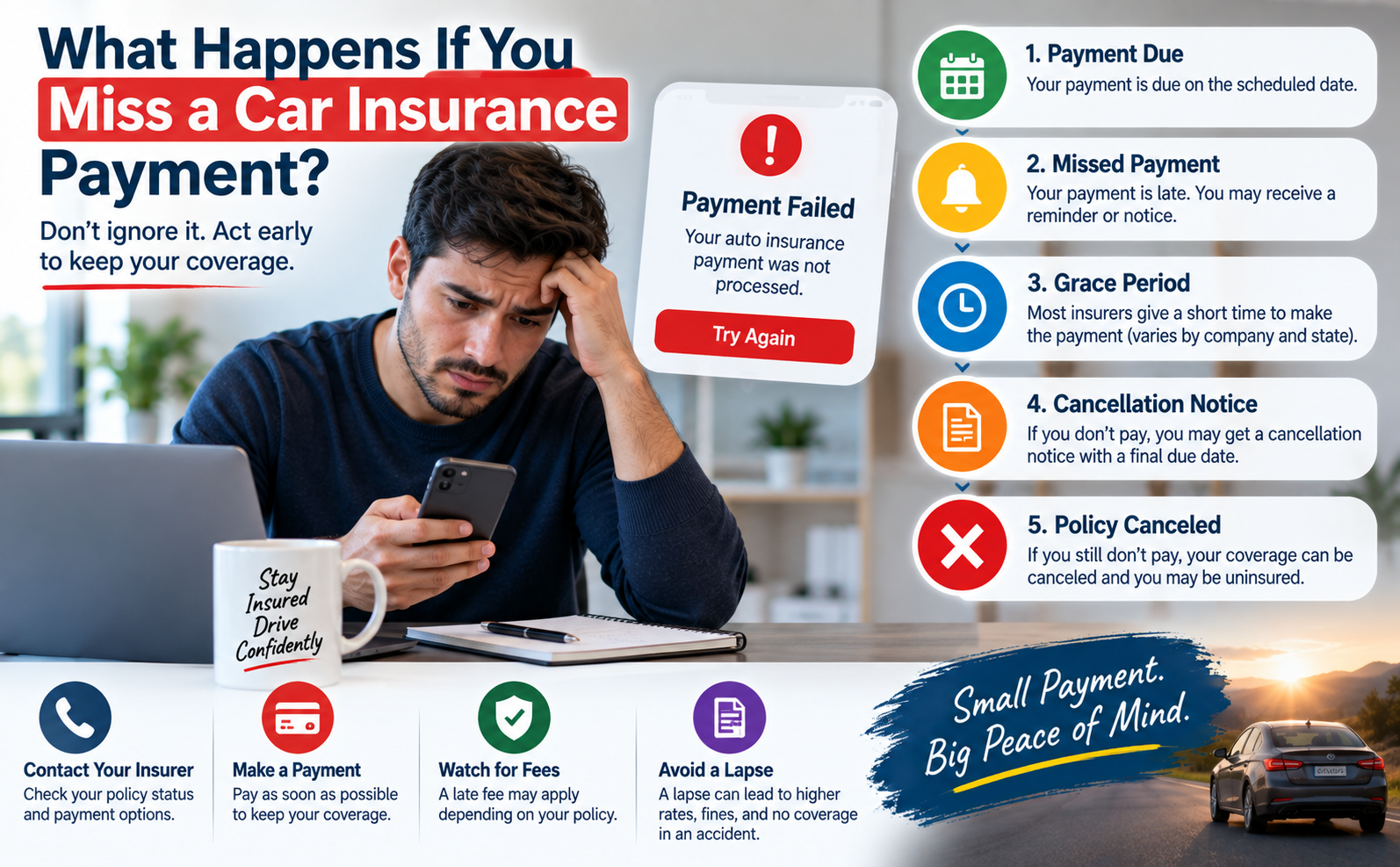
What Happens If You Miss a Car Insurance Payment?
You check your bank account and suddenly realize something.
Your car insurance payment was due three days ago.
Maybe your debit card expired.
Maybe there was not enough money in the account.
Maybe you simply forgot.
Now you are worried:
What happens if you miss a car insurance payment?
The good news is that missing the payment due date does not always mean your insurance disappears immediately.
Depending on your insurer, policy, and state rules, you may have a short period to make the missed payment before your policy is canceled.
This is often called a grace period.
But you should not assume that you automatically have a certain number of days.
Grace periods and cancellation requirements vary.
If you miss a payment, the best thing you can do is contact your insurance company and pay the overdue amount as quickly as possible.
Waiting can turn a simple late payment into a much bigger problem.
Does Car Insurance Cancel Immediately After a Missed Payment?
Usually, a policy is not simply canceled the second a payment becomes late.
Insurance companies generally have procedures they must follow before canceling a policy for nonpayment.
Depending on the insurer and state, you may receive:
- A late-payment notice
- A payment reminder
- A cancellation notice
- A final payment date
- Instructions for restoring the account
However, the exact timeline can vary.
Do not assume your friend's insurance company follows the same rules as yours.
If your payment is late, log into your account or contact your insurer immediately and ask:
“Is my policy currently active?”
That is the most important question.
What Is a Car Insurance Grace Period?
A grace period is a limited amount of time after a payment due date when you may still be able to make the payment before your policy ends.
For example:
Payment due date: September 1
Payment made: September 5
If your insurer and policy allow payment during that period without terminating coverage, you may be able to keep continuous insurance.
But every policy is different.
Some grace periods may be relatively short.
Others may provide more time.
State insurance rules can also affect how much notice an insurer must provide before cancellation.
Never rely on a general online number when your own policy can give you the exact answer.
How Long Is the Grace Period for Car Insurance?
There is no single nationwide grace period.
Depending on the insurer and state, it may range from only a few days to several weeks.
The exact period may also depend on why payment was missed.
For example:
A missed monthly installment may be handled differently from failing to pay a renewal premium.
Your insurer should be able to tell you:
- Your original due date
- Current amount due
- Final payment deadline
- Scheduled cancellation date
- Whether coverage remains active
If you have already missed the due date, find out these details today rather than waiting.
Are You Still Covered During the Grace Period?
Often, coverage may remain active during an applicable grace period if you satisfy the insurer's payment requirements before the deadline.
But do not assume this.
The safest approach is to confirm directly with the insurance company.
Ask:
“Is my coverage active right now?”
Do not only ask:
“Can I still make the payment?”
Those are not always exactly the same question.
You need to know whether an accident occurring today would fall within an active policy period.
What Happens If You Pay a Few Days Late?
If you are only a few days late, the situation may be relatively easy to fix.
You may simply need to:
Pay the outstanding premium.
Pay any applicable late fee.
Confirm that your policy remains active.
The important thing is speed.
The difference between realizing the problem two days late and ignoring it for several weeks can be significant.
If you discover a missed payment, handle it immediately.
Can a Late Car Insurance Payment Have a Fee?
Yes, an insurer may charge a late-payment fee or another billing-related fee depending on the policy and state.
For example:
Premium due: $180
Late fee: $10
Total required payment: $190
This is only an example.
Your actual fee may be different, or there may be no fee.
Check your billing notice rather than guessing.
What Happens If You Do Not Pay During the Grace Period?
This is where the situation becomes much more serious.
If you fail to make the required payment by the final deadline, the insurer may cancel the policy for nonpayment.
At that point, your coverage may lapse.
Once the cancellation becomes effective, you may no longer have active:
- Liability insurance
- Collision coverage
- Comprehensive coverage
- Uninsured motorist coverage
- PIP or Medical Payments coverage
- Rental reimbursement
- Other protections included in the policy
If your insurance reaches this stage, read What Happens If Your Car Insurance Lapses? Because the consequences become much broader than a late bill.
What Is a Cancellation Notice?
An insurance company may send you a notice explaining that your policy will be canceled if the required premium is not paid.
The notice may include:
- Amount owed
- Reason for cancellation
- Cancellation date
- Payment deadline
- Instructions for preventing cancellation
Do not ignore this notice.
It is not simply another marketing email.
The cancellation date can determine the exact point when your coverage ends.
What Does “Cancellation for Nonpayment” Mean?
It means the insurance company is ending your policy because the required premium was not paid.
For example:
Your monthly premium is due.
You do not pay it.
The insurer sends the required notice.
The final deadline passes.
The policy is canceled.
From that effective cancellation date forward, you may no longer have insurance protection.
That creates both insurance and legal risks if you continue driving.
Can You Drive After Missing a Car Insurance Payment?
If your insurer confirms that the policy remains active, you may still be insured.
But once the policy has actually been canceled and coverage has ended, you should not drive until valid insurance is restored.
Driving without required insurance can potentially lead to:
- Fines
- Registration problems
- License consequences
- Vehicle impoundment
- Financial responsibility requirements
- Other penalties
The rules depend on the state.
More importantly, you may have no insurance protection if you cause an accident.
What Happens If You Have an Accident After Missing a Payment?
The exact date of the accident matters.
Imagine:
Payment due: September 1
Policy remains active through the applicable notice period
Accident: September 4
Payment completed: September 5
Coverage may still exist depending on the policy and applicable rules.
Now consider another situation:
Policy canceled: September 10
Accident: September 12
New policy begins: September 13
The accident happened during the uninsured period.
A policy purchased afterward generally cannot be backdated to cover a loss that already happened.
This is why determining the exact cancellation date is so important.
Can You Pay After an Accident?
Paying an overdue bill after an accident does not automatically create coverage for the accident.
The important question is whether your policy was active at the time of the loss.
If coverage had already ended, making a payment afterward usually does not magically make the previous uninsured period covered.
Never misrepresent the date of an accident or claim.
Provide accurate information to the insurer.
Can You Reinstate Car Insurance After Missing a Payment?
Possibly.
If your policy has already been canceled for nonpayment, your insurer may allow reinstatement.
Reinstatement means restoring the insurance policy.
You may need to:
- Pay the overdue premium
- Pay fees
- Provide updated information
- Confirm that no loss occurred during the gap
- Meet other insurer requirements
Whether reinstatement is available depends on the insurer, policy, state, and length of time since cancellation.
Does Reinstatement Remove the Insurance Lapse?
Not always.
This is extremely important.
There are two possible situations.
Reinstatement With Continuous Coverage
The insurer restores the policy in a way that leaves no gap.
Reinstatement After a Gap
The insurer restarts your insurance, but there is still a period when coverage did not exist.
Those are very different outcomes.
When speaking with the insurance company, ask:
“Will my policy show continuous coverage, or will there still be a lapse?”
Do not assume the answer.
What Is a No-Loss Statement?
In some reinstatement situations, an insurer may ask you to confirm that no accident or other loss happened during the uninsured period.
This can sometimes be called a no-loss statement.
The reason is simple.
The insurer does not want someone to:
Let insurance lapse.
Have an accident.
Then restore the policy and pretend the accident occurred while insured.
Always answer accurately.
Providing false information about an accident can create serious claim and fraud issues.
Will Missing One Payment Increase Your Car Insurance Rate?
A payment being a few days late does not automatically mean your insurance rate will increase.
If you pay before coverage ends and maintain continuous insurance, the situation may be limited to a billing issue or possible late fee.
The bigger concern begins when the missed payment results in an actual insurance lapse.
Some insurers consider continuous insurance when pricing coverage.
A lapse can therefore make future insurance more expensive.
The exact effect depends on the insurer, state, and circumstances.
Will One Day Without Insurance Matter?
Potentially.
Never assume a one-day gap is meaningless.
For example:
Old policy ends Monday.
New policy begins Wednesday.
Tuesday is an uninsured day.
If you have an accident Tuesday, that single day becomes extremely important.
Even a short lapse can also affect future insurance pricing or state insurance requirements depending on the circumstances.
Can a Missed Payment Affect Your Credit Score?
A normal late auto-insurance premium does not work exactly like missing a credit-card or loan payment.
Auto insurance is not generally a traditional credit account.
But that does not mean an unpaid balance can always be ignored.
If a debt eventually becomes a collection matter, it can create a different financial situation.
The best approach is to resolve unpaid insurance bills rather than allowing them to remain outstanding.
If you are worried about credit and insurance shopping, read Does Getting Auto Insurance Quotes Affect Credit Score?
Can Your Insurance Company Send the Unpaid Balance to Collections?
Potentially.
Canceling the policy does not necessarily erase money you already owe.
Suppose your insurer provided coverage through part of the policy period before cancellation.
You may still owe premium for the period when coverage was active.
If an unpaid balance remains unresolved, the insurer may pursue collection according to applicable rules.
Do not assume:
“My policy was canceled, so I owe nothing.”
Contact the insurer and ask for your final account balance.
What Happens If Auto-Pay Fails?
Automatic payments are useful, but they are not perfect.
An auto-pay transaction may fail because:
- Your card expired
- Bank account was closed
- Insufficient funds
- Card was replaced
- The bank blocked the charge
- Payment information was incorrect
If auto-pay fails, your insurer may send a notice.
Do not assume that because you enrolled in automatic payments, your insurance can never lapse.
Check confirmation messages and account statements.
What If Your Credit or Debit Card Expired?
Update it immediately.
Many missed insurance payments happen because the policyholder forgets to replace an expired card.
Log in to your insurance account and update:
- Card number
- Expiration date
- Billing information
Then confirm whether the overdue payment was successfully processed.
Do not only update the card and assume the old payment automatically went through.
What If There Was Not Enough Money in Your Account?
Contact the insurer as soon as possible.
Ask whether:
- You can retry payment
- Another payment method is accepted
- A late fee applies
- Cancellation has been scheduled
- A payment arrangement is available
Ignoring the problem will not improve it.
Even if you cannot immediately pay the full amount, contacting the company before cancellation may give you more information about your options.
Can You Change the Payment Due Date?
Some insurers may allow customers to adjust billing arrangements or payment dates.
Availability varies.
If your insurance payment regularly falls at a difficult point in the month, ask whether the billing date can be changed.
For example, you might prefer payment shortly after payday.
A small billing adjustment can make future missed payments less likely.
Can You Switch to Monthly Payments?
Many insurers offer installment plans.
Instead of paying a six-month premium all at once, you may be able to pay monthly.
However, installment plans can involve fees or different pricing structures.
Compare the total cost.
For example:
Annual or six-month payments may have one total.
Monthly installments may create a slightly different total after fees.
The cheapest billing option depends on the insurer.
Is Paying Insurance in Full Better?
It can be useful if:
- You have the money available
- Your insurer offers a discount
- You want fewer payment deadlines
- You want to reduce the chance of a missed monthly payment
But do not drain emergency savings simply to pay a full insurance term if that creates another financial problem.
Choose a payment schedule you can manage reliably.
What Happens If You Miss the Renewal Payment?
This can be more serious than simply missing one installment.
A policy may be approaching the end of its term.
If you fail to pay the required renewal premium, the next policy term may not begin.
For example:
Current policy ends September 30.
New term begins October 1.
Required renewal payment is not completed.
You may have no active coverage beginning October 1.
Check renewal notices carefully.
Does Car Insurance Renew Automatically?
Some policies may automatically renew if payment requirements are met.
Others may require action.
Even with automatic renewal, you need to make sure:
- Payment method is valid, and the amount can be processed
- Required documents are complete
- The insurer has not issued a nonrenewal notice
Do not assume your policy renewed simply because it did so last time.
Check the new policy term.
What Happens If the Insurer Does Not Renew Your Policy?
Nonrenewal is different from missing a payment.
If the insurer chooses not to offer another policy term, it generally sends advance notice according to applicable requirements.
Possible reasons may include:
- Claims history
- Driving record
- Underwriting changes
- Market changes
- Other allowed reasons
If your policy is being nonrenewed, arrange replacement coverage before the existing policy expires.
Can Your Registration Be Affected If Insurance Is Canceled?
Potentially.
States handle insurance verification differently.
In some states, insurers electronically report coverage status.
If required coverage ends while your vehicle remains registered, you may face:
- Registration suspension
- Fees
- Proof-of-insurance requirements
- Other penalties
Check your own state's rules if your policy has actually been canceled.
Can Your License Be Suspended?
Driving without required insurance can create license consequences in some states.
The exact penalties vary.
This is why you should distinguish between:
Missing a payment while coverage is still active
and:
Driving after the policy has actually been canceled.
The second situation is much more serious.
What Happens If Your Car Is Financed?
A financed vehicle adds another layer.
Your lender generally requires you to maintain certain insurance on the vehicle.
This can include:
- Collision
- Comprehensive
- Required liability protection
If your policy is canceled for nonpayment, the lender may discover that required insurance is missing.
That can violate your loan agreement.
What Is Lender-Placed Insurance?
If a financed vehicle loses required insurance, the lender may sometimes purchase coverage protecting its financial interest.
This is often called:
lender-placed insurance
or
force-placed insurance.
This coverage can be expensive.
And it may primarily protect the lender rather than giving you all the protections of a normal personal auto policy.
You should not treat lender-placed insurance as a convenient substitute for maintaining your own coverage.
What Happens With a Leased Car?
Leasing companies also normally require specific insurance coverage.
A missed payment that causes your policy to end may put you in violation of the lease agreement.
If your insurance has lapsed:
Restore appropriate coverage.
Then provide proof to the leasing company when required.
Can You Get a New Insurance Policy After Missing Payments?
Yes.
If your current insurer will not reinstate the policy, you can shop for replacement insurance.
But buy the new policy before driving again.
A lapse may affect your new premium.
Different companies may price the gap differently.
This is another reason to compare several insurers.
You can use our Best Car Insurance Companies Finder and Top 10 Cheapest Car Insurance Companies tools to identify options worth comparing.
Should You Tell a New Insurer About the Lapse?
Yes.
Give accurate information.
A new insurer may ask:
- Previous insurance company
- Policy expiration date
- How long you have been uninsured
- Reason for lapse
Do not change the dates to make it look like your coverage was continuous.
Insurers may verify previous insurance information.
Accurate information helps prevent problems later.
Does Getting Several New Quotes Affect Your Credit Score?
Generally, insurance quote inquiries do not work like applications for a credit card or loan.
Where credit-related insurance information is permitted and used, the quote check is typically a soft inquiry.
That generally does not reduce your traditional credit score.
So if your policy has been canceled, fear of quote shopping should generally not stop you from comparing replacement insurance.
How Can You Make Car Insurance Cheaper If You Are Struggling to Pay?
Before letting coverage cancel, investigate legitimate ways to reduce the premium.
Compare Other Insurance Companies
Prices can vary significantly.
Review Your Deductibles
Increasing a deductible may lower the premium for collision or comprehensive coverage.
Only choose an amount you could afford after a claim.
Check Discounts
Ask about available:
- Multi-car discounts
- Bundling
- Safe-driver discounts
- Good-student discounts
- Low-mileage programs
- Payment discounts
- Other available savings
Review Your Mileage
If you drive much less than before, make sure your annual mileage is accurate.
Review Optional Coverage
Some optional coverage may no longer be useful to you.
But understand what you are removing before making changes.
Avoid Simply Dropping Important Protection
The cheapest possible policy can create much greater financial risk after an accident.
Should You Drop Collision and Comprehensive to Keep the Policy Affordable?
Maybe, but only after understanding the consequences.
If your car is financed or leased, you may not be allowed to remove them.
If you fully own an older vehicle, the decision may be different.
Without collision coverage, your insurer generally will not repair your own vehicle after a covered crash simply because you caused the accident.
Without comprehensive coverage, losses such as theft, hail, flooding, or vandalism may not be covered.
Read Collision vs Comprehensive Insurance: What’s the Difference? Before changing these coverages.
Can Raising Your Deductible Help Prevent a Payment Problem?
Possibly.
A higher collision or comprehensive deductible can sometimes reduce the premium.
For example:
$500 deductible: higher premium
$1,000 deductible: potentially lower premium
But you need to understand the trade-off.
You save money now.
You pay more yourself after an applicable covered claim.
Read What Is a Car Insurance Deductible and How Does It Work? before increasing it.
What Should You Do If You Missed Your Payment Today?
Follow this order.
1. Check Your Insurance Account
Look for:
- Amount due
- Due date
- Cancellation notice
- Policy status
2. Contact Your Insurer
Ask directly:
“Is my policy active right now?”
3. Pay the Amount Due
If you can, make the required payment immediately.
4. Get Confirmation
Keep proof that your payment was accepted.
5. Confirm Continuous Coverage
Ask whether any lapse occurred.
6. Check Automatic Payments
Fix expired cards or bank details.
7. Do Not Drive If Coverage Has Ended
Restore valid insurance first.
What Should You Do If Your Policy Was Already Canceled?
The steps are slightly different.
Contact the Previous Insurer
Ask whether reinstatement is possible.
Ask Whether the Gap Can Be Removed
Do not assume reinstatement means continuous coverage.
Get a New Policy If Necessary
Do this before driving.
Check State Requirements
A lapse may affect registration or other requirements.
Contact Your Lender
If the car is financed or leased, provide valid insurance information.
Keep All Documentation
Save:
- Payment receipts
- Reinstatement confirmation
- New policy documents
- Cancellation notices
How to Prevent Missing Future Car Insurance Payments
A few simple habits can prevent most payment-related lapses.
Use Auto-Pay
Automatic billing can help, but remember to keep the payment method current.
Turn On Payment Alerts
Use:
- Text messages
- App notifications
Add the Due Date to Your Calendar
Set more than one reminder.
For example:
Seven days before.
Two days before.
On the due date.
Keep Contact Information Updated
If you move or change your email address, update your insurer.
Check Renewal Documents
Do not ignore insurance emails because they look routine.
Create a Small Insurance Reserve
If possible, keep enough savings available for at least one premium payment.
Frequently Asked Questions
What happens if you miss a car insurance payment?
Your policy usually is not necessarily canceled immediately. You may have time to make the payment, but rules vary by insurer and state. If you fail to pay by the required deadline, the policy can be canceled.
How many days late can you be on car insurance?
There is no universal number. Grace periods and cancellation notice requirements vary by insurer, policy, and state.
Does car insurance have a grace period?
Many policies provide some time before cancellation becomes effective, but you should confirm the exact rules with your insurer rather than assuming a specific grace period.
Will my insurance cancel if I am one day late?
Not necessarily. A one-day late payment does not automatically mean every policy is immediately canceled. Check your actual policy status.
Can I drive if my payment is late?
Only if your insurance coverage is still active. Confirm with the insurer. Do not drive after the policy has actually been canceled.
Can I pay car insurance after the due date?
Often, yes, if you are still within the applicable payment or cancellation period. Fees may apply.
What happens if my policy is canceled for nonpayment?
You may need to reinstate the policy or purchase new insurance. Do not drive until valid coverage is active.
Can I reinstate car insurance after missing a payment?
Possibly. Reinstatement rules vary. Contact your insurer immediately and ask whether coverage can be restored continuously or whether a gap will remain.
Will a missed insurance payment raise my premium?
Being slightly late does not necessarily raise your rate. But if nonpayment creates an insurance lapse, future premiums may be affected.
Can a missed insurance payment hurt my credit?
A normal late insurance premium is not the same as a missed credit-card or loan payment. However, an unresolved balance that becomes a collection matter can create additional financial consequences.
What Happens If You Miss a Car Insurance Payment? The Bottom Line
Missing a car insurance payment does not necessarily mean your coverage disappears immediately.
But you should act quickly.
There may be a grace period or cancellation notice period that allows you to make the payment and keep your policy active.
If you ignore the payment long enough, the insurer may cancel your policy.
Once that happens, the consequences can become much more serious.
You could face:
A coverage lapse.
Higher future insurance costs.
State penalties.
Lender problems.
And potentially enormous personal financial responsibility if you drive without insurance and cause an accident.
If you missed a payment:
Contact your insurer immediately.
Ask whether your policy is active.
Ask for the exact cancellation date.
Pay the amount due if possible.
Confirm whether continuous coverage remains.
And if the policy has already ended, obtain valid insurance before driving again.
A missed payment can often be fixed.
An uninsured accident cannot be undone.
For more information, read What Happens If Your Car Insurance Lapses?, Does Getting Auto Insurance Quotes Affect Credit Score?, What Is a Car Insurance Deductible and How Does It Work?, or explore our Insurance Calculators for additional tools.
Check Below..
https://bestcarandautoinsurance.com/does-getting-auto-insurance-quotes-affect-credit-score