Does Auto Insurance Cover Flood Damage to a Car?
Does auto insurance cover flood damage to a car? Learn when comprehensive insurance may cover flood and water damage, how deductibles work, what happens if a flooded car is totaled, and what to do after a flood.
Does Auto Insurance Cover Flood Damage to a Car?
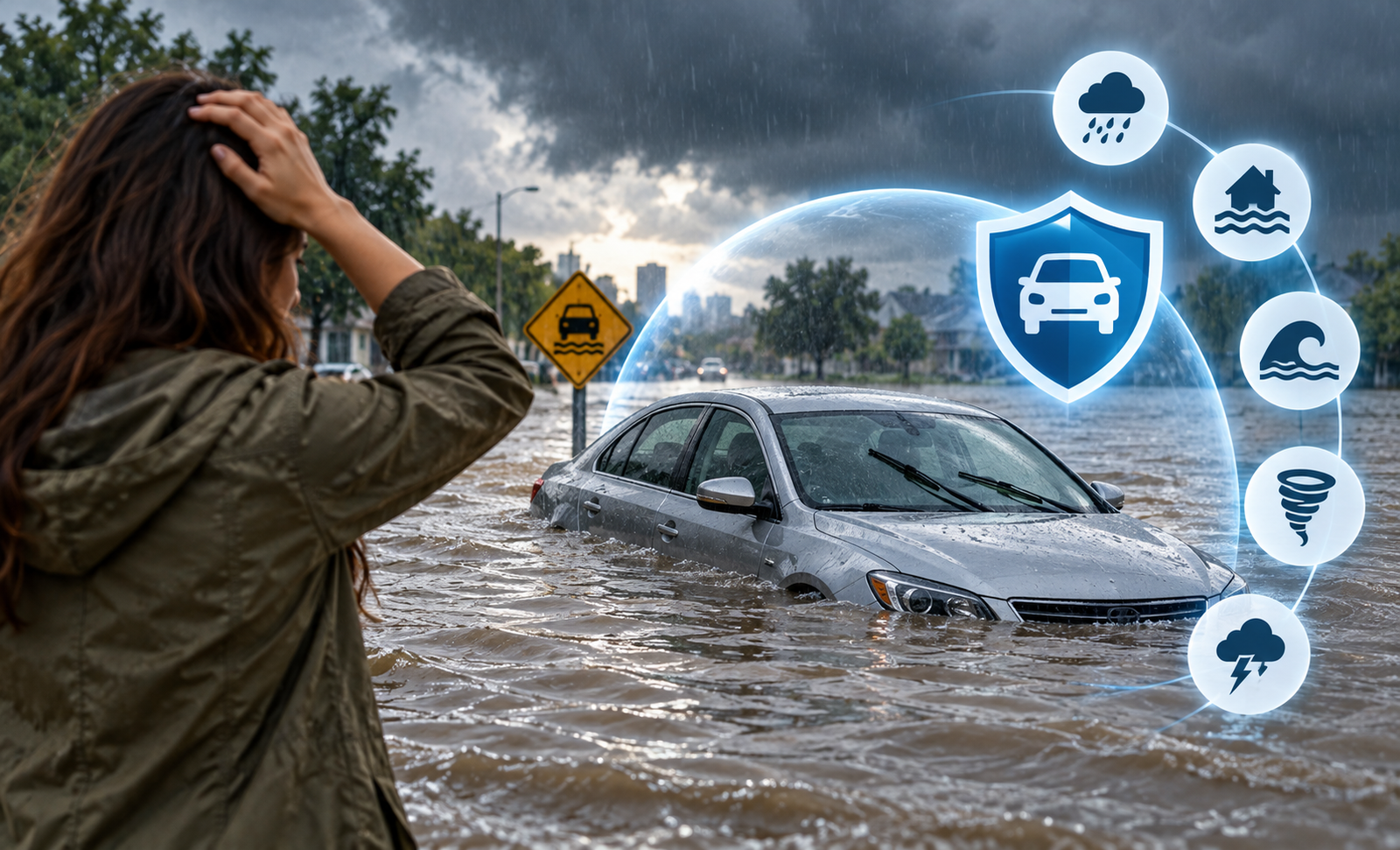
Heavy rain starts falling overnight.
By morning, the street outside your home is covered with water.
You walk outside and discover that water has reached your parked car.
The seats are wet.
The carpet is soaked.
The electrical system may be damaged.
And suddenly you have a very expensive question:
Does auto insurance cover flood damage to a car?
In many cases, flood damage to your own vehicle may be covered if your auto insurance policy includes comprehensive coverage.
Comprehensive insurance is the part of an auto policy that generally protects your vehicle against certain losses that are not caused by a normal collision.
Flooding, severe rain, rising water, storms, and certain other weather-related events may fall under this type of coverage.
But simply having “car insurance” does not automatically mean flood damage is covered.
If you carry only liability insurance, damage to your own car from a flood generally will not be covered by that liability protection.
Your actual policy, deductible, vehicle value, cause of damage, and claim circumstances all matter.
What Type of Car Insurance Covers Flood Damage?
Flood damage is generally associated with comprehensive auto insurance.
Comprehensive coverage may help protect your car from certain events such as:
- Flooding
- Heavy rain
- Hail
- Fire
- Theft
- Vandalism
- Falling objects
- Storm damage
- Certain animal-related damage
These are different from normal collision losses.
For example:
If you crash into another vehicle, collision coverage may apply.
If rising floodwater damages your parked vehicle, comprehensive coverage may apply.
If you want to understand the difference in more detail, read Collision vs Comprehensive Insurance: What’s the Difference?
Please Also Check..
https://bestcarandautoinsurance.com/does-car-insurance-cover-someone-else-driving-your-car
Does Liability Insurance Cover Flood Damage?
Generally, no.
Liability insurance is designed mainly to protect against covered injuries or property damage you cause to other people.
It does not normally pay to repair your own vehicle after a flood.
Imagine your car is worth $20,000.
A major storm floods it.
You carry liability insurance only.
Because you do not have comprehensive coverage, you may have to handle the loss yourself.
This is an important reason to understand your policy before severe weather occurs.
A policy can satisfy your state's minimum insurance requirements while still providing no flood protection for your own vehicle.
What About Full Coverage Insurance?
People often use the phrase full coverage to describe a policy that includes:
- Liability coverage
- Collision coverage
- Comprehensive coverage
If your so-called full coverage policy actually includes comprehensive insurance, flood damage may be covered according to the policy terms.
But “full coverage” is not one standardized insurance product.
Do not rely only on the phrase.
Check your policy documents and confirm that comprehensive coverage is listed.
How Does Comprehensive Insurance Cover Flood Damage?
Suppose your vehicle is parked outside during a major storm.
Water rises high enough to enter the cabin and damage:
- Seats
- Carpet
- Electronics
- Wiring
- Engine components
You have comprehensive insurance with a $500 deductible.
After you report the loss, your insurer investigates the damage.
If the flood loss is covered and repairs cost $7,000, a simplified example could look like this:
Repair cost: $7,000
Comprehensive deductible: $500
Potential covered amount after deductible: $6,500
The actual claim payment depends on your policy and the insurer's damage assessment.
If deductibles are confusing, read What Is a Car Insurance Deductible and How Does It Work?
Does Car Insurance Cover a Flooded Engine?
It may if the engine damage was caused by a covered flood event and you have applicable comprehensive coverage.
Water inside an engine can cause severe damage.
Modern cars also contain expensive electronic systems that can be affected even when the engine itself survives.
A flood claim may involve damage to:
- Engine components
- Electrical wiring
- Computers
- Sensors
- Transmission components
- Interior electronics
- Airbag systems
- Seats and carpets
This is one reason flood-damaged vehicles can become very expensive to repair.
What If You Drive Into Floodwater?
This situation can be more complicated.
Imagine a road is covered with water and you attempt to drive through it.
The water turns out to be much deeper than expected.
Your engine takes in water and stops.
Comprehensive coverage may still be relevant to water damage, but insurers evaluate the specific circumstances of each claim.
Policy exclusions, the cause of the damage, and what happened before the loss can matter.
The safest choice is simple:
Do not intentionally drive through flooded roads.
Water depth is difficult to judge.
A road underneath the water may also be damaged or washed away.
Protecting your car is important, but protecting yourself is much more important.
Does Insurance Cover a Car Flooded While Parked?
If you have comprehensive coverage, damage caused by rising floodwater while your vehicle is parked may generally fall under that coverage.
For example:
You park your car outside your home.
A severe storm occurs overnight.
A nearby river or drainage system overflows.
Floodwater enters the vehicle.
This is the type of event comprehensive coverage is designed to address, subject to the policy.
Does Insurance Cover Rainwater Inside a Car?
It depends on why the water entered.
If a severe covered weather event causes damage to the vehicle and rainwater enters, comprehensive coverage may potentially apply.
But there is an important difference between sudden accidental damage and poor maintenance.
Imagine a storm damages your vehicle and water enters through the resulting opening.
That may be very different from a car that has had a leaking sunroof for six months and slowly developed water damage because it was never repaired.
Insurance generally exists for covered unexpected losses, not routine maintenance.
Does Insurance Cover Water Damage From a Hurricane?
Comprehensive coverage may help with covered vehicle damage caused by flooding, wind, falling objects, and other qualifying hurricane-related events.
The exact cause matters.
For example, a hurricane could:
Flood the vehicle.
Cause a tree to fall onto it.
Send debris into the vehicle.
Produce hail or wind damage.
Comprehensive insurance may be relevant to several of these non-collision losses.
However, policy terms and claim circumstances determine the actual coverage.
Does Car Insurance Cover Storm Surge?
Storm surge can cause severe flooding in coastal areas.
If rising water damages your vehicle and you carry applicable comprehensive insurance, the resulting flood damage may be covered subject to the policy.
Drivers living in coastal or flood-prone areas should pay particular attention to whether their policies include comprehensive coverage.
Does Insurance Cover a Car Swept Away by Floodwater?
If floodwater carries away your vehicle and you have applicable comprehensive coverage, the resulting loss may potentially be handled as a comprehensive claim.
The vehicle may eventually be recovered.
Or it may be badly damaged.
In extreme cases, it may never be recovered at all.
The insurer will investigate what happened and determine whether the vehicle can be repaired or should be considered a total loss.
What Happens If a Flooded Car Is Totaled?
A vehicle can be declared a total loss when repairing it is not economically reasonable under the insurer's applicable rules and valuation process.
Flood damage can affect many systems at once.
For example:
- Engine
- Transmission
- Electrical system
- Interior
- Computers
- Safety systems
Even if the exterior looks normal, hidden water damage can be extensive.
If your insurer determines that a covered flooded vehicle is a total loss, the settlement is generally based on the vehicle's covered value under the policy rather than simply giving you the amount you originally paid for it.
Your comprehensive deductible may also be subtracted.
Example of a Flood Total-Loss Claim
Imagine your vehicle's covered value is determined to be:
$24,000
Your comprehensive deductible is:
$1,000
A simplified claim calculation might be:
Vehicle value: $24,000
Deductible: $1,000
Potential settlement: $23,000
This is only an example.
Real settlements depend on the vehicle, coverage, policy, valuation, taxes or fees where applicable, and other claim details.
What If You Still Owe Money on the Flooded Car?
This is very important.
An insurance settlement and your car loan balance are not necessarily the same amount.
Imagine:
You owe your lender: $28,000
Your flooded vehicle's covered value: $24,000
Comprehensive deductible: $1,000
Potential insurance settlement: $23,000
There could still be a difference between the insurance payment and the amount you owe.
This is where gap coverage may become relevant for some financed or leased vehicles.
Gap protection is different from comprehensive insurance.
Comprehensive insurance handles the covered vehicle loss.
Gap coverage may address certain remaining loan or lease differences according to its terms.
Does a Car Loan Require Flood Coverage?
A lender will commonly require comprehensive and collision coverage while a vehicle is financed.
The reason is straightforward.
The lender has a financial interest in the vehicle.
If the car is stolen, flooded, burned, or badly damaged, the lender wants the vehicle protected.
Check your loan agreement.
Removing required comprehensive coverage may violate the financing terms.
What About a Leased Vehicle?
Lease agreements also commonly require comprehensive and collision coverage.
A leased vehicle does not belong entirely to the person driving it.
The leasing company therefore usually has specific insurance requirements.
If a leased vehicle is flooded, contact:
Your insurance company.
And:
Your leasing company.
Follow the instructions provided by both.
Does Homeowners Insurance Cover a Flooded Car?
Generally, your auto policy—not your homeowners policy—is where you would look for coverage for flood damage to the vehicle itself.
Homeowners insurance may potentially become relevant to certain personal belongings that were inside the vehicle, depending on the policy and circumstances.
But the car itself is normally an auto-insurance issue.
Do not assume your homeowners policy will replace comprehensive auto insurance.
What About Personal Items Inside the Flooded Car?
Imagine floodwater destroys items inside your vehicle:
- Laptop
- Clothing
- Backpack
- Tools
- Electronics
Comprehensive auto coverage does not necessarily protect every loose personal item inside the car.
Personal belongings may potentially fall under another policy, such as homeowners or renters insurance, subject to that policy's deductible, limits, and exclusions.
Document damaged items carefully.
What Should You Do After Your Car Is Flooded?
What you do immediately after a flood can matter.
Put Safety First
Do not enter moving floodwater simply to reach your car.
Your vehicle can be replaced.
You cannot.
Do Not Start a Flooded Vehicle
This is extremely important.
If water has reached the engine or other critical systems, trying to start the vehicle can potentially create additional damage.
Wait for professional guidance.
Take Photos and Videos
If it is safe, document:
- Water level
- Exterior damage
- Interior damage
- Surrounding area
- Visible debris
- Damage inside the vehicle
Contact Your Insurance Company
Report the loss promptly.
Explain what happened and when you discovered the damage.
Arrange Safe Towing
A badly flooded car may not be safe to drive.
Follow your insurer's instructions and use professional towing when necessary.
Keep Records
Save:
- Claim number
- Photographs
- Repair estimates
- Towing receipts
- Communications with the insurer
- Other relevant documents
Why You Should Not Immediately Start a Flooded Car
Your first instinct may be:
“Let me see if the engine still works.”
That can be a costly mistake.
If water entered the engine, electrical system, or other components, trying to start the vehicle could create additional damage.
Modern vehicles contain complex electronics.
Water can affect systems long after the visible floodwater disappears.
Have the vehicle inspected before trying to operate it.
Can Flood Damage Cause Problems Later?
Yes.
A flood-damaged vehicle can develop problems that are not immediately obvious.
Possible issues include:
- Corrosion
- Electrical faults
- Sensor problems
- Mold
- Interior odors
- Safety-system problems
- Computer failures
This is why a professional inspection is important.
A car that appears to drive normally immediately after flooding may still contain hidden damage.
What If You Bought a Previously Flooded Car?
This is another reason to be careful when buying used vehicles.
Flood-damaged cars can sometimes reappear for sale.
Look for warning signs such as:
- Musty odors
- Water stains
- Unusual rust
- Mud in hidden areas
- New carpet in an older vehicle
- Electrical problems
- Condensation inside lights
- Corrosion under seats
A vehicle-history report and independent inspection can also be useful.
Do not rely only on how clean the car looks.
How Much Does Flood Damage Cost to Repair?
There is no single number.
Flood damage can range from relatively minor interior damage to complete destruction of the vehicle's electrical and mechanical systems.
Cost depends on:
- Water depth
- How long the vehicle was submerged
- Fresh water vs contaminated or salt water
- Vehicle type
- Electronics affected
- Engine damage
- Interior damage
- Repair labor
- Parts costs
In serious cases, repairing the vehicle may cost enough for the insurer to declare it a total loss.
Does Salt Water Make Flood Damage Worse?
Salt water can be especially damaging because it accelerates corrosion.
Vehicles exposed to coastal storm surge may experience serious electrical and mechanical problems.
Even after the vehicle dries, corrosion can continue affecting components.
This can make salt-water flood damage particularly difficult to repair safely and reliably.
Does a Flood Claim Increase Your Car Insurance Premium?
It can potentially affect your insurance history, but comprehensive claims are not necessarily treated the same as at-fault collision claims.
A flood is normally outside the driver's control.
How a claim affects future pricing depends on:
- State rules
- Insurance company
- Previous claims
- Location
- Type of claim
- Overall risk factors
Do not assume that one flood claim automatically causes a fixed percentage increase.
For more information, read Does Filing a Car Insurance Claim Increase Your Premium?
What If Your Repair Cost Is Below the Deductible?
Suppose floodwater causes $400 in covered damage.
Your comprehensive deductible is $500.
Because the repair cost is less than the deductible, there may be no payment under the coverage.
Now imagine the damage is $8,000.
With the same $500 deductible, comprehensive coverage becomes much more financially significant.
This is why your deductible matters.
Should You Choose a Lower Comprehensive Deductible in a Flood-Prone Area?
Maybe.
A lower deductible means you generally pay less yourself after a covered comprehensive loss.
But the premium may be higher.
A higher deductible may reduce the premium but requires you to absorb more of the loss yourself.
Compare several options.
Ask:
How much would a $250 deductible cost?
How much would $500 cost?
How much would $1,000 cost?
Then decide whether the premium savings justify the additional financial responsibility.
Can You Add Comprehensive Coverage Right Before a Storm?
Do not assume you can wait until a hurricane, flood, or major storm is approaching and then instantly add coverage.
Insurers may restrict policy changes or new coverage when a major weather event is imminent.
Coverage also does not apply retroactively to damage that already happened.
The better approach is to review your insurance before storm season or flood risk becomes immediate.
Can You Buy Comprehensive Coverage After the Car Floods?
Buying coverage after the damage occurs will not normally create insurance protection for an earlier loss.
Insurance is intended for eligible future events that occur while coverage is active.
You cannot wait until your vehicle is already underwater and then purchase comprehensive insurance expecting the previous damage to be covered.
How Can You Protect Your Car Before a Flood?
Insurance helps with covered financial losses, but preventing damage is better.
Move the Vehicle Early
If flooding is expected and authorities say it is safe to travel, move the vehicle to higher ground before roads become dangerous.
Avoid Underground Parking
Low parking structures can flood quickly.
Do Not Drive Through Water
Even shallow-looking water can be dangerous.
Follow Weather Alerts
Pay attention to local emergency warnings and evacuation instructions.
Keep Insurance Information Available
Store policy information somewhere you can access even if the vehicle is damaged.
Photograph the Vehicle
Having recent photographs may be helpful if a major storm is approaching and it is safe to prepare.
Is Comprehensive Insurance Worth Having?
That depends on your vehicle and finances.
Ask yourself:
What is my car worth?
Could I replace it tomorrow using my own savings?
How much does comprehensive coverage cost?
What deductible would I choose?
Is the car financed?
Do I live in an area exposed to flooding, storms, theft, or hail?
If losing the vehicle would create a serious financial problem, comprehensive coverage may deserve strong consideration.
What If Your Car Is Old?
An older vehicle does not automatically mean comprehensive coverage is useless.
Vehicle age is only one factor.
Consider the actual market value.
A 12-year-old vehicle could still be worth enough that replacing it would be financially difficult.
Compare:
Annual comprehensive premium
against:
Vehicle value minus deductible.
Then think about whether you could afford to replace the car yourself.
Flood Insurance for a House vs Flood Coverage for a Car
These are completely different issues.
Home flood insurance protects qualifying property under a flood policy.
Your automobile is generally handled through your auto policy.
For your vehicle, the coverage to look for is usually comprehensive auto insurance.
Do not assume that buying flood insurance for your home automatically covers your car.
Frequently Asked Questions
Does auto insurance cover flood damage to a car?
It may if your policy includes comprehensive coverage. Liability-only coverage generally does not cover flood damage to your own vehicle.
What type of insurance covers a flooded car?
Comprehensive auto insurance is generally the coverage associated with flood and other weather-related vehicle damage.
Does full coverage car insurance cover floods?
If your policy called “full coverage” includes comprehensive insurance, flood damage may be covered subject to the policy terms and deductible.
Does liability insurance cover flood damage?
Liability insurance generally does not pay for flood damage to your own car.
Does comprehensive insurance cover a flooded engine?
It may when the engine damage results from a covered flood event, subject to policy terms and the circumstances of the loss.
Will insurance total a flooded car?
It can. If flood damage is severe enough that repair is not economically reasonable under the insurer's process, the vehicle may be declared a total loss.
Do I pay a deductible for flood damage?
Comprehensive claims commonly involve the comprehensive deductible selected on the policy.
Does car insurance cover hurricane flooding?
Comprehensive coverage may help with covered flood and storm-related vehicle damage, depending on the circumstances and policy.
Can I add comprehensive insurance after a flood warning?
Coverage changes may be restricted when a major storm is approaching, and new coverage does not apply to damage that already occurred.
Should I start my car after it has been flooded?
Avoid starting a badly flooded vehicle until it has been professionally evaluated. Starting it may cause additional damage.
Does Auto Insurance Cover Flood Damage to a Car? The Bottom Line
So, does auto insurance cover flood damage to a car?
If you have applicable comprehensive coverage, flood-related vehicle damage may generally be covered according to the terms of your policy.
If you have only liability insurance, your own flooded vehicle generally will not have that protection.
Remember the simple distinction:
Collision coverage generally deals with crashes.
Comprehensive coverage generally deals with certain non-collision losses, including flooding and severe weather.
If your vehicle floods:
Put safety first.
Do not immediately start the engine.
Document the damage.
Contact your insurer.
Follow claim instructions.
And understand your comprehensive deductible.
Most importantly, check your coverage before severe weather arrives.
Waiting until your vehicle is already damaged is too late to buy insurance for that loss.
For more information, read Collision vs Comprehensive Insurance: What’s the Difference?, What Is a Car Insurance Deductible and How Does It Work?, Does Filing a Car Insurance Claim Increase Your Premium?, or explore our Insurance Calculators for additional tools.