How Long Does an Accident Stay on Your Car Insurance Record?
How long does an accident stay on your car insurance record? Learn how long accidents may affect your driving history and insurance rates, what changes the timeline, and when your premium may start going down.
How Long Does an Accident Stay on Your Car Insurance Record?
If you recently had a car accident, one of your biggest concerns may be what happens next to your insurance.
You may already have dealt with the police report, repairs, insurance claim, and deductible.
Then another question appears:
How long does an accident stay on your car insurance record?
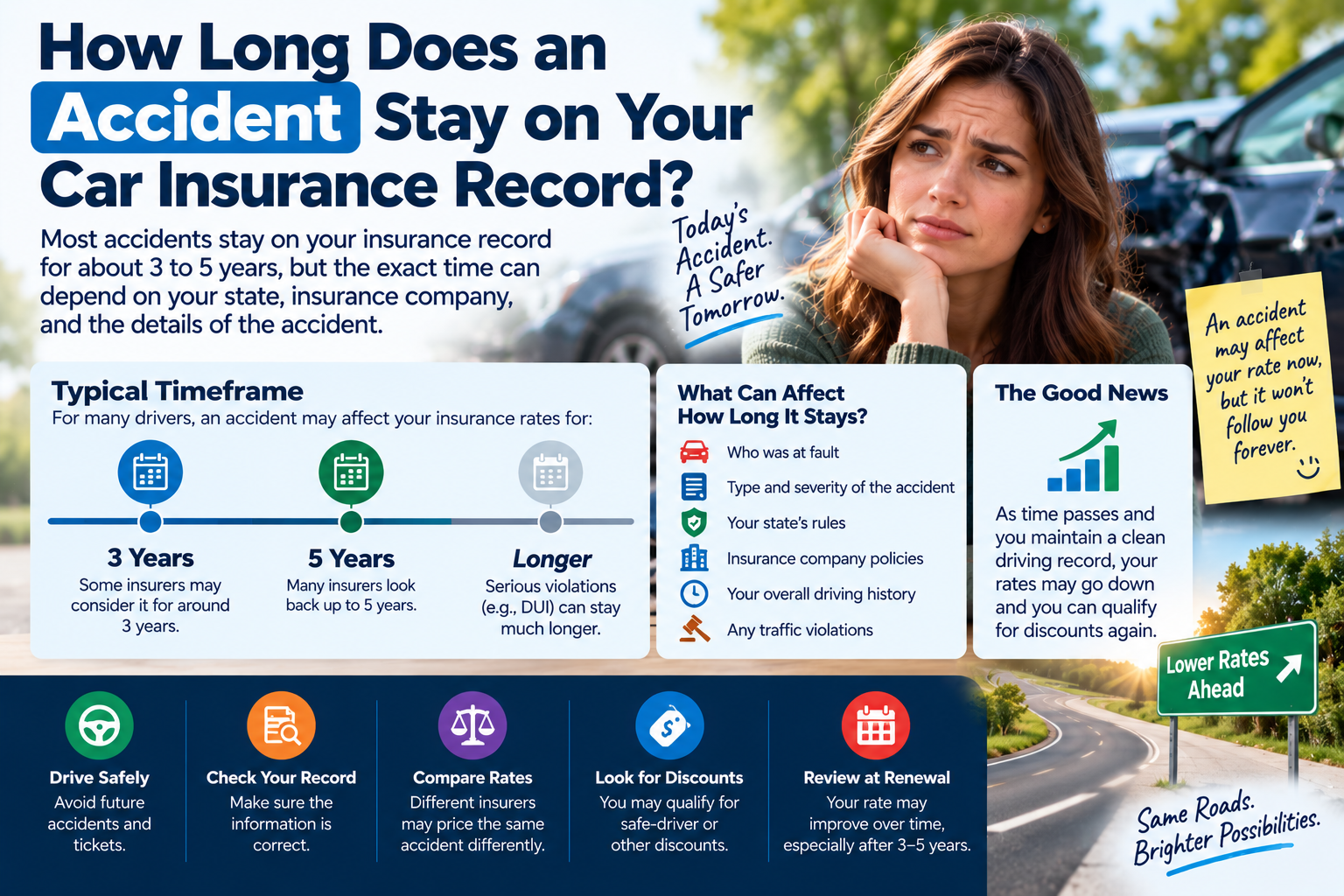
For many drivers, an accident can remain relevant to insurance pricing for roughly three to five years.
But that is not a universal rule.
The actual time can depend on your state, insurance company, whether you caused the accident, how serious it was, whether traffic violations were involved, and your previous driving history.
Some incidents can remain on an official driving record longer than the period during which they meaningfully affect an insurance premium.
That distinction is important.
An accident being visible somewhere in your history does not necessarily mean it will affect your insurance price forever.
Accident Record and Insurance Record Are Not Always the Same Thing
People often use the phrase “insurance record” as if there is one single record containing everything about a driver.
In reality, several types of information may be involved.
Your insurer may look at:
- Your motor vehicle record
- Previous insurance claims
- At-fault accidents
- Traffic violations
- Serious driving convictions
- Your previous insurance history
Different records may keep information for different periods.
For example, an accident may remain visible on a state driving record for a certain number of years while an insurance company may use a different lookback period when calculating your premium.
That is why you should not assume that one date applies to every part of your insurance history.
How Long Can an Accident Affect Car Insurance Rates?
A useful general range is three to five years for many ordinary accidents.
During that period, an insurer may consider a recent at-fault accident when calculating your rate.
However, the impact does not necessarily remain exactly the same every year.
Imagine you caused an accident last month.
To an insurer, that is a very recent event.
Now imagine the same accident happened four years ago and you have driven safely ever since.
Those two situations may not be viewed in the same way.
As time passes without another accident or serious violation, an older event may become less important.
Eventually, depending on the company and state, it may no longer be used in the same way when your rate is calculated.
Does an At-Fault Accident Stay on Your Record Longer?
Fault can matter.
An accident you caused may have a stronger effect on your insurance than an accident where another driver was clearly responsible.
An at-fault accident can become part of both your claims history and driving history.
It may also affect:
- Your premium
- Safe-driver discounts
- Claim-free discounts
- Eligibility for certain insurance programs
The effect can depend on how serious the accident was.
A minor parking-lot accident may not be viewed exactly like a major crash involving significant property damage or injuries.
What If the Accident Was Not Your Fault?
A not-at-fault accident can still appear in certain records.
That does not automatically mean it will increase your premium.
State rules and insurer practices matter.
Imagine another driver runs a red light and hits your vehicle.
You did nothing wrong.
Your insurer may still have information showing that a claim or accident occurred.
But that does not necessarily mean the event will be treated the same way as an accident you caused.
Some states also place restrictions on how insurers can use not-at-fault accidents when setting rates.
The safest approach is to ask your insurer how the specific accident is classified.
How Long Does an Accident Stay on Your Driving Record?
The answer varies by state.
For many ordinary accidents or violations, information may remain on a driver's motor vehicle record for several years.
Serious violations can remain much longer.
For example, an accident connected with a serious driving offense may be treated differently from a minor crash.
Possible serious violations can include:
- DUI or DWI
- Reckless driving
- Driving with a suspended license
- Leaving the scene of an accident
- Other major offenses
Do not assume that the timeline for a basic accident also applies to a serious driving conviction.
How Long Does an Insurance Claim Stay on Your Record?
Insurance companies may also review previous claim information when deciding how to price or underwrite a policy.
A claim can remain relevant for several years.
Again, there is no universal period that applies to every insurer.
The company may consider:
- Type of claim
- Date of claim
- Amount paid
- Who was at fault
- Number of previous claims
- Whether another accident occurred later
One isolated claim after years of clean driving can look different from several claims filed within a short period.
If you want a deeper explanation of claims and pricing, read Does Filing a Car Insurance Claim Increase Your Premium?
When Does the Clock Start?
Usually, the date of the accident or violation is important.
Suppose you had an accident in September 2026.
If an insurer uses a three-year lookback period for that type of event, September 2029 could become an important point.
If it uses five years, September 2031 could matter more.
But do not assume your rate will automatically fall on the exact anniversary.
Insurance companies normally recalculate premiums around policy renewals.
That means an accident may pass an important time threshold in September, but your rate may not be reviewed until your next renewal.
Does Your Premium Go Down Automatically After Three Years?
Not necessarily.
Many drivers think:
“My accident is now three years old, so my insurance should immediately become cheaper.”
Insurance pricing is more complicated.
Your premium can depend on many things besides one accident.
These may include:
- Your state
- City
- Vehicle
- Age
- Mileage
- Coverage limits
- Deductibles
- Other drivers
- New tickets
- Additional accidents
- Insurance company pricing
- Repair costs
- Discounts
So even if an old accident stops affecting your rate, another factor could keep the total premium the same or even make it higher.
Still, the three-year and five-year accident anniversaries can be useful times to compare new quotes.
Why Can Insurance Stay Expensive After the Accident Is Old?
Imagine your accident occurred four years ago.
You have not had another crash.
But your insurance premium is still higher than you expected.
There could be several reasons.
Your vehicle may now cost more to repair.
Insurance costs in your state may have increased.
You may have lost a discount.
You may have moved.
Another household driver may have been added.
Your insurer may have increased rates generally.
This is why you should not automatically assume that every premium change comes from your old accident.
Ask your insurer what factors are affecting your current rate.
Does the Severity of the Accident Matter?
It can.
A minor accident and a serious accident are not necessarily treated identically.
Consider these two situations.
Accident A
You lightly damage another car in a parking lot.
Nobody is injured.
The claim is relatively small.
Accident B
You cause a major crash involving several vehicles and significant damage.
Both may technically be at-fault accidents.
But the insurance risk connected with the events may be different.
Claim size, injuries, violations, and overall circumstances can all matter.
Does a Small Accident Stay on Your Record?
A small accident can still be recorded.
Do not assume that paying only a small claim means the accident disappears.
What matters depends on:
- Whether the accident was reported
- State reporting rules
- Insurance claim history
- Fault
- Any traffic citation
- Insurer practices
This is also why drivers should think carefully before filing extremely small claims involving only their own property.
If the repair cost is close to your deductible, the amount the insurer could actually pay may be small.
Our guide What Is a Car Insurance Deductible and How Does It Work? explains this in more detail.
What If You Do Not File an Insurance Claim?
Not filing a claim does not automatically mean an accident disappears from every record.
Suppose another driver is involved.
They may report the accident to their insurer.
Police may prepare an accident report.
A traffic ticket may be issued.
There may also be policy requirements to notify your insurance company of certain incidents.
So do not assume that simply paying for damage yourself guarantees that no record of the accident exists.
What If You Pay for the Accident Yourself?
Some drivers consider paying for minor damage themselves.
For example:
Repair cost: $700
Deductible: $500
The potential benefit of using collision coverage may be relatively small.
But private payment becomes more complicated when another person is involved.
Damage that initially looks inexpensive can become much more costly.
Someone may later report an injury.
Additional vehicle damage may be discovered.
There may also be reporting requirements.
Be careful about handling accidents privately simply to keep them away from insurance.
Does Accident Forgiveness Remove an Accident From Your Record?
No.
This is an important misunderstanding.
Accident forgiveness may prevent a qualifying accident from causing a certain accident-related surcharge under an insurer's program.
But it does not erase the accident.
The accident can still exist in your driving or claims history.
You may also experience another premium change for unrelated reasons.
For example, you could lose a safe-driver discount even if a specific accident surcharge is forgiven, depending on the program.
Always ask exactly how your insurer's accident-forgiveness feature works.
Does a Claim-Free Discount Come Back?
Possibly.
If you lost a claim-free or safe-driver discount after an accident, you may become eligible again after meeting the insurer's requirements.
The time required can vary.
That is another reason your insurance price may gradually improve as more accident-free time passes.
Instead of focusing only on whether an accident “falls off,” ask:
“When can I qualify again for my previous discounts?”
That question may be just as important.
Can an Accident Stay on Your Record for More Than Five Years?
Yes, depending on the circumstances.
Three to five years is a useful general range for many ordinary accidents when discussing insurance pricing.
It is not a maximum for every type of driving incident.
Serious offenses can remain on official driving records for much longer.
An accident connected with DUI, reckless driving, or another major violation should not be treated like a routine minor crash.
State rules determine how long many records remain visible.
Do Multiple Accidents Stay Longer?
Each accident can have its own date.
Imagine you have:
Accident 1 — January 2024
Accident 2 — August 2026
The older accident does not suddenly become new again just because another one occurred.
But the second accident creates another recent incident in your history.
From an insurer's perspective, multiple accidents can also suggest a pattern.
This can affect premiums or eligibility more significantly than one isolated crash.
Maintaining a clean record after an accident is therefore extremely important.
What Happens If You Get a Ticket With the Accident?
An accident can sometimes involve a separate traffic citation.
For example:
- Speeding
- Running a red light
- Unsafe lane change
- Distracted driving
- Reckless driving
Now there may be both an accident and a violation in your history.
Each can have its own effect and timeline.
For example, a texting-related violation may be considered separately from the accident itself.
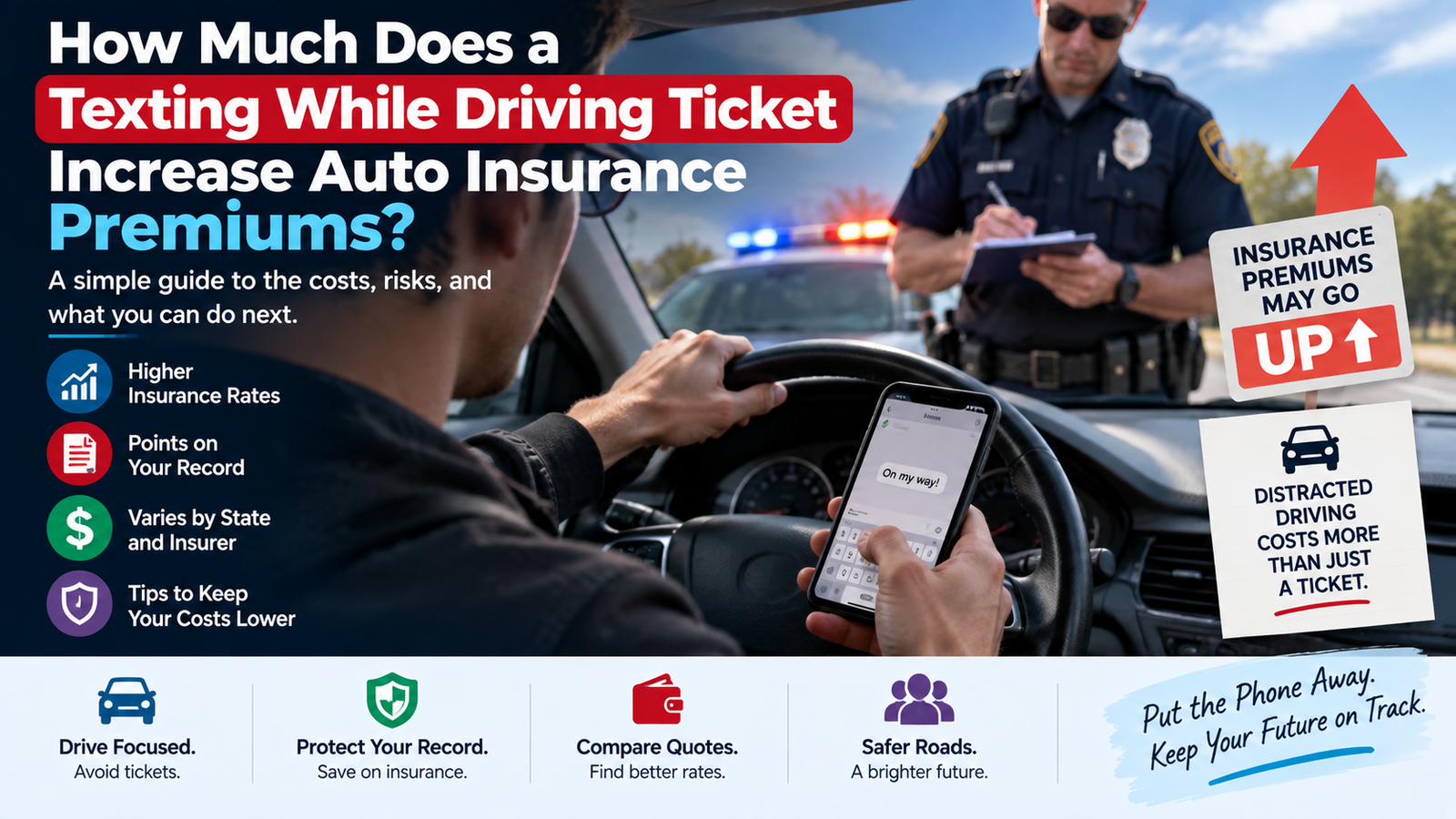
We explain distracted-driving pricing in How Much Does a Texting While Driving Ticket Increase Auto Insurance Premiums?
Can a Serious Accident Make You a High-Risk Driver?
Potentially.
One severe at-fault accident or several recent incidents can change how insurance companies view your profile.
You may receive higher quotes.
Some companies may be more willing than others to insure drivers with recent accidents.
This is why shopping around can become particularly important after an accident.
Different insurers do not always charge the same amount for the same history.
Can You Switch Insurance Companies While an Accident Is Still on Your Record?
Yes.
You do not have to wait three or five years before comparing insurers.
A new insurer will likely ask about or review recent accidents.
You should provide accurate information.
But that does not mean the new insurer will calculate the same premium as your current company.
One insurer may charge considerably more for an accident than another.
This makes comparison shopping useful even while the accident is still recent.
Use our Best Car Insurance Companies Finder if you want to compare insurance options based on your situation.
Will Switching Companies Remove the Accident?
No.
Changing insurers does not reset your driving history.
The accident can still be discovered through driving and claims information available to insurers.
Do not leave the accident off an application if you are asked about it.
Providing inaccurate information may create problems later.
The goal of switching insurers should be to find a company that prices your actual history more competitively.
When Should You Shop for Insurance After an Accident?
There is nothing wrong with comparing insurance immediately after your renewal increases.
But there are several particularly useful times to check again.
At Your Next Renewal
See how much your current insurer changed the premium.
Around the Three-Year Anniversary
For some companies and states, this may be an important point in how older accidents are treated.
Around the Five-Year Anniversary
Some insurers review approximately five years of driving history, making this another useful time to request new quotes.
These are not guarantees that your rate will drop.
They are simply sensible times to recheck the market.
Will Getting Several Quotes Hurt Your Credit?
Generally, auto insurance quote checks are handled as soft credit inquiries where credit-related information is used.
They do not normally lower your traditional credit score.
So you generally do not need to avoid comparing insurers because you are worried that getting several insurance quotes will damage your credit.
For a complete explanation, read Does Getting Auto Insurance Quotes Affect Credit Score?
How Can You Lower Car Insurance After an Accident?
You cannot change the accident that already happened.
But you can improve what happens next.
Avoid Another Accident
A clean period after an accident is valuable.
Multiple accidents can create a much more difficult insurance situation.
Avoid Traffic Tickets
A speeding or distracted-driving ticket added to a recent accident can make your profile worse.
Compare Insurance Companies
Different insurers may price the same accident differently.
Keep Coverage Comparisons Equal
Do not make one quote look cheaper by reducing protection.
Use similar:
- Liability limits
- Collision coverage
- Comprehensive coverage
- Deductibles
Review Discounts
Ask whether you qualify for:
- Multi-car discounts
- Bundling
- Low-mileage programs
- Defensive-driving programs
- Automatic payments
- Other available discounts
Review Your Mileage
If your driving has decreased, make sure your current mileage estimate is accurate.
Should You Raise Your Deductible After an Accident?
A higher deductible can sometimes reduce the premium for collision or comprehensive coverage.
But remember what that means.
Suppose you increase your deductible from $500 to $1,500.
Your monthly premium may decrease.
But if you have another covered accident, you could be responsible for an additional $1,000 before insurance handles its portion.
Only choose a deductible you could realistically afford.
Do not create a future financial problem just to make today's monthly premium look better.
Should You Drop Collision Coverage After an Accident?
Not automatically.
If your vehicle is still valuable or financed, collision coverage may remain important.
Ask yourself:
What is my car worth?
Could I replace it myself?
What is my deductible?
How much does collision coverage actually cost?
Is the vehicle financed or leased?
Do not remove useful protection only because your premium increased.
If you are unsure about the difference between vehicle coverages, read Collision vs Comprehensive Insurance: What’s the Difference?
Will Your Rate Ever Return to What It Was Before the Accident?
It might become more competitive as the accident gets older and eventually stops affecting certain rating factors.
But your exact old premium may never return.
Insurance prices change over time.
Vehicle repair costs change.
Medical costs change.
Your location can change.
Insurer pricing can change.
So rather than waiting for one exact old number, focus on whether your current rate is competitive for your present situation.
How to Check Whether an Accident Is Still Affecting Your Insurance
If you think an old accident should no longer be influencing your rate, contact your insurance company.
Ask directly:
“Is this accident still being used when calculating my premium?”
Also ask:
“When will it stop affecting my rate?”
And:
“Am I currently missing any safe-driver or claim-free discounts because of this accident?”
Those questions may give you more useful information than guessing based on the accident date.
What If the Accident Information Is Wrong?
Mistakes can happen.
You may find:
- An accident incorrectly marked as at fault
- An accident that does not belong to you
- Incorrect claim information
- A duplicate incident
- Incorrect dates
If something appears wrong, do not ignore it.
Ask the appropriate insurer, claims database provider, or state agency how to dispute inaccurate information.
Accurate records matter when insurers calculate your premium.
Frequently Asked Questions
How long does an accident stay on your car insurance record?
For many ordinary accidents, a common insurance-pricing period is roughly three to five years, but the exact length varies by state, insurer, fault, and severity.
Does an accident disappear after three years?
Not necessarily. Some insurers may stop treating certain accidents the same way after around three years, while others may review a longer period. The accident may also remain on an official driving record for a different length of time.
Can an accident affect insurance for five years?
Yes. Some insurers review approximately five years of driving history when determining rates or eligibility.
How long does an at-fault accident stay on your record?
It varies, but an at-fault accident can remain relevant for several years. State rules and insurer practices determine the exact period.
Does a not-at-fault accident stay on your insurance record?
It may still appear in claims or accident history, but that does not mean it will affect your premium in the same way as an at-fault accident.
When will my insurance go down after an accident?
There is no guaranteed date. Your rate may improve as the accident gets older, especially if you maintain a clean record, but other pricing factors also affect your premium.
Does accident forgiveness remove an accident?
No. Accident forgiveness may prevent a qualifying accident from causing a particular surcharge, but it does not erase the accident from your history.
Can I switch insurers before the accident falls off?
Yes. Other insurers can still see or ask about the accident, but they may price your driver profile differently.
Do multiple accidents affect insurance more?
They can. Several recent accidents may have a greater impact on pricing and eligibility than one isolated incident.
Should I compare insurance after three years?
It can be a good time to compare again because some insurers may treat an older accident differently. The five-year anniversary can also be worth checking.
How Long Does an Accident Stay on Your Car Insurance Record? The Bottom Line
So, how long does an accident stay on your car insurance record?
For many ordinary accidents, three to five years is a useful general range when thinking about insurance pricing.
But it is not a universal rule.
Your state matters.
Your insurance company matters.
Fault matters.
Accident severity matters.
Traffic violations matter.
And your complete driving history matters.
An accident can also remain visible on an official driving record for a different amount of time than it affects your premium.
The best thing you can do after an accident is simple:
Drive safely.
Avoid additional violations.
Keep accurate insurance information.
Review your discounts.
And compare insurers periodically.
As the accident becomes older and you build a clean driving history afterward, your insurance options may improve.
For more information, read Does Filing a Car Insurance Claim Increase Your Premium?, What Is a Car Insurance Deductible and How Does It Work?, and Collision vs Comprehensive Insurance: What’s the Difference?, or explore our Insurance Calculators for additional tools.