Does Filing a Car Insurance Claim Increase Your Premium?
Does filing a car insurance claim increase your premium? Learn when a claim may raise your rate, why some claims affect insurance differently, and what to consider before filing a small claim.

Does Filing a Car Insurance Claim Increase Your Premium?
You have an accident.
Your car is damaged.
You know you have insurance, but before calling the company, one question comes to mind:
Will filing this claim make my car insurance more expensive?
The answer is:
It can, but not every claim automatically increases your premium.
What happens after a claim depends on several things, including what caused the loss, whether you were responsible for the accident, how much the insurer paid, your previous claims history, your driving record, your state, your insurance company, and whether your policy includes features such as accident forgiveness.
A small windshield claim is not necessarily treated the same way as a major at-fault collision.
A theft claim is different from a speeding-related accident.
And a driver filing a first claim after many clean years may be viewed differently from someone who has filed several claims recently.
That is why there is no honest answer such as:
“Every insurance claim raises your premium by 20%.”
Car insurance does not work that way.
Why Can a Car Insurance Claim Increase Your Premium?
Insurance companies use past driving and claims information when evaluating future risk.
If a claim suggests that the chance of another loss may be higher, the insurer may change the price of the policy when it is renewed.
This is especially relevant after an at-fault accident.
But a premium increase is not always caused by one simple action.
For example, after an accident, several things could affect the next premium.
The insurer may consider the accident itself.
You may lose a claim-free or safe-driver discount.
Your driving record may change.
Repair costs in your area may also be increasing.
Your insurer may have changed its overall rates.
That means the final renewal price can reflect several factors at the same time.
Does Every Insurance Claim Increase Your Rate?
No.
Filing a claim does not automatically mean your premium must increase.
Different claims can be treated differently.
The outcome can depend on the circumstances surrounding the loss and the rules that apply where you live.
For example, an at-fault collision may have a different effect from a comprehensive claim for hail damage.
An insurer may also consider whether this was your first claim or one of several recent claims.
This is why you should not avoid a legitimate claim only because someone told you that “any claim will double your insurance.”
That statement is too simple.
Does an At-Fault Accident Claim Increase Car Insurance?
An at-fault accident is one of the situations most likely to affect future auto insurance pricing.
Imagine you cause an accident that damages another vehicle and your own car.
Your insurer may have to pay under several parts of the policy.
The accident can then become part of your claims and driving history.
When the policy renews, the insurer may consider that information when calculating your new premium.
How much the price changes can depend on the severity of the accident, the amount paid, your previous record, the insurer, and your state.
There is no single percentage that applies to everyone.
What If the Accident Was Not Your Fault?
A not-at-fault accident can be treated differently.
If another driver caused the accident, their liability insurance may be responsible for covered damage.
However, real claims are not always that simple.
You might need to use your own collision coverage while fault is being investigated.
The other driver may be uninsured.
Fault may be disputed.
Your insurer may have to pay first and attempt to recover the money later.
Whether a not-at-fault claim can affect your premium depends partly on state rules and insurer practices.
You should not automatically assume that every not-at-fault claim will raise your rate, but you also should not assume that it can never have any effect.
Does a Comprehensive Claim Increase Your Premium?
Comprehensive insurance covers certain non-collision losses involving your vehicle.
Examples can include theft, hail, vandalism, fire, falling objects, and certain animal-related losses.
A comprehensive claim may be treated differently from an at-fault collision because the event may not involve unsafe driving.
For example, you cannot control a hailstorm.
You may also have limited control over someone stealing your parked car.
Still, a comprehensive claim becomes part of your insurance history, and how it affects future pricing can depend on the company, location, claim history, and applicable rules.
If you want to understand the coverage itself, read Collision vs Comprehensive Insurance: What’s the Difference?
Can a Windshield Claim Raise Your Insurance?
Windshield claims can be handled differently depending on your coverage and state.
Some policies apply the normal comprehensive deductible.
Others may offer special glass coverage.
A small glass claim may not be treated the same way as a major accident claim.
However, repeated glass or comprehensive claims may still matter to an insurer.
If you have a small chip or crack, it is worth checking the cost of repair, your deductible, and your glass coverage before deciding how to handle it.
Does a Theft Claim Increase Car Insurance?
Vehicle theft is normally associated with comprehensive coverage.
If your car is stolen and the insurer pays a covered claim, that loss becomes part of your claims history.
Whether it changes your future premium depends on your situation.
Location can also matter.
If theft losses are becoming more common in an area, insurance pricing for many drivers in that area may change even if they personally have never had a vehicle stolen.
If you want to understand what happens when theft occurs without applicable coverage, see What Would Happen If Your Car Were Stolen and You Didn't Have Auto Insurance?
Does the Size of the Claim Matter?
It can.
A $900 claim is very different from a $40,000 claim.
But claim amount is not necessarily the only thing an insurer considers.
Imagine two situations.
In the first, you accidentally damage your bumper in a parking lot.
In the second, you cause a serious multi-vehicle accident.
The second event may tell the insurer much more about future risk even beyond the amount paid.
Insurers can consider the type and circumstances of the claim along with its cost.
Does Your Previous Claims History Matter?
Yes.
One claim after many years without an incident may be viewed differently from several claims within a short period.
Suppose Driver A has been insured for ten years and has never filed a claim.
Driver B has filed three claims during the last two years.
Even if they now experience similar accidents, their overall insurance histories are not the same.
This is one reason repeatedly filing very small claims deserves careful thought.
Insurance is designed to protect against financial losses, especially losses that would be difficult to handle yourself.
It is not always necessary to file every tiny repair bill.
Should You File a Small Car Insurance Claim?
This is where your deductible becomes important.
Imagine the repair costs $800.
Your collision deductible is $500.
The amount above the deductible is only $300.
Before filing, you may want to think carefully about whether making a $300 insurance claim makes sense for your situation.
Now imagine the repair costs $8,000.
With the same $500 deductible, the financial value of using insurance becomes much clearer.
This does not mean you should hide accidents or ignore reporting requirements.
Certain incidents may need to be reported to your insurer, lender, police, or other parties regardless of whether you ultimately receive a claim payment.
But for minor damage involving only your own vehicle, understanding the deductible and repair cost can help you make a more informed decision.
If deductibles are confusing, read What Is a Car Insurance Deductible and How Does It Work?
Claim Cost vs Deductible
Before deciding whether a small covered loss is worth claiming, compare the repair estimate with your deductible.
Suppose:
Repair cost is $650.
Your deductible is $500.
The difference is only $150.
Now suppose:
Repair cost is $5,500.
Your deductible is $500.
The difference is $5,000.
Those are very different financial situations.
This simple comparison can help you understand how much help the insurance policy may actually provide.
What Is Accident Forgiveness?
Some insurance companies offer accident-forgiveness features.
The exact rules vary.
In some cases, qualifying drivers may avoid a surcharge after their first eligible accident.
But accident forgiveness does not necessarily mean the accident disappears from your record.
It also does not necessarily mean your total premium can never change for another reason.
You could lose a safe-driver discount.
The insurer's base rates could change.
Another factor in your policy could change.
So if your insurer says you have accident forgiveness, ask exactly what it does and does not protect.
Can You Lose a Claim-Free Discount?
Yes, this is another reason your premium may appear to increase after a claim.
Suppose your base premium does not receive a large accident surcharge.
But before the claim, you had a claim-free discount.
After the claim, you no longer qualify.
Your insurance bill rises.
From your perspective, the claim increased your cost.
Technically, part of that increase may have come from losing a discount rather than receiving a direct surcharge.
Either way, the amount you pay has changed.
When Will the Premium Increase Happen?
A claim does not necessarily change your monthly premium immediately.
Often, the insurer evaluates new information when your policy renews.
For example, you could have an accident in March while your current policy runs until August.
Your existing payment may continue until the current policy period ends.
The change may appear at your August renewal.
Insurance practices vary, so ask your insurer if you want to know when a specific claim may affect the policy.
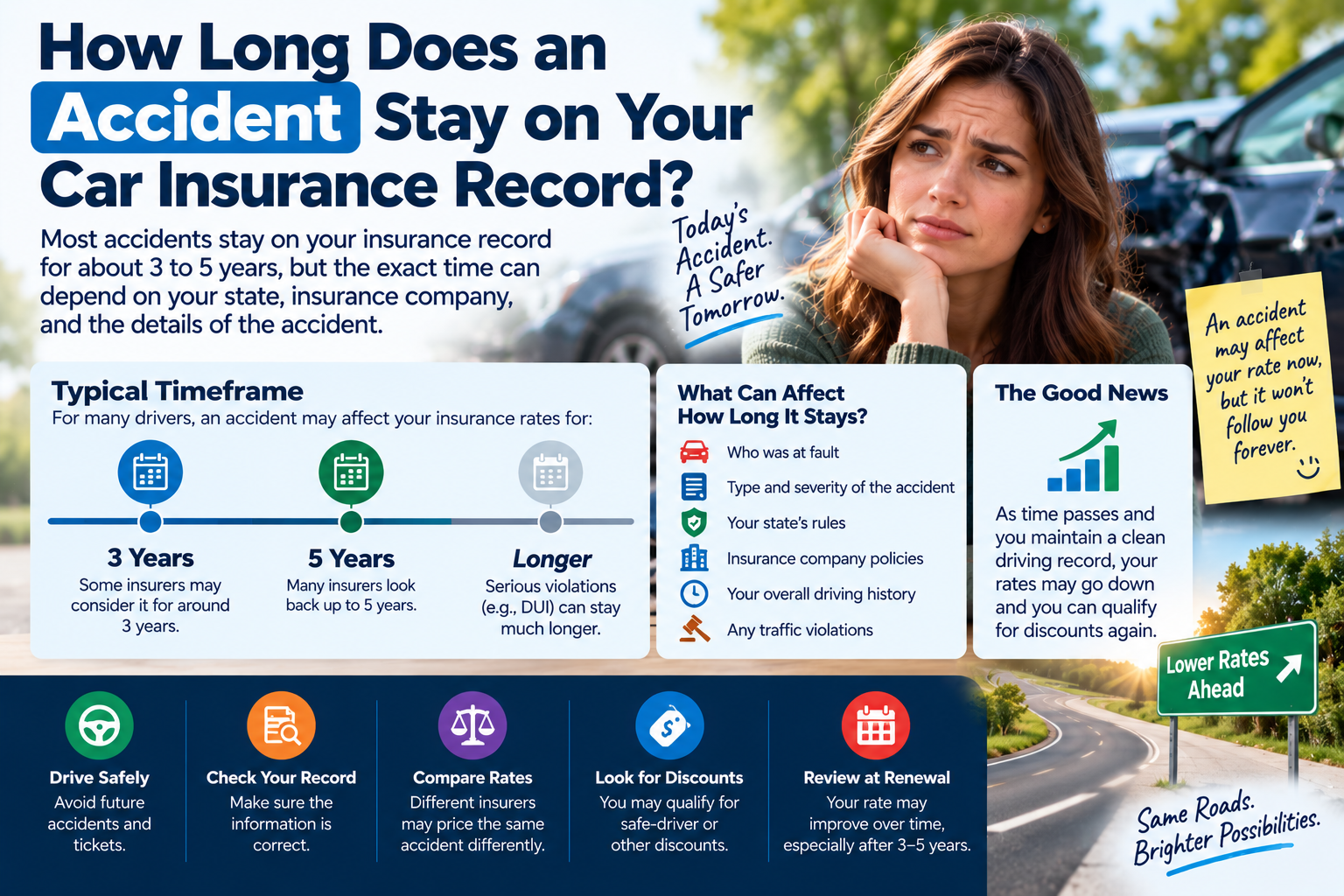
How Long Can a Claim Affect Car Insurance?
There is no universal number of years that applies to every claim.
Claims and accidents can remain relevant for several years depending on the type of loss, state rules, insurance company, and your overall history.
An older claim may eventually have less effect than a recent one.
But another accident or violation during that period can create a different situation.
The safest approach is not to assume that a claim will disappear from pricing after exactly one, three, or five years.
Ask how your insurer evaluates the specific claim.
Can Multiple Claims Cause a Bigger Increase?
Multiple claims can create more concern than one isolated event.
Imagine a driver files:
One collision claim.
Six months later, another collision claim.
Eight months later, a comprehensive claim.
Even if each incident is explainable on its own, the overall claims frequency may become important to the insurer.
Multiple claims may affect pricing, eligibility, discounts, or even whether a company wants to continue offering certain coverage.
The exact result depends on the insurer and applicable rules.
ALso CHeck below..
https://bestcarandautoinsurance.com/does-getting-auto-insurance-quotes-affect-credit-score
Can an Insurance Company Cancel You After a Claim?
A single claim does not automatically mean your insurance company will cancel your policy.
There are rules governing cancellation and nonrenewal, and they vary by state.
However, a history of repeated claims, serious violations, fraud, nonpayment, or other risk factors can affect whether an insurer continues offering coverage.
Cancellation and nonrenewal are also different.
A company ending a policy in the middle of its term is not the same as choosing not to renew it when the term ends.
If you receive a cancellation or nonrenewal notice, read it carefully and contact the insurer if anything is unclear.
Will Switching Insurance Companies Remove the Claim?
No.
Changing insurers does not erase your claims history.
A new company may review information about previous claims and driving incidents when calculating your premium.
You should answer application questions accurately.
The reason to compare insurers after a claim is not to hide what happened.
It is to see whether another insurer prices your complete driver profile differently.
Should You Compare Insurance After a Claim?
It can be worthwhile.
Insurance companies do not all respond to claims in exactly the same way.
After your policy renews, compare your new premium with several other insurers using the same coverage.
Do not reduce coverage simply to make the new quote look cheaper.
Keep the same or similar liability limits.
Keep collision and comprehensive coverage consistent.
Keep the same deductibles.
Then compare the final premiums.
That tells you whether another insurer may offer better value for your current profile.
Why You Should Not Hide a Previous Claim
Trying to hide an accident or insurance claim can create problems.
Insurers may review claims and driving-history information during underwriting.
If an application asks about previous accidents or claims, answer honestly.
A low quote based on inaccurate information may change when the insurer verifies the details.
More importantly, intentionally giving false information can create serious policy or claims issues.
Accurate information produces a much more useful insurance comparison.
Will Filing a Claim Always Cost More Than Paying Yourself?
No.
This depends on the size of the loss.
Suppose you have $12,000 in covered damage and a $500 deductible.
Even if your premium later increases, filing the claim may still protect you from a much larger immediate financial loss.
Insurance exists precisely because some losses are too large for most people to comfortably pay themselves.
The question becomes more difficult with very small claims.
A $700 repair with a $500 deductible creates a different decision from a $12,000 loss.
Should You Pay for an Accident Out of Pocket?
Sometimes people consider handling a small accident privately rather than involving insurance.
Be careful.
Damage that looks minor at first can become more expensive once repairs begin.
Another person involved may later report injuries.
There may be legal or policy requirements to report the accident.
If another vehicle or person is involved, simply handing someone cash and walking away can create significant risk.
For accidents involving other people, injuries, meaningful property damage, or uncertain liability, consider contacting your insurer and following applicable reporting requirements.
What If the Claim Is Below Your Deductible?
If your own covered vehicle damage costs less than the deductible, there may be no payment under that coverage.
For example:
Repair cost: $400.
Deductible: $500.
There is no amount above the deductible for the insurer to pay.
Whether you still need to report the incident can depend on the situation.
An accident involving another driver can create liability issues even if your own car has very little damage.
Does Filing a Claim Affect Your Credit Score?
A car insurance claim itself is not the same thing as applying for credit.
Insurance claims and credit inquiries are separate issues.
If you are also comparing insurance quotes after the claim, requesting normal auto insurance quotes generally does not work like applying for a loan.
For a detailed explanation, read Does Getting Auto Insurance Quotes Affect Credit Score?
Can a Claim Affect a Young Driver More?
Young drivers often already pay higher premiums because they have less driving experience.
A new at-fault accident can therefore make an already expensive insurance situation more difficult.
But the effect varies by insurer and state.
Young drivers should compare companies carefully after a renewal increase and check whether student, training, or safe-driving programs remain available.
Does a Claim Affect Senior Drivers Differently?
Senior drivers are not all treated the same way.
Age, driving history, mileage, state, vehicle, and claim history can all matter.
A retired driver with low mileage and a long clean history may have a very different insurance profile from another senior driver with recent accidents.
The claim should be considered as part of the whole profile.
Can Your Premium Increase Even Without Filing a Claim?
Yes.
This is important because drivers sometimes blame a claim for an increase that has several causes.
Your insurance premium can change because of broader factors such as repair costs, medical costs, theft trends, severe weather, local claim frequency, or insurer-wide pricing changes.
Your personal situation may also change.
You may move.
Buy another car.
Add a driver.
Drive more miles.
Change coverage.
Lose a discount.
So if your premium increases after a claim, ask your insurer what factors contributed to the new price rather than assuming the entire increase came from one event.
Should You Avoid Filing a Legitimate Large Claim?
Usually, fear of a future premium increase should not make you ignore a major covered loss that you cannot reasonably afford yourself.
Imagine your vehicle suffers $18,000 in covered damage.
Avoiding a legitimate claim just because you are worried about next year's premium could leave you responsible for a very large loss.
This is exactly the kind of situation insurance is designed to address.
The calculation becomes more important for small claims where the amount above your deductible is relatively small.
How to Decide Whether a Small Claim Is Worth Filing
Before filing a minor claim involving only your own property, think about the full situation.
Consider the repair cost, deductible, whether another person is involved, whether the accident must be reported, your previous claims history, and how difficult it would be to pay for the repair yourself.
Do not look only at the deductible.
And do not make the decision based only on fear that your premium might increase.
The details of the event matter.
What Should You Do After an Accident?
Safety comes first.
Make sure everyone is safe and seek emergency assistance when necessary.
Document what happened.
Exchange required information with other drivers.
Take photographs if it is safe to do so.
Report the accident to law enforcement when required.
Keep repair estimates and relevant records.
Then contact your insurer when appropriate and explain what happened accurately.
Trying to change the story later can create unnecessary problems.
How Can You Reduce Insurance Costs After a Claim?
A claim may be behind you, but you can still make good decisions going forward.
The most useful steps are generally straightforward: maintain a clean driving record, avoid additional claims when preventable, compare insurers at renewal, review legitimate discounts, make sure your mileage is accurate, choose deductibles you can afford, and compare the same coverage between companies.
Do not remove important protection only because you want the old premium back.
A cheaper policy that exposes you to a much larger financial loss may not actually save you money.
Frequently Asked Questions
Does filing a car insurance claim increase your premium?
It can, especially after certain at-fault accidents, but not every claim automatically raises the premium. The outcome depends on the claim, insurer, state, driving history, claims history, discounts, and other factors.
How much will my insurance increase after a claim?
There is no fixed percentage that applies to every driver. The size of the increase can vary significantly based on the accident and your insurance profile.
Does a not-at-fault claim increase insurance?
Not necessarily. How a not-at-fault claim affects pricing depends on the circumstances, insurer, and state rules.
Does a comprehensive claim raise insurance?
It may affect your insurance history, but comprehensive claims can be treated differently from at-fault collision claims.
Will a windshield claim increase my premium?
It depends on the insurer, type of glass coverage, state, and your previous claims history.
Should I file a $500 insurance claim?
First compare the covered repair cost with your deductible. If the repair amount is close to or below the deductible, there may be little or no insurance payment. Other reporting obligations can still apply.
How long does an accident affect car insurance?
It can remain relevant for several years, but the exact period varies by insurer, state, and type of incident.
Does accident forgiveness stop my premium from increasing?
Accident forgiveness may protect qualifying drivers from certain accident-related surcharges, but it does not necessarily prevent every possible change in the total premium.
Can I change insurance companies after a claim?
Yes. A new insurer may still review your previous claim, but different companies may price your profile differently.
Is it better to pay for small damage yourself?
Sometimes it may make financial sense, particularly when the repair cost is close to your deductible. However, accidents involving other people, liability, injuries, or reporting requirements should be handled carefully.
Does Filing a Car Insurance Claim Increase Your Premium? The Bottom Line
So, does filing a car insurance claim increase your premium?
The most accurate answer is:
It can, but it depends on the claim.
An at-fault accident may affect your insurance differently from hail damage.
A first claim may be treated differently from several recent claims.
A $500 loss is different from a $30,000 accident.
Your insurer, state, driving history, claims history, discounts, and policy features all matter.
For a major covered loss, insurance can protect you from an expense that would otherwise be extremely difficult to handle yourself.
For a very small claim, compare the repair cost with your deductible and consider the complete situation before deciding.
Most importantly, do not make insurance decisions based on the belief that every claim automatically raises your premium by the same percentage.
Understand the claim.
Understand your deductible.
Review your renewal.
Then compare your options.
For more information, read What Is a Car Insurance Deductible and How Does It Work? and explore our Insurance Calculators to compare insurance options for your situation.