What Would Happen If Your Car Were Stolen and You Didn't Have Auto Insurance?
What happens if your car is stolen and you do not have auto insurance? Learn who may be responsible for the loss, what happens to a car loan, what steps to take after a theft, and how comprehensive coverage can help.
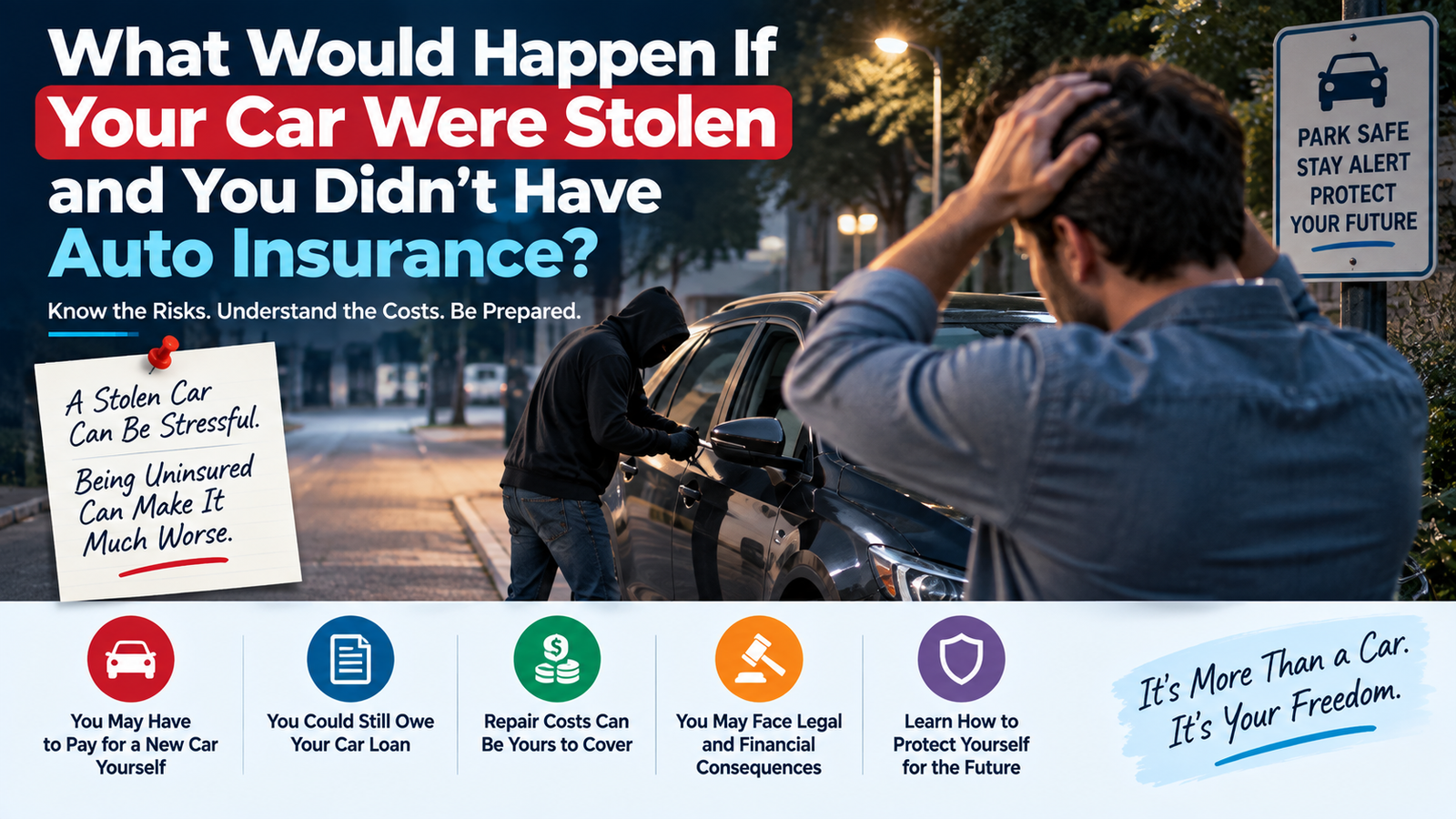
What Would Happen If Your Car Were Stolen and You Didn't Have Auto Insurance?
Imagine waking up in the morning, walking outside, and realizing your car is gone.
At first, you might think you parked somewhere else.
Then you check the street.
You check your driveway.
You call a family member.
A few minutes later, you realize the car may actually have been stolen.
Now imagine dealing with that situation without auto insurance.
If your car is stolen and you do not have insurance that covers theft, you may have to absorb the financial loss yourself.
That can become especially difficult if the vehicle is expensive or you still owe money on a car loan.
The exact situation depends on whether you own the vehicle outright, whether it is financed or leased, whether another insurance policy might apply to certain property inside the vehicle, and whether the car is later recovered.
Understanding these differences can help you know what to do next.
Does Auto Insurance Pay for a Stolen Car?
It can, but only if your policy includes the appropriate coverage.
Car theft is generally associated with comprehensive coverage.
Comprehensive coverage is designed to help with certain losses that are not caused by a normal collision.
Depending on the policy, these can include events such as:
- Vehicle theft
- Vandalism
- Fire
- Certain weather damage
- Falling objects
- Some animal-related damage
If you only carry liability insurance, theft of your own vehicle is generally not covered by that liability coverage.
This is an important difference.
Many drivers hear the words “I have insurance” and assume every possible problem involving their vehicle is covered.
That is not necessarily true.
If you are unsure what different types of auto insurance protect, read What Does Auto Insurance Cover?
What Happens If You Have No Auto Insurance at All?
If your vehicle is stolen while you have no applicable auto insurance, there is normally no auto insurer available to reimburse you for the stolen vehicle.
That means you could be responsible for the financial loss yourself.
Suppose your car was worth $18,000 before it was stolen.
If there is no theft coverage and the vehicle is never recovered, you may lose the value of that vehicle.
There is no insurance company automatically replacing the car simply because it was stolen.
This is one of the biggest financial risks of having no applicable coverage.
What If You Own the Car Completely?
If you own the vehicle outright and it is stolen without applicable insurance coverage, the loss is generally yours to bear.
For example, imagine you own a car worth approximately $12,000.
You have no loan.
You also have no comprehensive insurance.
If thieves take the vehicle and police never recover it, you may lose the car and its value.
You do not have monthly loan payments remaining, but you may still have to find money to buy another vehicle.
For someone who relies on a car for work, school, childcare, or daily life, that can create an immediate financial problem.
What If the Stolen Car Is Financed?
This situation can be much more stressful.
A car being stolen does not normally erase the loan used to purchase it.
Imagine you still owe $20,000 to your lender.
Your vehicle is stolen.
You do not have insurance that will pay for the theft.
Even though the vehicle is gone, the loan agreement may still require you to repay what you owe.
You could therefore end up in a very difficult position:
No car.
But still a car loan.
This is one reason lenders commonly require borrowers to maintain certain physical-damage coverage on financed vehicles.
If you finance a vehicle, review your loan agreement carefully so you understand the insurance requirements.
What If the Car Is Leased?
A leased vehicle usually belongs to the leasing company rather than the driver.
Lease agreements commonly require specific levels and types of insurance coverage.
If a leased vehicle is stolen while required coverage is missing, the situation can become complicated and potentially expensive.
The lease does not simply disappear because the vehicle was stolen.
You should contact the leasing company immediately and follow the requirements in your agreement.
Please Also Check ...
https://bestcarandautoinsurance.com/top-10-cheapest-car-insurance-companies-calculator
Does Liability Insurance Cover a Stolen Car?
Usually, liability coverage is not the coverage designed to reimburse you for the theft of your own vehicle.
Liability insurance primarily deals with covered injuries or property damage you cause to other people.
That is different from protecting your own car against theft.
A driver can therefore be legally insured to drive and still lack theft protection for their own vehicle.
This distinction is important.
If theft protection matters to you, look specifically at comprehensive coverage rather than assuming liability insurance provides it.
Does Full Coverage Include Car Theft?
The phrase “full coverage” is commonly used to describe a policy containing liability insurance plus collision and comprehensive coverage.
Because comprehensive coverage generally addresses vehicle theft, a typical full-coverage policy may provide theft protection.
However, “full coverage” is not one standardized policy that covers everything.
Always check the actual policy.
Look at:
- Comprehensive coverage
- Deductible
- Exclusions
- Vehicle value
- Coverage conditions
Never assume something is covered simply because someone called the policy “full coverage.”
What Should You Do Immediately If Your Car Is Stolen?
Discovering a missing vehicle can be stressful, but acting carefully can help.
Make Sure the Car Was Actually Stolen
Before reporting a theft, make sure the vehicle was not:
- Towed
- Repossessed
- Moved by another household member
- Parked somewhere different
- Relocated because of parking restrictions
If you are confident the vehicle was stolen, move to the next step.
Contact the Police
Report the stolen vehicle to the appropriate local law-enforcement agency.
Be prepared to provide information such as:
- License plate
- Vehicle identification number
- Make
- Model
- Year
- Color
- Distinguishing features
- Location where you last saw it
- Approximate time it disappeared
Keep your police report information.
It may be important later.
Contact Your Insurance Company If You Have Coverage
If you do have an active insurance policy, contact your insurer even if you are unsure whether theft is covered.
The company can tell you whether your policy includes comprehensive coverage and explain the claims process.
Contact Your Lender or Leasing Company
If the vehicle is financed or leased, inform the lender or leasing company.
Do not simply stop making payments because the vehicle is missing.
Ask what your agreement requires you to do.
What Happens If Police Recover the Car?
Not every stolen vehicle disappears permanently.
Some are found relatively quickly.
Others may be recovered days, weeks, or even longer after the theft.
The condition of the vehicle can vary considerably.
A recovered vehicle might be almost unchanged.
Or it could have:
- Broken windows
- Damaged locks
- Missing wheels
- Interior damage
- Body damage
- Mechanical damage
- Missing parts
If you do not have insurance covering the damage, you may need to pay repair costs yourself.
Before using a recovered vehicle, make sure it is safe and follow instructions from law enforcement and any applicable vehicle authorities.
What If the Car Is Recovered but Damaged?
This is another situation where comprehensive coverage can become important.
A thief may damage the vehicle during the theft even if the car is eventually recovered.
Without applicable coverage, repairs may become your responsibility.
Imagine your car is recovered but needs:
$1,500 in window and lock repairs.
$2,000 in body repairs.
$1,000 in interior repairs.
Suddenly, getting the car back does not mean the financial problem is over.
The vehicle may require thousands of dollars of work before you can comfortably use it again.
What Is a Comprehensive Deductible?
Even when comprehensive insurance covers theft, you may still have a deductible.
The deductible is the amount you are responsible for under the terms of the coverage before the insurer's payment is calculated.
For example, imagine an insured stolen vehicle has a covered value determined at $15,000 and the applicable comprehensive deductible is $500.
The deductible may reduce the amount payable under the claim.
The exact settlement depends on the policy terms and claim.
This is why choosing a deductible should not be based only on finding the lowest premium.
Ask yourself whether you could comfortably pay that amount after an unexpected event.
Will Insurance Buy You a Brand-New Car?
Not necessarily.
People sometimes assume that if a $30,000 car is stolen, an insurer will simply give them $30,000 to buy a new one.
That is not how every policy works.
The claim settlement depends on the coverage, vehicle, policy terms, valuation method, deductible, and other relevant details.
A vehicle's current value can be different from what you originally paid for it.
This can become especially important with financed vehicles.
What If You Owe More Than the Car Is Worth?
Suppose you owe $24,000 on your vehicle.
But its value at the time of a covered total loss is only $20,000.
That leaves a possible gap between the insurance settlement and the loan balance.
This is where drivers sometimes hear about gap insurance or gap-related coverage.
Gap protection may help with certain differences between a qualifying insurance settlement and the amount still owed on a loan or lease, depending on the product and its terms.
It is not the same as comprehensive insurance.
Comprehensive coverage addresses the covered vehicle loss.
Gap coverage addresses a different financial problem.
If you finance or lease a vehicle, understand both before assuming you are fully protected.
What Happens to Personal Items Inside a Stolen Car?
Suppose your stolen vehicle contained:
- A laptop
- Clothes
- A backpack
- Tools
- Electronics
- Other personal belongings
Do not automatically assume your auto insurance covers everything that was inside the vehicle.
Personal property may be treated differently from the vehicle itself.
Depending on your circumstances, homeowners or renters insurance may potentially apply to certain personal property losses, subject to policy terms, deductibles, limits, and exclusions.
Keep a detailed list of anything that was inside the vehicle and report the theft accurately.
Do not exaggerate or add items that were not actually there.
What About Items Permanently Attached to the Car?
Factory-installed equipment and permanently attached vehicle equipment may be treated differently from loose personal belongings.
Aftermarket equipment can also have special limits or coverage requirements.
If your vehicle has expensive custom equipment, wheels, audio equipment, or modifications, make sure you understand how your insurance handles them before a loss occurs.
Can You Get Insurance After the Car Has Already Been Stolen?
Buying insurance after a theft generally does not create coverage for a loss that already happened.
Insurance is designed to cover eligible future events under an active policy.
You cannot normally wait until your vehicle disappears and then purchase coverage expecting the insurer to pay for the earlier theft.
This is why insurance should be considered before something goes wrong.
What If Your Insurance Policy Recently Expired?
If the policy ended before the theft, there may be no applicable coverage for the incident.
The exact timing matters.
If you believe coverage should have been active, contact the insurance company and verify the policy dates and payment records.
Do not guess.
Ask the company to explain the policy status in writing if necessary.
Can You Drive Without Auto Insurance?
Insurance requirements differ by state, but most drivers need to satisfy their state's financial-responsibility or auto-insurance requirements before driving on public roads.
Driving without required coverage can lead to serious consequences depending on the state.
Possible consequences can include:
- Fines
- Registration problems
- License-related consequences
- Vehicle-related penalties
- Higher future insurance costs
- Personal responsibility for accident costs
The exact rules vary by location.
A stolen car creates a financial problem.
Driving uninsured can create additional legal and financial problems.
What If Someone Steals an Uninsured Car and Crashes It?
This situation can become complicated quickly.
The theft, ownership of the vehicle, who was driving, how the vehicle was used, state law, and insurance status can all affect what happens next.
You should report the theft promptly and keep documentation showing when you discovered and reported the vehicle missing.
For a serious accident or legal dispute, professional legal guidance may be appropriate.
How Much Could You Lose If an Uninsured Car Is Stolen?
The answer depends largely on the vehicle.
Think about what replacing your car today would cost.
If your vehicle is worth $5,000, that may be your main financial exposure.
If it is worth $40,000, the potential loss is much larger.
Now think about whether you still owe money on it.
You may also face:
- Replacement transportation costs
- Loan payments
- Repair costs if the vehicle is recovered damaged
- Towing or storage-related costs in some situations
- Lost personal belongings
- Time away from work
- Other unexpected expenses
This is why theft should be considered when deciding whether comprehensive coverage is worthwhile.
Is Comprehensive Insurance Worth It for an Older Car?
This requires a personal decision.
Suppose your car is worth $2,500.
You may question whether paying for comprehensive coverage still makes sense.
Now suppose your vehicle is worth $25,000.
Losing the car without insurance would be a much larger financial event.
Consider:
- Current vehicle value
- Comprehensive premium
- Deductible
- Your savings
- Your ability to replace the vehicle
- Local theft risk
- Whether the vehicle is financed
Do not automatically remove comprehensive coverage simply because the car is older.
Look at the actual numbers.
How Can You Reduce the Risk of Car Theft?
Insurance can help financially after certain covered thefts, but preventing a theft is better.
Simple habits may help reduce risk.
Lock the Car
It sounds obvious, but always lock the vehicle.
Do Not Leave Keys Inside
Never leave spare keys or key fobs inside the car.
Park Carefully
When possible, use well-lit and visible parking areas.
Avoid Leaving Valuables in Sight
A visible laptop, phone, bag, or other valuable item can attract attention.
Use Available Security Features
Modern vehicles may include alarms, immobilizers, tracking technology, or other anti-theft features.
Understand how the security systems in your car work.
Keep Important Vehicle Information
Store your VIN, plate number, insurance details, and vehicle information somewhere outside the car.
If the vehicle is stolen, you will have that information available immediately.
Should You Drop Comprehensive Coverage to Save Money?
It may reduce your insurance premium, but think carefully about the risk you are accepting.
Ask yourself:
“If my car disappeared tonight and was never recovered, could I replace it myself?”
If replacing it would create a serious financial problem, comprehensive coverage may deserve careful consideration.
If the vehicle has very little value and you could comfortably replace it, the decision may look different.
There is no single correct answer for every driver.
Why Cheap Car Insurance Is Not Always Enough
Everyone wants affordable insurance.
But the cheapest policy is not always the policy that protects against the risks you care about.
A low-cost liability-only policy may meet certain state requirements while providing no coverage for theft of your own car.
That does not necessarily make the policy bad.
It simply means you need to understand what you bought.
If price is your main concern, use the Top 10 Cheapest Car Insurance Companies comparison tool, but always compare coverage as well as premium.
You can also use the Best Car Insurance Companies Finder when comparing insurers based on broader needs.
Questions to Ask Before Removing Comprehensive Coverage
Before removing comprehensive coverage, ask yourself:
- What is my car worth today?
- Do I still owe money on it?
- Does my lender require comprehensive coverage?
- What is my current deductible?
- How much does comprehensive add to my premium?
- Could I replace the car using my savings?
- Would losing the vehicle affect my job?
- Would I need to finance another car immediately?
- Am I comfortable accepting the theft risk myself?
Answering those questions can be more useful than simply asking whether comprehensive coverage is “expensive.”
Frequently Asked Questions
What happens if my car is stolen and I have no insurance?
If there is no applicable insurance coverage for the theft, you may have to bear the financial loss yourself. If the vehicle is financed, you may also remain responsible for the loan.
Will liability insurance pay if my car is stolen?
Liability coverage is generally not designed to cover theft of your own vehicle. Comprehensive coverage is the part of an auto policy commonly associated with theft protection.
What insurance covers a stolen car?
Comprehensive coverage generally provides protection for covered vehicle theft, subject to the policy terms and deductible.
Do I still have to pay my car loan if the vehicle is stolen?
A theft does not normally cancel the debt you owe your lender. Contact the lender promptly to understand your obligations.
What happens if my stolen car is found damaged?
If you have applicable comprehensive coverage, covered theft-related damage may be handled under the policy. Without applicable coverage, repair costs may become your responsibility.
Does car insurance cover belongings stolen from inside the car?
Auto insurance does not necessarily cover loose personal belongings in the vehicle. Depending on the circumstances, another policy such as homeowners or renters insurance may potentially apply.
Can I buy insurance after my car is stolen and make a claim?
Insurance purchased after the loss generally does not cover a theft that already occurred.
Does full coverage cover theft?
A typical policy described as full coverage often includes comprehensive coverage, which commonly covers vehicle theft. Always verify the actual policy rather than relying on the phrase “full coverage.”
Is comprehensive coverage required by law?
State auto-insurance laws generally focus on liability or financial-responsibility requirements rather than requiring comprehensive coverage. However, a lender or leasing company may require comprehensive and collision coverage.
Should I keep comprehensive insurance on an old car?
It depends on your vehicle's value, deductible, premium, financial situation, financing requirements, and ability to replace the vehicle yourself.
What Would Happen If Your Car Were Stolen and You Didn't Have Auto Insurance? The Bottom Line
If your car were stolen and you did not have applicable auto insurance, the financial consequences could be significant.
If the vehicle is never recovered, you may lose its entire value.
If you still owe money on the vehicle, you may continue owing the lender even though you no longer have the car.
If police recover it with serious damage, you may need to pay for repairs yourself.
That is why understanding your coverage before something happens is so important.
Do not simply ask whether you “have car insurance.”
Ask what your insurance actually covers.
Check whether you have comprehensive coverage.
Know your deductible.
Understand what your vehicle is worth.
And if you finance or lease your car, understand what coverage your agreement requires.