PIP vs Medical Payments Coverage: What’s the Difference?
PIP and Medical Payments coverage can both help with accident-related medical expenses, but they are not the same. Learn how PIP vs MedPay works, what each may cover, and which protection may fit your needs.
PIP vs Medical Payments Coverage: What’s the Difference?
You are injured in a car accident.
You need an ambulance, emergency treatment, follow-up appointments, and several weeks to recover.
Now an important question appears:
Which part of your car insurance can help with those expenses?
Two coverages you may hear about are Personal Injury Protection, usually called PIP, and Medical Payments coverage, commonly called MedPay.
They sound similar because both can help with medical expenses after a car accident.
But they are not identical.
The simplest difference is this:
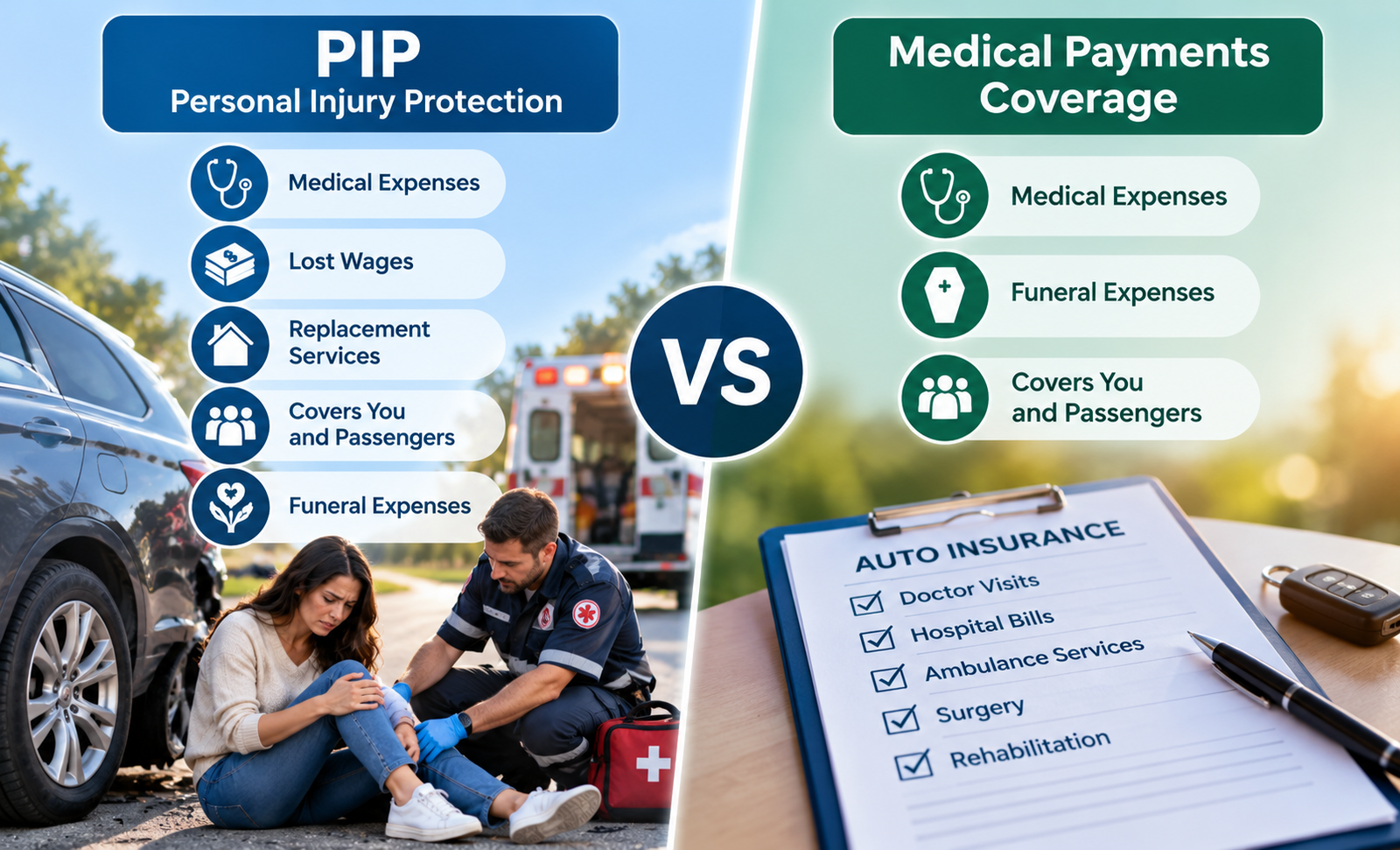
Medical Payments coverage mainly focuses on medical and certain funeral expenses.
PIP can provide broader protection and may also help with things such as lost income and certain services you cannot perform because of your injuries.
Both can generally provide benefits without first requiring you to prove that another driver caused the accident.
However, availability, requirements, limits, deductibles, and benefits vary significantly by state and policy.
Understanding those differences can help you avoid paying for coverage you do not understand—or discovering after an accident that you do not have the protection you expected.
What Is Personal Injury Protection?
Personal Injury Protection is auto insurance coverage designed to help with certain expenses after you or other qualifying people are injured in a car accident.
It is commonly known as PIP insurance.
PIP is strongly associated with no-fault auto insurance systems, although the exact rules differ by state.
The basic idea is that certain benefits may be available through your own insurance coverage regardless of who caused the accident.
Depending on your state and policy, PIP may help with:
- Medical bills
- Hospital treatment
- Ambulance expenses
- Rehabilitation
- Lost income
- Certain replacement services
- Funeral expenses
- Other qualifying injury-related costs
This broader range of potential benefits is one of the biggest differences between PIP and Medical Payments coverage.
What Is Medical Payments Coverage?
Medical Payments coverage, or MedPay, is another type of auto insurance protection for accident-related medical expenses.
It can generally help pay qualifying medical expenses for you and certain passengers regardless of who caused the accident.
Depending on the policy, covered expenses may include:
- Ambulance services
- Emergency-room treatment
- Hospital bills
- Doctor visits
- Surgery
- X-rays
- Certain rehabilitation expenses
- Funeral expenses
However, MedPay is generally narrower than PIP.
It normally focuses primarily on medical and funeral costs rather than providing broader benefits such as lost wages or replacement services.
PIP vs MedPay: The Simple Difference
Think about the two coverages this way.
Medical Payments Coverage
Primarily helps with:
Medical expenses after an auto accident.
Personal Injury Protection
Can help with:
Medical expenses plus certain additional financial consequences of an injury.
Those additional benefits may include lost income or certain household services depending on the state and policy.
That does not automatically mean PIP is always better.
Some drivers may not have access to PIP.
Others may live in states where PIP is required.
Some may have MedPay available instead.
Your location matters.
Does PIP Cover Medical Bills?
Yes, qualifying medical expenses are one of the main purposes of PIP.
Depending on the policy, this can potentially include expenses such as:
- Ambulance transportation
- Emergency treatment
- Hospital stays
- Doctor appointments
- Diagnostic tests
- Surgery
- Rehabilitation
- Certain other necessary medical treatment
Coverage remains subject to your PIP limits and other policy rules.
PIP does not mean every medical expense is automatically unlimited.
Does MedPay Cover Medical Bills?
Yes.
Medical bills are the main focus of Medical Payments coverage.
Suppose you are injured in a covered auto accident and receive:
$1,000 in emergency-room treatment
$800 in imaging
$1,200 in follow-up medical care
Your MedPay coverage may help with qualifying expenses up to the applicable policy limit.
How payments are coordinated with health insurance or other coverage can vary.
Does PIP Cover Lost Wages?
This is one of PIP's major differences from MedPay.
Depending on your state and policy, PIP may help replace part of the income you lose because accident-related injuries prevent you from working.
Imagine you earn $1,000 per week.
After an accident, your doctor says you cannot work for four weeks.
Medical insurance may help with your treatment.
But it does not replace the paycheck you are missing.
PIP may provide certain lost-income benefits when those benefits are included under the applicable policy and state system.
Exact percentages, limits, and waiting periods can vary.
Does Medical Payments Coverage Pay Lost Wages?
Generally, MedPay focuses on medical and certain funeral expenses rather than lost income.
This is one of the clearest differences between the two coverages.
If income protection after an accident is important to you, do not assume Medical Payments coverage provides it.
Check the policy carefully.
What Are Replacement Services Under PIP?
Suppose your injuries prevent you from performing normal household tasks.
Perhaps you cannot:
- Clean your home
- Care for young children
- Perform certain household activities
- Handle other necessary daily tasks
Depending on the PIP system and policy, certain replacement-service expenses may potentially be covered.
This is another example of how PIP can go beyond simply paying hospital bills.
MedPay usually does not provide this same broad category of benefits.
Does PIP Cover Funeral Expenses?
Depending on the policy and state, PIP may provide certain death or funeral-related benefits after a covered auto accident.
The exact amount and eligibility can vary.
Never assume the benefit is unlimited.
Check the limits shown in your policy.
Does MedPay Cover Funeral Expenses?
Medical Payments coverage may also include certain funeral expenses for a qualifying covered person.
This is one area where PIP and MedPay can overlap.
But again, the available amount depends on the policy limit.
Do PIP and MedPay Cover You Regardless of Fault?
One of the important features of both PIP and Medical Payments coverage is that they can generally provide qualifying benefits without first requiring you to prove that the other driver caused the accident.
Imagine you accidentally cause the collision.
You are injured.
Your passenger is also injured.
Liability insurance is primarily designed to protect against injuries you cause to other people.
PIP or MedPay may potentially help with qualifying injuries to you and your passengers regardless of who caused the crash.
This is an important distinction.
PIP vs Bodily Injury Liability
These coverages perform very different jobs.
Bodily Injury Liability
Helps when you are legally responsible for injuring someone else in a covered accident.
PIP
Helps with certain injury-related expenses for you and qualifying occupants regardless of fault, according to your state's system and policy.
For example:
You cause an accident.
The other driver is injured.
Your bodily injury liability may help with their qualifying injuries.
You are also injured.
Your PIP may help with your own qualifying injury expenses.
If you want to understand liability coverage in detail, read What Is Bodily Injury Liability Coverage?
MedPay vs Bodily Injury Liability
The difference is similar.
Bodily injury liability helps protect you from certain claims involving injuries you legally cause to others.
Medical Payments coverage can help with medical expenses for you and qualifying occupants of your vehicle.
So:
Bodily injury liability protects against your liability to others.
MedPay helps with certain medical expenses for insured people.
They should not be confused.
Who Does PIP Cover?
Coverage depends on state law and policy definitions.
Depending on the policy, PIP may protect:
- You
- Certain family members
- Passengers
- Other qualifying insured people
In some situations, PIP protection may also extend beyond being inside your own vehicle.
For example, certain pedestrian-related auto injuries may qualify depending on state rules.
Always check who your policy defines as an insured person.
Who Does Medical Payments Coverage Protect?
Medical Payments coverage can commonly apply to:
- You
- Passengers in your vehicle
- Certain family members
Depending on the policy, it may also apply in certain situations when you are injured as a pedestrian or while occupying another vehicle.
Coverage definitions vary.
Do not assume every MedPay policy covers exactly the same people.
Do PIP and MedPay Cover Passengers?
They can.
This can make either coverage particularly useful when several people regularly ride in your vehicle.
Imagine you are driving with two friends.
You are involved in an accident.
All three of you require medical treatment.
Depending on your coverage, policy limits, and state rules, PIP or MedPay may help with qualifying expenses.
However, the amount available per person or accident may be limited.
Does PIP Cover Someone Else Driving Your Car?
Possibly, depending on who qualifies as an insured person and the circumstances.
Insurance coverage involving another driver can become complicated because their relationship to you matters.
For example:
A listed household driver may be treated differently from an occasional friend.
An excluded driver can create another situation entirely.
If you regularly allow another person to operate your vehicle, make sure your insurer knows about them where required.
For more information, read Does Car Insurance Cover Someone Else Driving Your Car?
Is PIP Required?
It depends on your state.
Some states require certain drivers to carry PIP.
In other states, it may be optional.
And some states may not use PIP in the same way at all.
This is why you should not rely on an article that simply says:
“Everyone needs PIP.”
Auto insurance requirements are state-specific.
Check the rules where your vehicle is insured.
Is Medical Payments Coverage Required?
MedPay requirements and availability also vary by state.
For many drivers, it is optional.
In some jurisdictions, rules can be different.
Your insurer's quote or policy should show whether Medical Payments coverage is:
Required,
optional,
unavailable,
or coordinated with another type of coverage.
What Is a No-Fault State?
The phrase no-fault insurance can be confusing.
It does not mean nobody is ever responsible for causing an accident.
Instead, no-fault systems generally require certain injury-related benefits to be handled first through the injured person's own PIP coverage, regardless of who caused the crash.
Rules about lawsuits and injury thresholds can also differ.
Property damage is another issue.
Do not interpret “no-fault” as meaning drivers can cause accidents without responsibility.
It is mainly about how certain injury claims are handled.
Is MedPay the Same as No-Fault Insurance?
No.
MedPay can provide medical benefits regardless of fault, but that does not automatically make it the same as a state no-fault system.
PIP generally plays the larger role in states with formal no-fault insurance structures.
MedPay is usually a more limited medical-expense coverage.
Does PIP Have a Deductible?
It can, depending on the state and policy.
PIP structures vary significantly.
A policy may involve:
- Deductibles
- Copayments
- Coverage percentages
- Medical limits
- Income-loss limits
- Other restrictions
Do not assume your PIP works like someone else's policy in another state.
Review your declarations page and policy documents.
Does Medical Payments Coverage Have a Deductible?
MedPay often operates differently from collision or comprehensive deductibles, but the exact structure depends on the policy and jurisdiction.
The important thing is to check:
- Coverage limit
- Any deductible
- Eligible expenses
- Coordination with health insurance
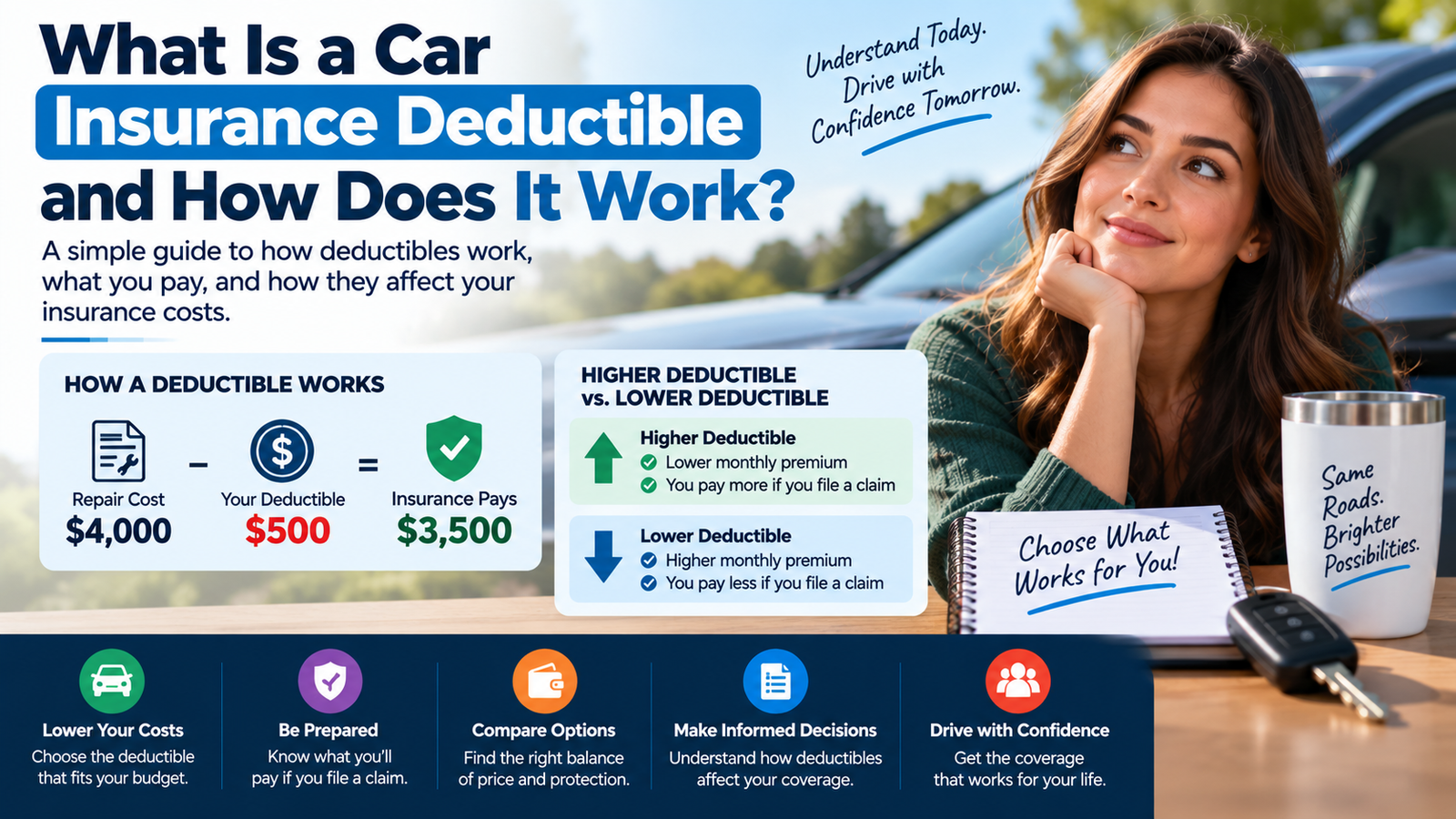
If deductibles are confusing, read What Is a Car Insurance Deductible and How Does It Work?
How Do PIP Limits Work?
PIP is not unlimited insurance.
Your policy can contain specific maximum benefits.
For example, there may be a limit for:
- Medical expenses
- Lost income
- Replacement services
- Certain other benefits
The structure depends on state law and the policy.
Suppose you have $20,000 of applicable PIP medical coverage.
Your qualifying medical expenses reach $30,000.
PIP does not automatically become $30,000 just because your costs are higher.
Once the available limit is exhausted, other insurance or financial resources may become relevant.
How Do MedPay Limits Work?
Medical Payments coverage normally has a selected limit.
For example:
$1,000
$5,000
$10,000
$25,000
or another amount offered by the insurer.
Suppose your MedPay limit is $5,000.
Your qualifying medical bills total $8,000.
MedPay generally cannot pay beyond the available limit simply because the medical expenses are higher.
That is why choosing the limit matters.
Is PIP More Expensive Than MedPay?
It can be, especially because PIP may provide broader benefits.
But there is no universal price comparison.
Premiums depend on:
- State
- Coverage limit
- Driver
- Insurance company
- Benefits included
- Policy structure
- Other rating factors
The best approach is to request actual quotes.
Ask:
How much does my policy cost with this PIP limit?
How much does it cost with a different limit?
If MedPay is available, what does that option cost?
Then compare actual dollars instead of relying on generic averages.
Can You Have PIP and MedPay at the Same Time?
In some states or policy structures, both types of coverage may be available.
In others, the options may be different.
If both are offered, ask the insurer how they work together.
You do not want to assume that buying both simply doubles every benefit.
There may be rules governing which coverage pays first or how benefits coordinate.
Does PIP Pay Before Health Insurance?
The relationship between PIP and health insurance varies by state and policy.
In some systems, PIP may be a primary source of payment for certain auto-accident medical expenses.
In other situations, coordination rules can be more complicated.
Your health insurance plan can also have its own rules regarding auto accidents.
If you have both PIP and health insurance, ask:
Which coverage pays first?
Does my health plan exclude or limit auto accident treatment?
Do I have a PIP deductible?
Do I need to submit medical bills to both insurers?
Understanding this before a serious accident can make the claims process easier.
Does MedPay Pay Before Health Insurance?
MedPay can also interact with health insurance.
How the two coordinate depends on the policy, state, and health plan.
In some cases, MedPay can help with expenses that might otherwise be subject to:
- Health insurance deductibles
- Copays
- Coinsurance
But do not assume it always pays first or always reimburses every medical expense.
Check the specific rules.
Do You Need PIP If You Have Good Health Insurance?
Possibly.
Health insurance and PIP do not necessarily provide identical benefits.
Health insurance may primarily focus on medical care.
PIP can potentially provide additional benefits such as:
- Lost income
- Replacement services
- Other qualifying accident-related expenses
Health insurance can also contain:
- Deductibles
- Copays
- Coinsurance
- Network restrictions
The value of PIP therefore depends on more than whether you already have health insurance.
Do You Need MedPay If You Have Health Insurance?
Maybe.
Consider what your health insurance would leave you responsible for after a car accident.
For example:
Health deductible: $3,000
Emergency treatment: $4,500
MedPay may potentially help with certain qualifying medical costs, depending on the policy and coordination rules.
It can also potentially provide medical protection for passengers who may have different health insurance arrangements.
What If Your Passenger Has No Health Insurance?
This is one reason Medical Payments or PIP coverage can be useful.
Imagine a friend riding with you is injured in an accident.
They have no health insurance.
If they qualify under your PIP or MedPay coverage, the policy may provide some medical protection subject to your limits and state rules.
Without applicable coverage, paying for emergency treatment could become much more complicated.
Does PIP Cover Damage to Your Car?
No.
PIP is injury-related coverage.
It is not designed to repair your vehicle.
Damage to your own car may instead involve:
- Collision coverage
- Comprehensive coverage
depending on what caused the damage.
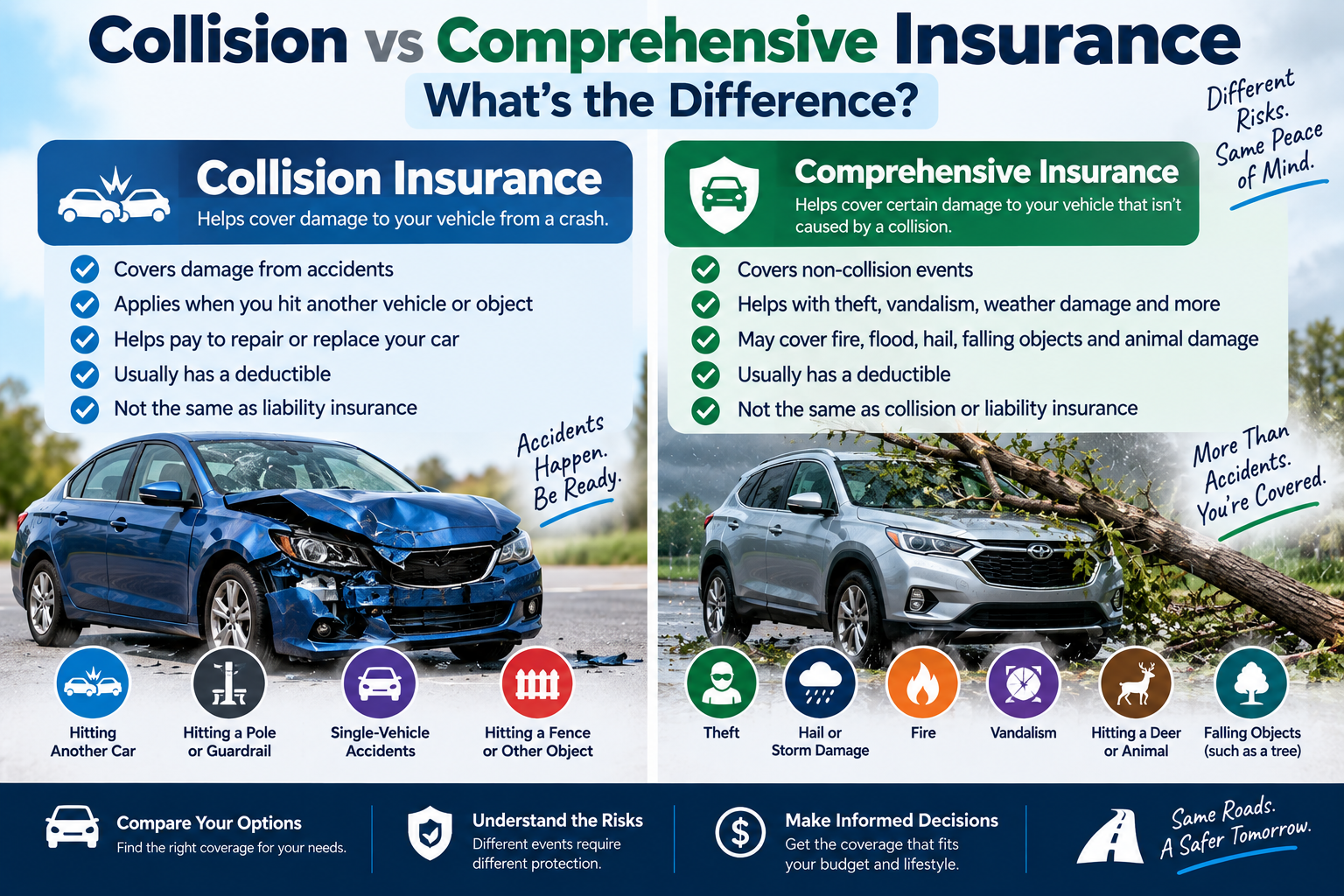
If you want to understand those coverages, read Collision vs Comprehensive Insurance: What’s the Difference?
Does MedPay Cover Damage to Your Car?
No.
Medical Payments coverage focuses on medical expenses, not vehicle repair.
The word “payments” sometimes confuses people into thinking it can pay any accident expense.
It cannot.
Your car requires the appropriate vehicle-damage coverage.
Does PIP Cover Damage You Cause to Another Car?
No.
Property damage you cause to another person's vehicle is generally handled by property damage liability coverage.
PIP deals with qualifying injury-related expenses.
Again, auto insurance policies contain several different types of coverage because one coverage cannot handle every possible loss.
Does MedPay Cover Another Driver's Injuries?
MedPay generally focuses on medical expenses for you and qualifying occupants or insured persons rather than paying liability claims for people you injure.
If you legally cause injuries to another driver, bodily injury liability coverage is generally the relevant protection.
PIP vs Uninsured Motorist Coverage
These are different protections.
PIP
Can provide certain injury benefits regardless of fault.
Uninsured Motorist Coverage
Can help protect you after a qualifying accident caused by someone who does not have enough applicable insurance.
Depending on the accident, both types of coverage may potentially become relevant.
For more information, read What Is Uninsured Motorist Coverage and Do You Need It?
What Happens If Another Driver Causes the Accident?
Suppose another driver runs a red light and injures you.
You may eventually have a claim against their bodily injury liability insurance.
But if you have PIP or MedPay, your own policy may also provide certain benefits without waiting for the complete fault dispute to finish.
How different coverages coordinate depends on state rules and policy terms.
This can be one of the practical advantages of no-fault medical coverage.
Can PIP Cover a Pedestrian Accident?
Depending on state law and policy definitions, PIP may potentially provide benefits when a covered person is injured as a pedestrian in an auto-related accident.
For example, you may be struck by a vehicle while crossing a street.
Whether your PIP applies depends on who qualifies under the policy and your state's rules.
Can MedPay Cover You as a Pedestrian?
Some MedPay policies may also cover a qualifying insured person who is struck by a vehicle while walking.
Again, policy definitions matter.
Do not assume every policy provides identical pedestrian protection.
What About Bicycle Accidents?
Auto-related injuries involving cyclists can sometimes involve PIP, MedPay, liability, or uninsured motorist coverage depending on the circumstances.
The answer can change based on:
- Which vehicle caused the accident
- Who was insured
- State rules
- Available coverage
Cyclist claims can become complicated, so review the actual policy after an incident.
PIP vs MedPay Example
Consider two drivers injured in similar accidents.
Driver A Has MedPay
Medical bills: $8,000
Lost income: $3,000
MedPay limit: $10,000
MedPay may help with qualifying medical bills.
But the $3,000 in lost wages generally would not be the type of benefit MedPay is designed to provide.
Driver B Has PIP
Medical bills: $8,000
Lost income: $3,000
Their PIP policy includes applicable medical and lost-income benefits.
PIP may potentially help with both categories, subject to the policy's limits and rules.
This example shows why PIP is often considered broader.
Which Coverage Is Better: PIP or MedPay?
There is no universal winner.
In some states, you may not even have a choice because one coverage is required or the other is what insurers offer.
If you can choose, consider:
- Medical insurance you already have
- Income you could lose after an accident
- Household responsibilities
- Passengers you regularly carry
- Coverage limits
- Deductibles
- Premium difference
- State rules
A broader policy can provide more protection, but additional benefits can also cost more.
The best choice is the one that fits your financial situation and the options actually available in your state.
When PIP May Be Especially Valuable
PIP can deserve serious consideration when:
- Your state requires it
- You want protection for lost income
- You have a high health insurance deductible
- You regularly carry passengers
- Missing work after an injury would create financial problems
- You want broader injury-related benefits
The exact decision still depends on the policy.
When MedPay May Be Useful
MedPay can be useful when:
- It is available in your state
- You want additional help with accident-related medical costs
- Your health plan has a high deductible
- You regularly carry passengers
- You want a relatively simple medical-expense benefit
Again, compare the premium with the available limit.
Should You Choose the Lowest PIP or MedPay Limit?
Not automatically.
The lowest limit may reduce your premium.
But ask yourself how far that amount would go after a serious accident.
Emergency treatment can become expensive quickly.
If you choose $2,000 of medical coverage but a serious injury produces much larger costs, that limit may be exhausted quickly.
Compare several limits and their actual premium differences before deciding.
Questions to Ask Before Buying PIP or MedPay
Ask your insurer:
- Is PIP required in my state?
- Is MedPay available?
- Can I have both?
- What are my coverage limits?
- Does a deductible apply?
- Are lost wages covered?
- Are replacement services covered?
- Are passengers covered?
- Are family members covered?
- Am I covered as a pedestrian?
- How does this work with my health insurance?
- Which coverage pays first?
- What happens if another driver is at fault?
- How much would higher limits cost?
These questions are much more useful than simply asking:
“Which one is cheaper?”
Frequently Asked Questions
What is the difference between PIP and Medical Payments coverage?
Both can help with qualifying medical expenses after an auto accident regardless of fault. PIP is generally broader and may also include benefits such as lost wages and certain replacement services, while MedPay mainly focuses on medical and funeral expenses.
Is PIP the same as MedPay?
No. They overlap in medical coverage, but PIP can provide broader benefits depending on the state and policy.
Does PIP cover lost wages?
It can. Lost-income protection is one of the important benefits that may be available through PIP.
Does MedPay cover lost wages?
Generally, Medical Payments coverage focuses on medical and certain funeral expenses rather than lost wages.
Do PIP and MedPay cover passengers?
They can, subject to policy definitions, limits, and state rules.
Is PIP required?
It depends on your state. Some states require PIP, while others make it optional or do not use it in the same way.
Is Medical Payments coverage required?
Requirements vary by location. For many drivers MedPay is optional, but you should check your state's insurance requirements.
Do I need PIP if I have health insurance?
Possibly. PIP can provide benefits beyond medical treatment, such as certain lost wages or replacement services, depending on your policy.
Do I need MedPay if I have health insurance?
It can still be useful for qualifying accident-related medical expenses, especially when health insurance has deductibles or other out-of-pocket costs.
Does PIP cover car repairs?
No. PIP is injury-related coverage. Vehicle damage is handled by other coverages such as collision or comprehensive when applicable.
PIP vs Medical Payments Coverage: The Bottom Line
So, what is the main difference between PIP vs Medical Payments coverage?
Both can help with qualifying medical expenses after a car accident.
Both can generally provide certain benefits without first requiring you to prove that someone else caused the accident.
But PIP is usually broader.
Medical Payments coverage primarily focuses on medical and certain funeral expenses.
PIP may also include lost income, certain replacement services, and other qualifying injury-related benefits.
Which one you can buy—and whether you are required to carry one—depends heavily on your state.
Before choosing coverage:
Check your state's requirements.
Review your health insurance.
Think about how you would manage lost income.
Consider the passengers you regularly carry.
Compare available limits.
Check any deductible.
And ask how the coverage works with your health insurance.
Do not choose based only on the lowest premium.
The real question is how much financial protection you would have if you were injured tomorrow.
For more information, read What Is Bodily Injury Liability Coverage?, What Is Uninsured Motorist Coverage and Do You Need It?, What Does Auto Insurance Cover?, or explore our Insurance Calculators