What Is a Car Insurance Deductible and How Does It Work?
Learn what a car insurance deductible is, when you have to pay it, how $500 and $1,000 deductibles work, and how choosing a deductible can affect your auto insurance premium.
What Is a Car Insurance Deductible and How Does It Work?
A car insurance deductible is the amount of money you agree to pay toward certain covered claims before your insurance company pays its part.
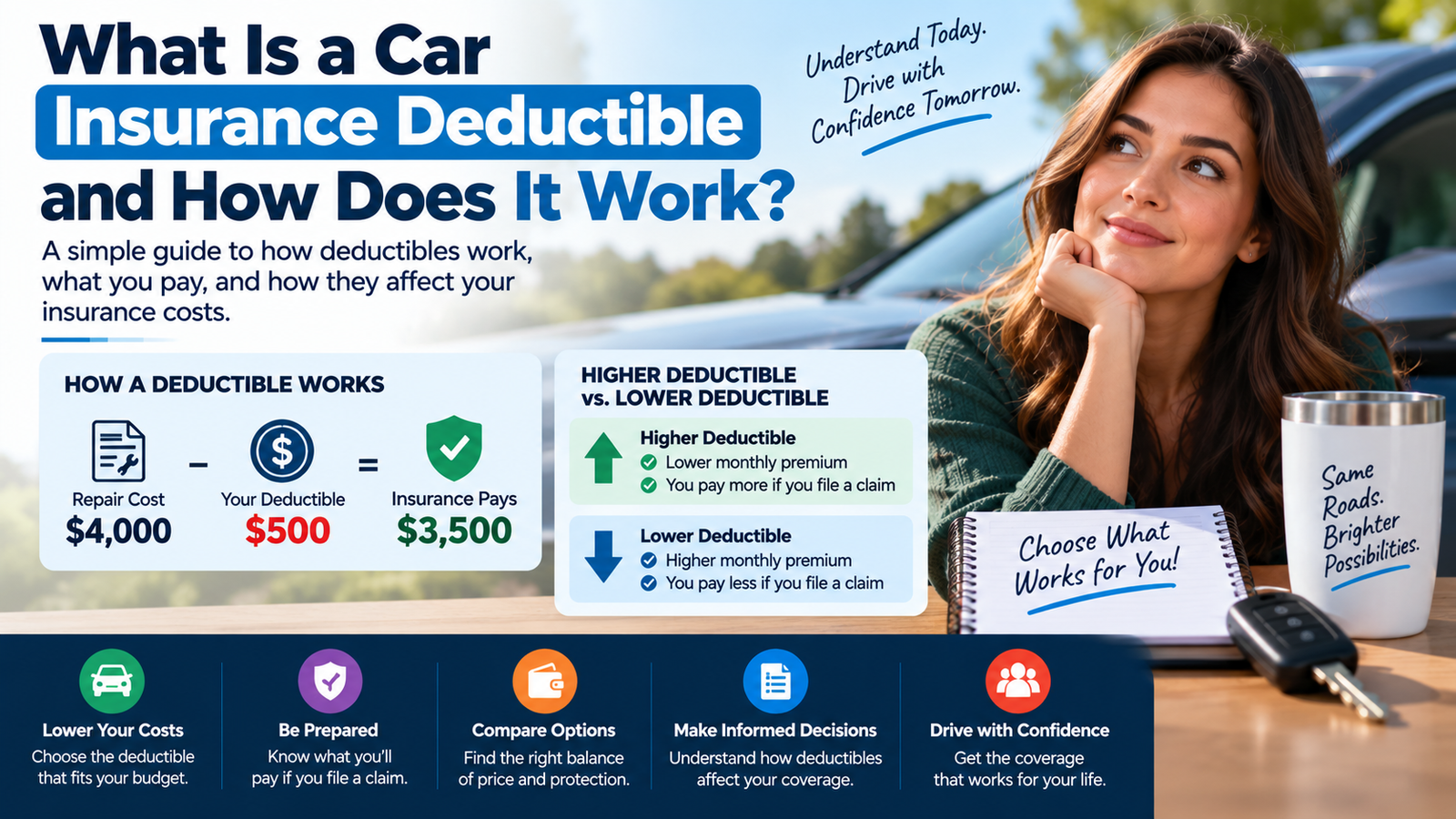
For example, imagine your car has $4,000 in covered collision damage and your deductible is $500.
You would generally be responsible for the first $500.
Your insurance company would then handle the remaining covered amount according to the terms of your policy.
In this example:
Repair cost: $4,000
Deductible: $500
Potential insurance payment: $3,500
That sounds simple, but deductibles often confuse drivers because they do not apply to every type of auto insurance claim.
You may also have different deductibles for different types of coverage.
Understanding how deductibles work can help you choose a policy that fits both your monthly budget and the amount you could afford after an unexpected accident.
How Does a Car Insurance Deductible Work?
Think of your deductible as your share of a covered loss.
Suppose you have collision coverage with a $1,000 deductible.
You are involved in a covered accident and repairs to your vehicle cost $6,000.
The basic calculation would look like this:
Repair cost: $6,000
Your deductible: $1,000
Remaining covered amount: $5,000
You are responsible for the deductible.
The insurer considers the remaining covered loss according to the policy.
The deductible is not normally an extra fee charged by the insurance company.
It is simply the portion of the covered loss you agreed to take responsibility for.
Please Also Check THIS...
https://bestcarandautoinsurance.com/what-does-auto-insurance-cover
Do You Pay a Car Insurance Deductible Every Month?
No.
Your deductible is not the same thing as your insurance premium.
Your premium is what you pay to keep your policy active.
That may be paid monthly, every six months, annually, or according to another billing schedule offered by your insurer.
A deductible generally becomes relevant when you make a covered claim under coverage that includes a deductible.
For example, you may pay:
$180 per month for your insurance policy
and have:
$500 collision deductible
Those are two completely different costs.
You do not pay $500 every month.
The deductible normally applies when an eligible claim occurs.
Which Car Insurance Coverages Usually Have a Deductible?
Deductibles are commonly associated with coverage that protects your own vehicle.
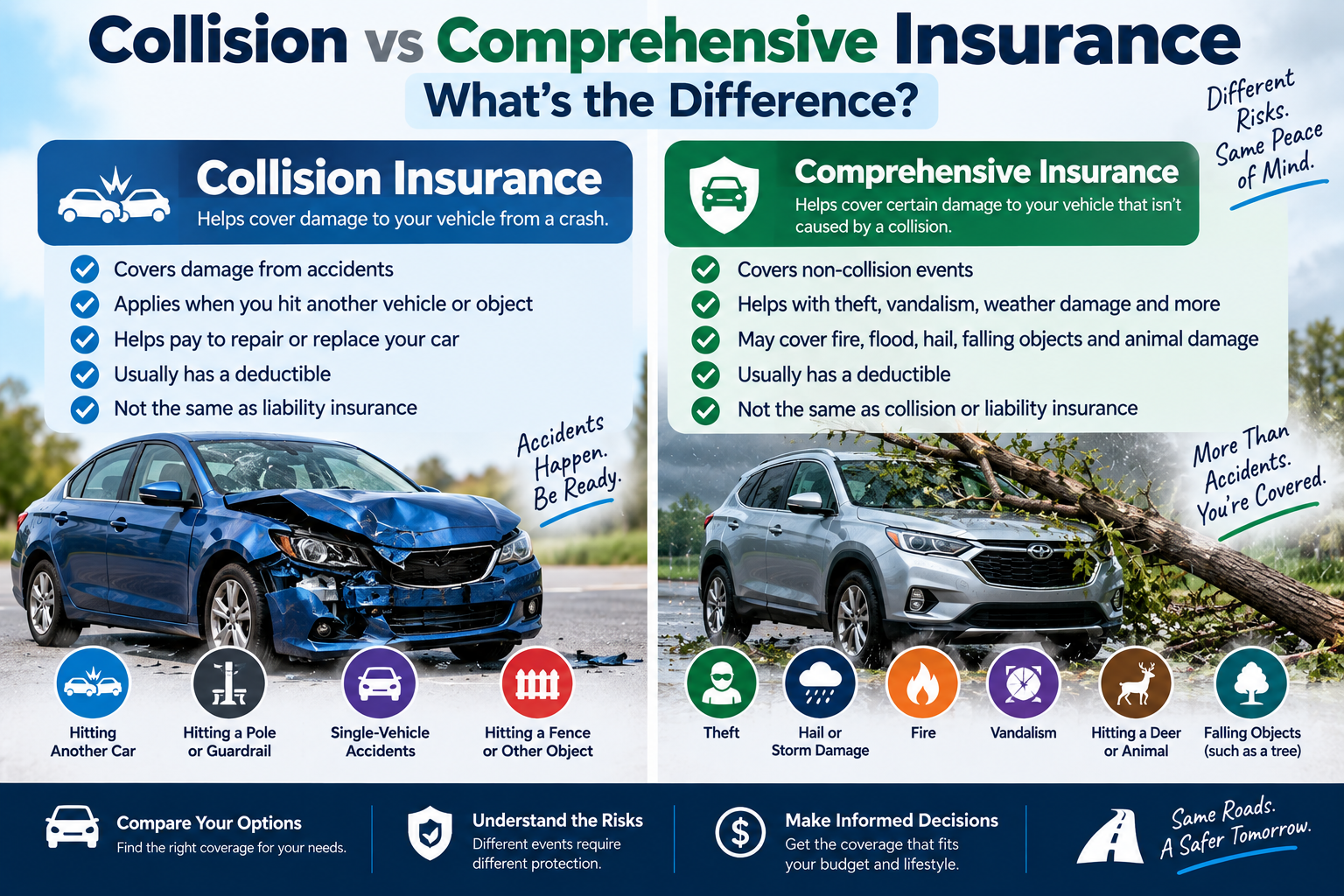
The two most common examples are collision and comprehensive coverage.
Collision Coverage
Collision coverage can help with covered damage to your own vehicle after certain collisions.
Examples may include hitting:
- Another vehicle
- A guardrail
- A pole
- Another object
If your collision coverage has a deductible, that amount is normally considered when the claim is settled.
Comprehensive Coverage
Comprehensive coverage generally applies to certain non-collision losses.
Depending on the policy, these can include things such as:
- Theft
- Vandalism
- Hail
- Storm damage
- Falling objects
- Fire
- Certain animal-related damage
Comprehensive coverage often has its own deductible.
If you are unsure how these coverages differ, read What Does Auto Insurance Cover?
Does Liability Insurance Have a Deductible?
Standard personal auto liability coverage typically does not work like collision or comprehensive coverage with a deductible paid by you for covered damage to another person.
Liability coverage is designed primarily to help with covered injuries or property damage you cause to others.
For example, if you cause an accident and damage someone else's car, your property-damage liability coverage may respond according to the policy limits and terms.
Your own vehicle damage would be a separate issue.
This is why understanding each part of your policy matters.
A deductible does not automatically apply to every claim simply because you have car insurance.
What Is a $500 Car Insurance Deductible?
A $500 deductible means that you are generally responsible for the first $500 of a covered loss under the coverage to which that deductible applies.
Imagine your car suffers $3,500 in covered collision damage.
With a $500 deductible:
Damage: $3,500
Deductible: $500
Potential covered amount after deductible: $3,000
Now imagine the damage is only $400.
If your deductible is $500, the repair cost is below the deductible.
In that situation, there may be nothing for the insurer to pay under that coverage.
That is one reason small repair claims sometimes do not make sense to file.
What Is a $1,000 Car Insurance Deductible?
A $1,000 deductible means you accept more of the financial responsibility after a covered loss.
Suppose covered repairs cost $5,000.
With a $1,000 deductible:
Repair cost: $5,000
Deductible: $1,000
Potential covered amount after deductible: $4,000
A $1,000 deductible may sometimes result in a lower insurance premium than a $500 deductible because you are agreeing to pay more yourself if a covered claim occurs.
But lower premium does not automatically mean better value.
You need to be able to afford that $1,000 if something happens.
$500 vs $1,000 Deductible: Which Is Better?
There is no single correct choice for everyone.
A $500 deductible may make sense if you prefer a lower out-of-pocket cost after a covered claim.
A $1,000 deductible may appeal to someone who wants to reduce the premium and has enough savings to comfortably cover the larger deductible.
Think about it this way.
$500 Deductible
Possible advantages:
- Lower out-of-pocket responsibility after a covered loss
- Easier for some households to pay unexpectedly
Possible disadvantage:
- The insurance premium may be higher
$1,000 Deductible
Possible advantages:
- The premium may be lower
- You accept more of the smaller losses yourself
Possible disadvantage:
- You need more cash available after an accident or other covered loss
The right choice depends on your financial situation.
Does a Higher Deductible Lower Car Insurance?
Often, choosing a higher deductible can reduce the premium for the coverage affected by that deductible.
Why?
Because you are agreeing to pay a larger portion of a covered loss yourself.
Imagine two identical drivers with identical cars and coverage.
Driver A chooses a $500 collision deductible.
Driver B chooses a $1,000 collision deductible.
Driver B may receive a lower premium.
However, the exact savings vary by insurance company, state, vehicle, and policy.
Do not assume that doubling your deductible will cut your premium in half.
It usually does not work that way.
Ask the insurer for both prices and compare the actual difference.
Is a Higher Deductible Always Better?
No.
A higher deductible can reduce your premium, but it also transfers more financial responsibility to you.
Suppose increasing your deductible from $500 to $1,000 saves you $8 per month.
That saves:
$96 per year.
But after a covered collision, you could be responsible for an additional $500 before insurance pays its portion.
You would need to decide whether that trade-off makes sense for you.
Do not choose a $1,000 or $2,000 deductible simply because the monthly premium looks cheaper.
Choose an amount you could realistically afford after an unexpected loss.
How Much Deductible Should You Choose?
Ask yourself one simple question:
If my car were damaged tomorrow, how much could I comfortably pay without creating a financial emergency?
If paying $1,000 unexpectedly would be extremely difficult, a $1,000 deductible may not be a good fit even if it saves money each month.
If you have enough emergency savings and prefer a lower premium, a larger deductible may be reasonable.
Your decision can depend on:
- Your savings
- Monthly budget
- Vehicle value
- Premium difference
- Risk tolerance
- How much you drive
- Whether the vehicle is financed
- Your ability to handle an unexpected repair expense
Can You Have Different Collision and Comprehensive Deductibles?
Yes.
Your collision deductible does not necessarily have to be the same as your comprehensive deductible.
For example, a policy might have:
Collision deductible: $1,000
Comprehensive deductible: $500
Or:
Collision deductible: $500
Comprehensive deductible: $250
Available options depend on the insurer and policy.
When comparing insurance quotes, make sure you look at both deductibles.
A policy can appear cheaper simply because it uses higher deductibles.
Do You Pay the Deductible Before the Insurance Company Pays?
How the deductible is handled can depend on the claim.
For a repair claim, the insurance company may pay the repair shop its covered portion while you pay your deductible portion.
For a total-loss claim, the deductible may instead be subtracted from the settlement.
For example:
Covered vehicle value: $15,000
Deductible: $500
Potential settlement after deductible: $14,500
This is a simplified example.
Actual settlements depend on policy terms, vehicle valuation, coverage, and claim details.
What Happens If the Repair Cost Is Less Than Your Deductible?
Suppose your comprehensive deductible is $500.
Your car receives covered damage costing $350 to repair.
Because the repair cost is lower than your deductible, there may be no insurance payment under that coverage.
You would generally handle the $350 yourself.
This is important to understand before filing very small claims.
What Happens If the Repair Cost Equals Your Deductible?
Imagine your repair cost is exactly $500 and your deductible is also $500.
There may be no amount remaining for the insurer to pay under that coverage.
You would be responsible for the repair cost.
Again, exact claim handling depends on the policy and circumstances.
Do You Pay a Deductible If Your Car Is Totaled?
If a covered total loss falls under coverage with a deductible, the deductible can normally be taken from the claim settlement.
For example:
Vehicle's covered value: $20,000
Comprehensive deductible: $1,000
Potential settlement after deductible: $19,000
This might occur if a vehicle is stolen and not recovered and the loss is covered by comprehensive insurance.
If you want to understand theft situations in more detail, read What Would Happen If Your Car Were Stolen and You Didn't Have Auto Insurance?
Do You Pay a Deductible If Someone Else Hits You?
This can depend on how the claim is handled.
If the other driver is responsible and their liability insurer pays your covered damages, your own collision deductible may not be involved in the same way.
However, situations can become more complicated when:
- Fault is disputed
- The other driver is uninsured
- The other insurer delays the claim
- You choose to use your own collision coverage first
If your own collision coverage is used, your deductible may initially apply.
Your insurer may later attempt to recover money from the responsible party or insurer.
Whether your deductible can eventually be recovered depends on the circumstances.
What Is Deductible Recovery?
Suppose another driver causes an accident.
You use your collision insurance because you want your vehicle repaired quickly.
You pay your $500 deductible.
Your insurance company later seeks reimbursement from the responsible driver's insurer.
If the insurer successfully recovers the money, you may eventually receive some or all of your deductible back depending on the recovery and circumstances.
This process is not automatic in every claim.
Do not assume your deductible will definitely be returned.
Ask your insurer how the claim is being handled.
Do You Pay a Deductible for a Stolen Car?
If your policy includes comprehensive coverage for theft and that coverage has a deductible, the deductible can generally apply to the theft claim.
For example:
Covered vehicle value: $18,000
Comprehensive deductible: $500
Potential covered settlement: $17,500
The exact settlement depends on the policy and claim.
Without comprehensive coverage, liability insurance alone generally does not protect your own vehicle against theft.
Does Windshield Insurance Have a Deductible?
Windshield and glass claims can work differently depending on the policy and state.
Some policies apply the normal comprehensive deductible.
Others may offer separate glass coverage with a lower deductible.
In some situations, glass coverage may be available without a deductible.
The rules and options vary.
Check your actual policy before assuming a cracked windshield will be free to repair.
Does Roadside Assistance Have a Deductible?
Roadside assistance usually works differently from collision and comprehensive insurance.
Depending on the policy or program, it may provide services such as:
- Towing
- Battery jump-start
- Lockout help
- Flat-tire assistance
- Fuel delivery
The benefit can have limits, but it does not normally work like a standard collision deductible.
Always check your policy because roadside programs vary.
Does Rental Car Coverage Have a Deductible?
Rental reimbursement coverage is another type of optional protection.
It may help with the cost of a temporary rental vehicle after a covered loss.
Instead of a traditional deductible, rental reimbursement commonly has limits such as:
A maximum amount per day.
And:
A maximum total amount or number of days.
Check your policy to see how your rental benefit works.
Deductible vs Premium: What Is the Difference?
These two terms are easy to confuse.
Premium
Your premium is the price you pay for the insurance policy.
Example:
$175 per month.
Deductible
Your deductible is the amount you agree to pay toward certain covered claims.
Example:
$500 collision deductible.
You can pay thousands of dollars in premiums over several years without ever paying a deductible if you never make a claim to which one applies.
Likewise, paying your deductible after a claim does not replace your regular insurance premium.
Deductible vs Coverage Limit
A deductible is also different from a coverage limit.
The deductible determines how much of a covered loss you handle before the insurance payment is calculated.
A coverage limit determines the maximum amount the insurer may pay under a particular coverage, subject to the policy.
For example:
Deductible: $500
Coverage limit: depends on the type of coverage and policy
These terms perform very different jobs.
Can You Change Your Car Insurance Deductible?
Usually, you can choose from deductible options offered by your insurer.
You may also be able to change your deductible later.
However, changes generally apply going forward.
You cannot normally change your deductible after an accident and then expect the new deductible to apply to a loss that already happened.
The policy in effect at the time of the loss matters.
If you want to change the deductible, contact the insurer before you need to make a claim.
Should You Lower Your Deductible Before a Road Trip?
Changing coverage only because you believe an accident might happen soon is generally not a useful way to think about insurance.
Choose coverage and deductibles based on your overall financial situation and risk rather than trying to predict the exact day something may happen.
If you change coverage, understand when the change becomes effective.
What If You Cannot Afford Your Deductible?
This is one of the biggest reasons not to choose an unnecessarily high deductible.
Imagine saving $10 per month by selecting a $2,000 deductible.
Then you have an accident.
Your car needs $6,000 in covered repairs.
You now need to handle the $2,000 deductible.
If you do not have the money available, repairing the car can become difficult.
A deductible should be large enough to help control your premium but small enough that you can realistically handle it after a loss.
Should an Emergency Fund Cover Your Deductible?
It can be helpful.
If your deductible is $1,000, having at least enough accessible savings to cover that amount can make a claim much less stressful.
Some drivers choose their deductible by looking at their emergency savings first.
For example:
Emergency savings: $300
A $2,000 deductible may be difficult.
Emergency savings: $8,000
A $1,000 deductible may be easier to manage.
Your situation is personal.
Does an Expensive Car Need a Lower Deductible?
Not automatically.
A more expensive vehicle may make collision and comprehensive coverage more important, but that does not necessarily mean the deductible must be lower.
The right deductible still depends on:
- Your finances
- Premium difference
- Vehicle value
- Loan or lease requirements
- Your comfort with risk
Compare several deductible options before deciding.
Does a Financed Car Have a Deductible?
Yes, financed vehicles can still have collision and comprehensive deductibles.
Your lender may require you to maintain collision and comprehensive coverage while the loan is active.
The financing agreement may also place limits on how high your deductible can be.
Check the loan agreement before selecting a very high deductible.
What About a Leased Vehicle?
Lease agreements often include insurance requirements.
The leasing company may require:
- Certain liability limits
- Collision coverage
- Comprehensive coverage
- Deductibles below a particular maximum
You cannot assume that every deductible option offered by an insurer will satisfy your lease agreement.
Review the lease requirements first.
Should You Raise Your Deductible to Save Money?
Maybe.
But calculate the trade-off.
Suppose:
$500 deductible premium: $180/month
$1,000 deductible premium: $165/month
Difference: $15/month
Annual savings:
$15 × 12 = $180
By increasing the deductible, you save $180 per year.
But you accept an additional $500 of responsibility after certain claims.
You can now make a more informed decision.
This type of calculation is much better than simply assuming “higher deductible is cheaper, so higher must be better.”
When a Lower Deductible May Make Sense
A lower deductible may be attractive if:
- You have limited emergency savings
- Paying a large amount suddenly would be difficult
- You prefer more predictable out-of-pocket costs
- The premium difference between deductible options is small
Again, there is no universal best number.
When a Higher Deductible May Make Sense
A higher deductible may be reasonable if:
- You have enough savings to comfortably pay it
- You want to lower the premium
- The premium savings are meaningful
- You are comfortable assuming more financial risk
The decision should reflect your finances, not someone else's recommendation.
How Deductibles Affect Insurance Quote Comparisons
This is extremely important when shopping for auto insurance.
Suppose:
Company A: $140/month
Company B: $155/month
Company A looks cheaper.
But then you notice:
Company A collision deductible: $1,500
Company B collision deductible: $500
Now you are not comparing identical policies.
The cheaper premium may partly exist because you are accepting much more financial responsibility.
Always compare:
- Liability limits
- Collision deductible
- Comprehensive deductible
- Coverage options
- Discounts
along with the premium.
Use our Best Car Insurance Companies Finder if you want to compare insurers based on your broader needs.
Can Choosing a Deductible Help You Find Cheaper Insurance?
Potentially.
Changing the deductible is one way to adjust premium costs.
But it should not be the only strategy.
You can also compare:
- Different insurers
- Available discounts
- Bundling options
- Mileage programs
- Usage-based insurance
- Coverage choices
If price is your main concern, our Top 10 Cheapest Car Insurance Companies tool can help you identify additional companies worth comparing.
Frequently Asked Questions
What is a car insurance deductible?
A car insurance deductible is the amount you agree to pay toward certain covered losses before the insurer pays its covered portion.
How does a $500 car insurance deductible work?
If a covered loss costs $4,000 and your deductible is $500, you are generally responsible for $500 and the insurer considers the remaining $3,500 according to the policy.
Is a $500 or $1,000 deductible better?
Neither is automatically better. A $500 deductible means less out-of-pocket cost after certain claims, while a $1,000 deductible may provide a lower premium. Your finances should guide the choice.
Do I pay my deductible every month?
No. Your deductible is separate from your insurance premium and generally becomes relevant only when you make a covered claim under coverage that includes one.
Do I pay a deductible if I am not at fault?
It depends on how the claim is handled. If you use your own collision coverage, your deductible may initially apply even when another driver caused the accident.
Do I pay a deductible if my car is totaled?
A deductible can be subtracted from a covered total-loss settlement when the applicable coverage includes one.
Does liability insurance have a deductible?
Personal auto liability coverage generally does not use the same type of deductible commonly found with collision and comprehensive coverage.
Does comprehensive insurance have a deductible?
Usually, comprehensive coverage has a deductible, although available options vary by insurer and certain types of claims may be treated differently.
Does a higher deductible lower insurance?
It often can reduce the premium for the affected coverage, but the amount of savings varies.
Can I change my deductible later?
Generally, yes, subject to the insurer's available options. The new deductible applies according to the effective date of the policy change and does not retroactively change an earlier loss.
What Is a Car Insurance Deductible and How Does It Work? The Bottom Line
A car insurance deductible is the amount of a covered loss that you agree to handle yourself before the insurer's covered payment is calculated.
The basic idea is simple.
A lower deductible means:
You generally pay less yourself after an applicable covered claim.
But:
Your premium may be higher.
A higher deductible means:
You accept more of the financial responsibility after an applicable covered claim.
But:
Your premium may be lower.
Neither choice is automatically right.
The best deductible is one that balances your monthly insurance cost with the amount you could realistically afford after an unexpected loss.
Before choosing, compare several deductible options.
Look at the real premium difference.
Check your emergency savings.
Understand what coverage the deductible applies to.
And when comparing insurance companies, make sure the deductibles are the same or similar before deciding which quote is actually cheaper.
For additional help, explore our Insurance Calculators or use the Best Car Insurance Companies Finder to compare insurance options based on your needs.