Collision vs Comprehensive Insurance: What’s the Difference?
Collision and comprehensive insurance both help protect your vehicle, but they cover different types of damage. Learn what each coverage does, when deductibles apply, and whether you may need one or both.
Collision vs Comprehensive Insurance: What’s the Difference?
Collision and comprehensive insurance both help protect your own vehicle, but they are designed for different types of losses.
The easiest way to remember the difference is this:
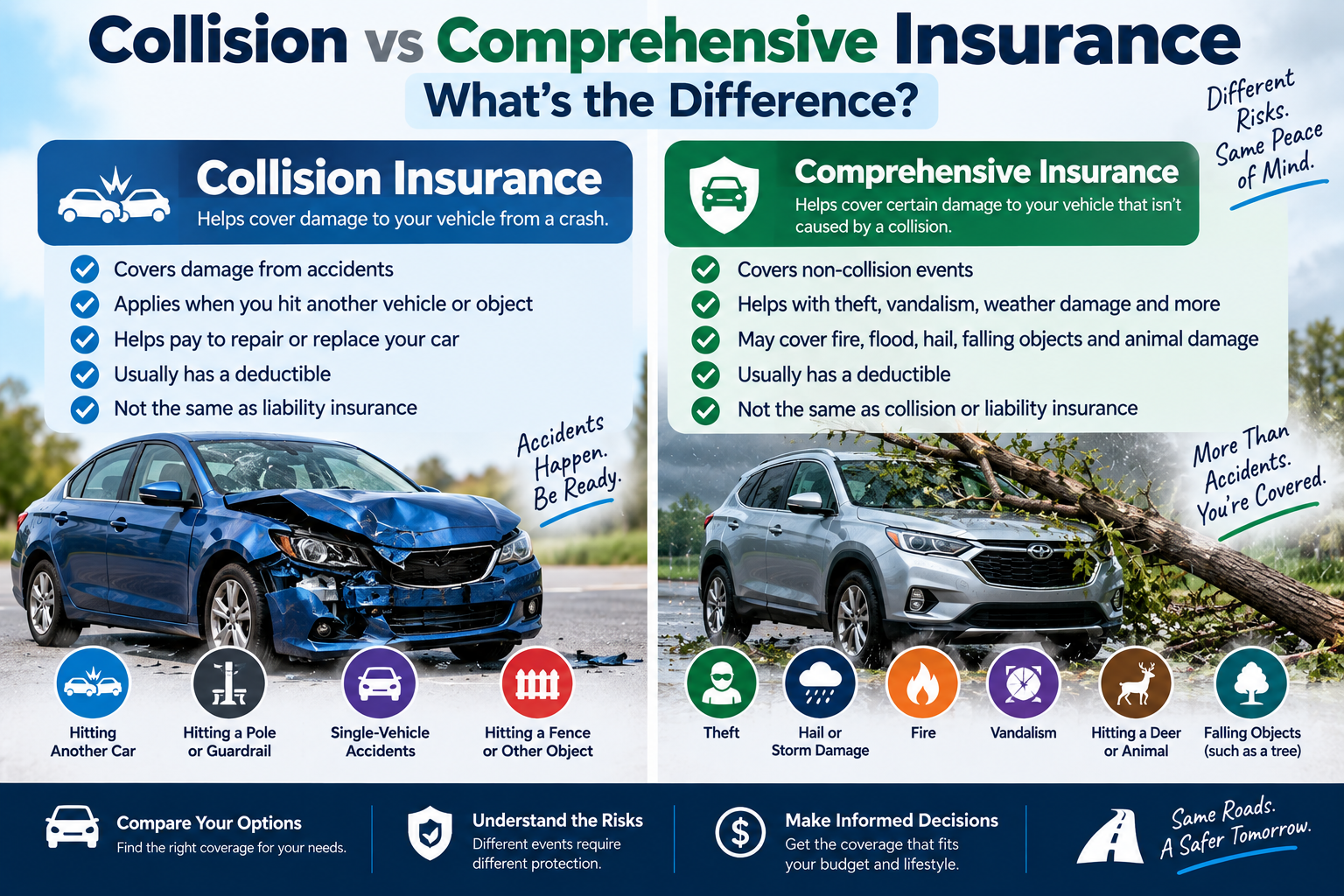
Collision coverage generally deals with damage from crashes.
Comprehensive coverage generally deals with covered damage that is not caused by a normal collision.
For example, if you hit another car, collision coverage may help with damage to your vehicle.
If your car is stolen, damaged by hail, or hit by a falling tree branch, comprehensive coverage may be the coverage that applies.
Many drivers buy both coverages together, especially when they have a newer, financed, or valuable vehicle.
But collision and comprehensive are not the same thing, and neither one replaces liability insurance.
Understanding how they work can help you decide what protection makes sense for your car and your budget.
What Is Collision Insurance?
Collision insurance helps pay for covered damage to your own vehicle after certain types of collisions.
It may apply when your car hits:
- Another vehicle
- A guardrail
- A fence
- A pole
- A wall
- Another object
It may also apply in certain single-vehicle accidents, such as losing control and hitting an object.
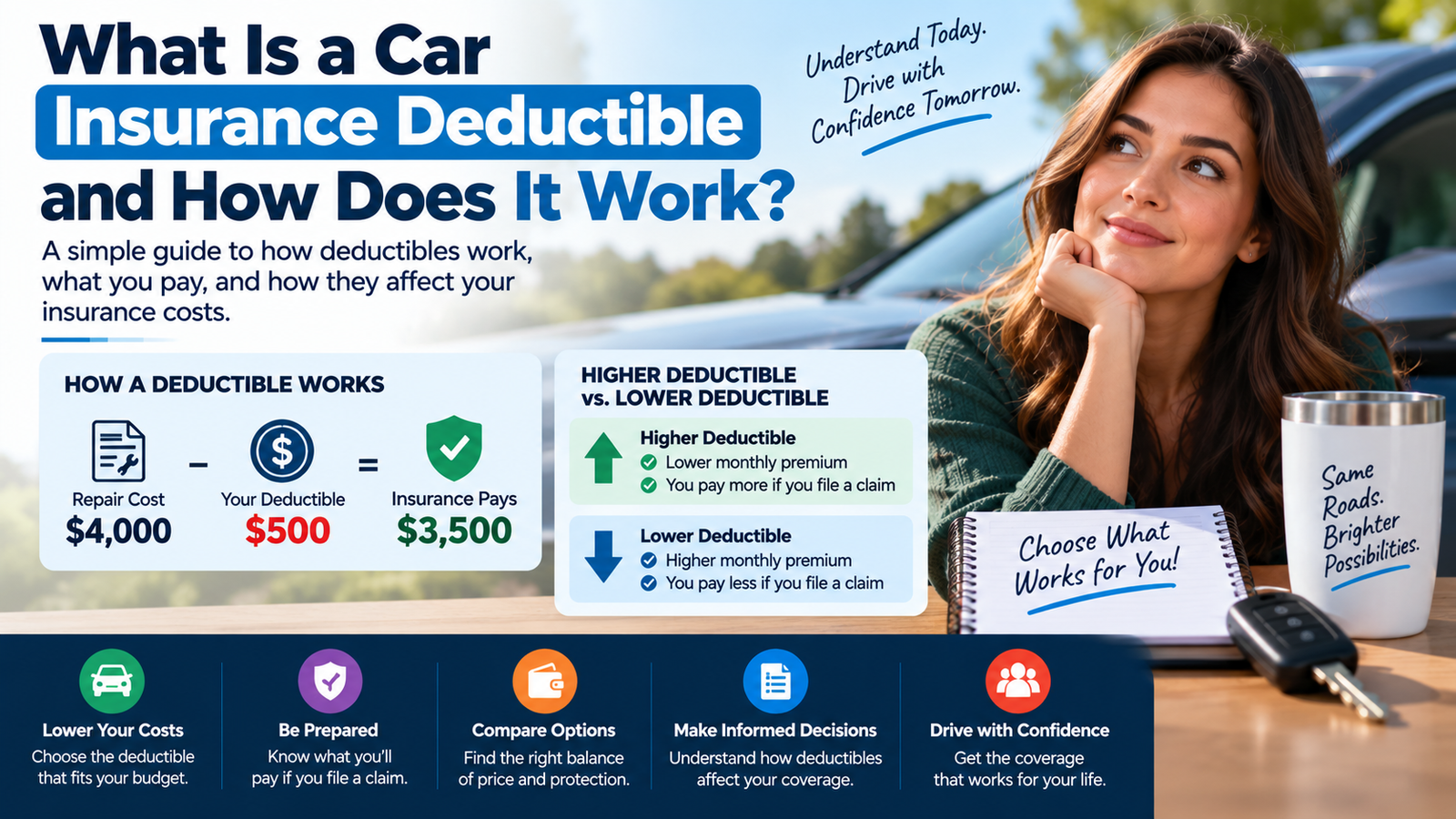
Collision coverage normally has a deductible.
That means you agree to pay part of an eligible covered loss before the insurer calculates its payment.
If you are not familiar with deductibles, read our guide What Is a Car Insurance Deductible and How Does It Work?
What Is Comprehensive Insurance?
Comprehensive insurance is designed for certain covered losses that are not normal vehicle collisions.
It is sometimes called “other than collision” coverage.
Depending on the policy, comprehensive insurance may help with situations such as:
- Vehicle theft
- Vandalism
- Hail
- Wind damage
- Falling objects
- Fire
- Flood-related damage
- Certain animal-related damage
- Broken glass
Comprehensive coverage also normally comes with a deductible.
The exact events covered depend on the policy.
You should always check your own insurance documents instead of assuming every non-collision event is automatically covered.
The Simple Difference Between Collision and Comprehensive
Here is an easy way to think about it.
Collision
Ask:
Did my car hit something, or did something collide with my car in a typical crash?
Collision coverage may be relevant.
Comprehensive
Ask:
Was my car damaged by something other than a normal collision?
Comprehensive coverage may be relevant.
For example:
You hit another vehicle.
That is generally a collision-type loss.
A storm drops a tree branch onto your parked car.
That is generally a comprehensive-type loss.
Someone steals your car.
That is generally a comprehensive-type loss.
A deer runs into your vehicle.
That is commonly handled under comprehensive coverage rather than collision.
Please Also Check Below..
https://bestcarandautoinsurance.com/does-getting-auto-insurance-quotes-affect-credit-score
Collision vs Comprehensive Insurance Examples
Examples make the difference much easier to understand.
You Hit Another Car
You are driving through an intersection and accidentally hit another vehicle.
Damage to your own car may fall under collision coverage.
Damage you caused to the other person's vehicle is generally handled through property-damage liability coverage, subject to your policy.
You Back Into a Pole
You reverse in a parking lot and hit a pole.
That is normally the type of event associated with collision coverage.
Your Car Is Stolen
You wake up and discover that your vehicle has disappeared.
Theft is generally associated with comprehensive coverage.
If you want a deeper explanation of theft situations, read What Would Happen If Your Car Were Stolen and You Didn't Have Auto Insurance?
Hail Damages Your Car
Your vehicle is parked outside during a severe hailstorm.
The roof and hood are covered in dents.
This is generally the type of damage handled by comprehensive coverage.
A Tree Falls on Your Car
Your vehicle is parked under a tree during a storm.
A large branch falls and damages the roof.
That is normally a comprehensive-type claim.
You Hit a Guardrail
You lose control on a wet road and hit a guardrail.
Damage to your vehicle would generally be associated with collision coverage.
An Animal Hits Your Vehicle
If you strike a deer or another animal, the damage is generally treated as a comprehensive loss.
This surprises many drivers because the vehicle technically collided with something.
Insurance policies often classify animal strikes differently from normal vehicle collisions.
Does Collision Insurance Cover Another Person’s Car?
Collision coverage is mainly designed to protect your own insured vehicle.
If you cause an accident that damages someone else's vehicle, your property-damage liability coverage is generally the coverage intended for that damage.
This is an important distinction.
Collision insurance is not a substitute for liability insurance.
Your policy can contain several separate coverages, and each one has a different job.
For a broader explanation, read What Does Auto Insurance Cover?
Does Comprehensive Insurance Cover Another Person’s Car?
No, comprehensive coverage is not normally designed to pay for damage you cause to someone else's vehicle.
It protects your own insured vehicle against specified non-collision risks.
If you are responsible for damaging another person's property, liability coverage is generally the relevant part of your policy.
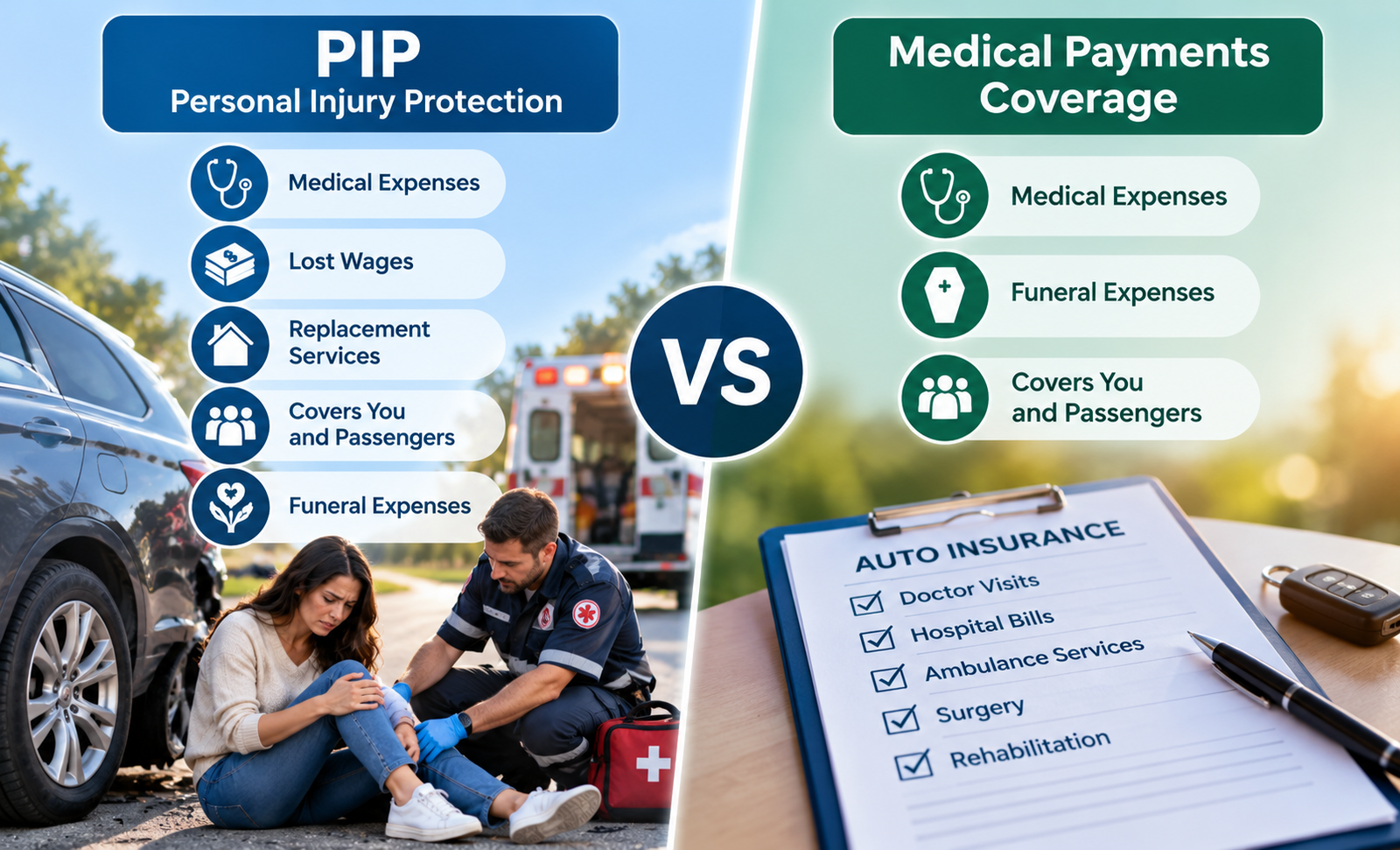
Do Collision and Comprehensive Cover Injuries?
Collision and comprehensive primarily focus on damage to your vehicle.
They are not designed to replace bodily injury liability, medical payments, personal injury protection, or other injury-related coverage that may apply depending on your policy and state.
This is why buying collision and comprehensive does not mean you are “covered for everything.”
Auto insurance is made up of different types of protection.
Do Collision and Comprehensive Have Deductibles?
Usually, yes.
You may be able to choose different deductibles for each coverage.
For example:
Collision deductible: $1,000
Comprehensive deductible: $500
Suppose you have $5,000 in covered collision damage.
With a $1,000 collision deductible, you would generally be responsible for the first $1,000.
The insurer would then consider the remaining covered amount according to the policy.
Now imagine hail causes $3,000 in covered damage and your comprehensive deductible is $500.
You would generally be responsible for $500 of that covered loss.
The deductible choice can affect both your premium and your out-of-pocket cost after a claim.
Is Collision Insurance Required by Law?
Collision coverage is generally not the type of insurance required by state financial-responsibility laws.
State insurance requirements usually focus on liability or other required coverages.
However, there is an important exception in practice:
Your lender may require collision coverage.
If you finance a vehicle, the lender has a financial interest in the car.
For that reason, financing agreements commonly require collision and comprehensive coverage.
Is Comprehensive Insurance Required by Law?
Comprehensive insurance is also generally not required by state auto-insurance law.
But a lender or leasing company may require it.
If your vehicle is financed or leased, check your agreement before removing either collision or comprehensive coverage.
Dropping required coverage could violate the terms of the loan or lease.
Do You Need Both Collision and Comprehensive Insurance?
Many drivers purchase both.
Whether you need them depends on your situation.
They may be particularly useful when:
- Your vehicle is newer
- Your car has significant value
- Your vehicle is financed
- Your car is leased
- Replacing the vehicle yourself would be difficult
- You want protection against theft and weather damage
- You want protection for your own vehicle after a crash
However, an older vehicle with very little market value can create a different decision.
You should compare the value of the vehicle with the cost of the coverage and the deductible.
Can You Buy Comprehensive Without Collision?
Depending on the insurer, you may be able to carry comprehensive coverage without collision.
For example, someone with an older vehicle might decide that they can afford to take the risk of collision damage themselves but still want protection against:
- Theft
- Hail
- Fire
- Vandalism
- Falling objects
Availability and policy rules vary, so ask your insurer what options are offered.
Can You Buy Collision Without Comprehensive?
Some insurers may allow this, but it depends on their underwriting rules and your situation.
If your car is financed or leased, your agreement may require both.
Before choosing only one coverage, think about what financial risks you would be accepting.
Collision vs Comprehensive: Which Is More Important?
There is no universal answer.
The more useful question is:
Which risks would be hardest for me to pay for myself?
If your car were badly damaged in an accident tomorrow, could you repair or replace it yourself?
If the car were stolen tonight, could you replace it yourself?
If a storm caused thousands of dollars of damage, could you comfortably pay for the repairs?
Your answers can help you decide how valuable each coverage is to you.
How Much Does Collision Insurance Cost?
There is no one price for collision coverage.
The cost can depend on factors such as:
- Your vehicle
- Your state
- Your driving history
- Your deductible
- Your insurer
- Vehicle repair costs
- Vehicle value
- Other rating factors
A $500 collision deductible may produce a different premium from a $1,000 deductible.
The only useful way to know the difference for your policy is to compare actual quotes.
How Much Does Comprehensive Insurance Cost?
Comprehensive pricing also varies by driver, vehicle and location.
A vehicle in an area with higher theft or weather-related risk may not be priced the same as a similar vehicle somewhere else.
Your deductible can also change the price.
Rather than relying on a national average, ask your insurer to show you the premium with different comprehensive deductibles.
Does a Higher Deductible Make Collision and Comprehensive Cheaper?
It often can reduce the premium.
For example, a $1,000 deductible may cost less than a $500 deductible.
But you are accepting more financial responsibility after a claim.
Imagine:
Repair cost: $4,000
With a $500 deductible, you handle $500.
With a $1,000 deductible, you handle $1,000.
You should decide whether the premium savings are worth the additional amount you would need after a loss.
What Happens If Damage Costs Less Than the Deductible?
Imagine your comprehensive deductible is $500.
A covered event causes $300 in damage.
Because the damage is less than your deductible, there may be no insurance payment under that coverage.
You would generally handle the repair yourself.
This is why deductible amount matters when selecting coverage.
Does Collision Cover a Hit-and-Run?
Collision coverage may help with damage to your own vehicle after a hit-and-run, depending on the circumstances and policy.
Other coverage, such as uninsured motorist property-damage coverage, may also be relevant in some states and situations.
How a hit-and-run claim is handled can vary.
Report the incident and ask your insurer which coverage applies.
Does Comprehensive Cover Theft?
Vehicle theft is one of the most important risks commonly associated with comprehensive coverage.
If the vehicle is stolen and not recovered, comprehensive coverage may help with a covered total-loss claim, subject to the policy and deductible.
If the car is recovered damaged, covered theft-related damage may also be considered.
Liability-only insurance generally does not provide this type of protection for your own stolen vehicle.
Does Comprehensive Cover Flood Damage?
Flood-related vehicle damage is generally associated with comprehensive coverage.
For example, your parked car may be damaged by rising water during a severe storm.
That type of event is different from crashing your vehicle into another object.
However, the actual claim still depends on the policy terms and circumstances.
Does Comprehensive Cover Hail Damage?
Hail damage is commonly handled under comprehensive coverage.
A severe storm can cause thousands of dollars in body and glass damage.
If your area experiences frequent severe weather, comprehensive coverage may be particularly important to consider.
Does Comprehensive Cover a Cracked Windshield?
It can.
Glass damage is often handled under comprehensive coverage, but deductibles and glass options vary.
Some policies may use the standard comprehensive deductible.
Others may offer a separate glass deductible or special glass coverage.
Check your policy before assuming that every windshield repair will be free.
Does Collision Cover Pothole Damage?
Damage caused by hitting a pothole can commonly fall under collision coverage.
However, whether filing a claim makes sense depends on the repair cost and your deductible.
If the repair costs $600 and your collision deductible is $500, the potential insurance payment may be small.
Always consider the deductible before filing a minor claim.
What If Another Driver Hits Your Parked Car?
This can depend on whether the responsible driver is known and insured.
Their liability insurance may be responsible for covered damage.
If they cannot be identified or there are problems with their insurance, your own collision coverage or another applicable coverage may become relevant.
Claim handling varies, so contact your insurer.
What If You Hit Your Own Garage?
Suppose you accidentally drive into your own garage door.
Damage to your car may fall under collision coverage.
Damage to the building is a separate insurance issue.
This is another example of why different insurance policies and coverages can apply to different parts of the same event.
Collision vs Comprehensive for an Older Car
Drivers with older vehicles often ask whether these coverages are still worth keeping.
There is no automatic age when you should remove them.
Instead, consider the car's actual value.
Imagine your vehicle is worth $3,000.
You have a $1,000 collision deductible.
You are paying a meaningful amount each year for collision coverage.
At some point, you may decide the potential insurance benefit is no longer worth the premium.
But if your vehicle is worth $15,000, the decision may look very different.
How to Decide Whether to Keep Collision Coverage
Ask yourself:
- What is my vehicle worth?
- How much does collision coverage cost?
- What is my deductible?
- Could I replace the vehicle myself?
- Is the car financed or leased?
- How much emergency savings do I have?
Do not remove collision coverage simply because someone says an old car “doesn't need it.”
Use your own financial situation.
How to Decide Whether to Keep Comprehensive Coverage
Ask similar questions.
Also think about the risks around you.
Could you financially handle:
- Theft?
- Hail damage?
- Flood damage?
- Vandalism?
- A fallen tree?
- Broken glass?
Comprehensive coverage can sometimes remain useful even when a driver is less concerned about collision damage.
What Happens If Your Car Is Totaled?
If a covered event results in a total loss, the insurance company generally determines the vehicle's covered value according to the policy and claims process.
Your deductible may then be subtracted from the settlement.
For example:
Covered value: $16,000
Deductible: $500
Potential settlement after deductible: $15,500
This is only a simplified example.
Actual settlements depend on the vehicle and policy.
What If You Owe More Than the Car Is Worth?
Collision and comprehensive coverage do not necessarily pay your entire remaining loan balance.
Suppose:
Loan balance: $25,000
Vehicle's covered value: $21,000
There may be a financial gap.
This is where gap protection can become relevant for some financed or leased vehicles.
Gap coverage is different from collision and comprehensive insurance.
What Is Full Coverage Insurance?
People often say “full coverage” when a policy includes:
- Liability coverage
- Collision coverage
- Comprehensive coverage
But full coverage is not one standardized insurance product.
A policy can still have:
- Different liability limits
- Different deductibles
- Different optional coverage
- Different exclusions
Never buy a policy based only on the phrase “full coverage.”
Review the actual coverage.
Collision vs Comprehensive vs Liability
These three coverages perform different jobs.
Liability Insurance
Helps with covered injuries or property damage you cause to others.
Collision Insurance
Helps with covered damage to your own vehicle from collisions.
Comprehensive Insurance
Helps with certain covered non-collision losses involving your vehicle.
A policy may contain all three because they protect against different risks.
Should You Choose the Cheapest Policy?
Not automatically.
Imagine two policies:
Policy A: $120 per month
Policy B: $155 per month
Policy A looks much cheaper.
Then you discover Policy A has liability only.
Policy B includes liability, collision and comprehensive.
Those are not comparable policies.
Before deciding that one insurer is cheaper, look at what is actually included.
Use our Best Car Insurance Companies Finder if you want to compare insurers based on coverage, service and other preferences.
If price is your main concern, you can also compare options with our Top 10 Cheapest Car Insurance Companies tool.
When Might Collision and Comprehensive Be Worth Keeping?
They may deserve serious consideration if:
- Your car is valuable
- You could not afford to replace it
- You rely heavily on the vehicle
- It is financed
- It is leased
- You live in an area with theft risk
- Your area experiences severe weather
- You want broader protection for your own vehicle
Price matters, but so does the amount of financial risk you would carry without the coverage.
When Might You Consider Dropping Them?
Some drivers with low-value vehicles may eventually decide that paying for collision or comprehensive is no longer worthwhile.
Before removing coverage, calculate:
Vehicle value
minus deductible
compared with
annual coverage cost.
Also think about whether losing the vehicle tomorrow would create a serious financial problem.
Do not make the decision based only on vehicle age.
Frequently Asked Questions
What is the difference between collision and comprehensive insurance?
Collision insurance generally covers certain damage to your vehicle from crashes, while comprehensive insurance generally covers certain non-collision losses such as theft, hail, fire, vandalism and falling objects.
Is comprehensive the same as full coverage?
No. Comprehensive is one type of coverage. “Full coverage” commonly refers to a combination of liability, collision and comprehensive coverage.
Is collision insurance required?
State law generally does not require collision coverage, but a lender or leasing company may require it.
Is comprehensive insurance required?
It is generally not required by state law, but financing or lease agreements may require it.
Does collision insurance cover theft?
No. Vehicle theft is generally handled under comprehensive coverage.
Does comprehensive insurance cover accidents?
Normal vehicle-to-vehicle or object collisions are generally handled under collision coverage rather than comprehensive.
Does comprehensive cover hitting a deer?
Animal strikes are commonly handled under comprehensive coverage.
Does collision cover potholes?
Damage from hitting a pothole is commonly associated with collision coverage.
Can I have different deductibles for collision and comprehensive?
Yes. Policies can allow separate deductible amounts for each coverage.
Do I need collision and comprehensive on an old car?
It depends on the vehicle's value, coverage cost, deductible, financing requirements and your ability to replace or repair the vehicle yourself.
Collision vs Comprehensive Insurance: The Bottom Line
The difference between collision and comprehensive insurance becomes much easier once you think about what caused the damage.
Collision coverage generally protects your vehicle against covered crash-related damage.
Comprehensive coverage generally protects your vehicle against covered non-collision events such as theft, hail, fire, vandalism, falling objects and certain animal-related losses.
Many drivers carry both because they protect against different risks.
But they are not automatically right for every vehicle.
Look at your car's value.
Check your deductible.
Compare the premium.
Think about how much you could afford to pay yourself after a loss.
And if the vehicle is financed or leased, check the insurance requirements before changing coverage.
The goal is not to buy the most coverage possible.
The goal is to understand what each coverage does and choose protection that makes sense for your vehicle and your financial situation.
For more information, read What Does Auto Insurance Cover?, learn What Is a Car Insurance Deductible and How Does It Work?, or explore our Insurance Calculators to compare your options.