What Is Bodily Injury Liability Coverage?
Learn what bodily injury liability coverage is, what it may pay for after an at-fault accident, how policy limits work, what it does not cover, and how much protection you may need.

What Is Bodily Injury Liability Coverage?
Imagine you are driving home and accidentally cause a serious car crash.
The other driver is injured.
An ambulance takes them to the hospital.
They need medical treatment and cannot work for several weeks.
Now the accident is no longer only about repairing two vehicles.
There are medical bills, lost income, and potentially other injury-related costs.
This is where bodily injury liability coverage can become important.
Bodily injury liability is part of auto liability insurance. It can help pay certain costs when you are legally responsible for injuring another person in a covered car accident.
Depending on the circumstances and policy, it may help with expenses such as medical treatment, lost income, legal defense, and certain other damages for which you are legally responsible.
But bodily injury liability has limits.
If the cost of an accident goes beyond those limits, you could potentially be responsible for the remaining amount.
That is why understanding your liability limits can be just as important as knowing your monthly insurance premium.
How Does Bodily Injury Liability Insurance Work?
Bodily injury liability protects you against certain financial consequences when you cause injuries to other people in a covered accident.
Suppose you cause an accident and another driver is injured.
Their qualifying injury-related losses total $30,000.
You have enough bodily injury liability coverage to handle that amount.
Your insurer may pay covered damages according to the terms and limits of your policy.
Now imagine the injuries are much more serious.
The qualifying losses reach $150,000, but your applicable insurance limit is only $50,000.
Your insurer will not simply continue paying without a limit.
Once applicable policy limits are exhausted, you could potentially face personal financial exposure for additional amounts you legally owe.
This is one reason buying only the lowest liability limit available deserves careful thought.
What Does Bodily Injury Liability Cover?
Coverage depends on the accident, state law, and your actual policy.
However, bodily injury liability may help with several types of injury-related damages.
Medical Expenses
A serious crash can result in:
- Ambulance transportation
- Emergency-room treatment
- Hospital stays
- Surgery
- Doctor visits
- Rehabilitation
- Physical therapy
- Other qualifying medical care
Medical expenses can grow quickly after a major accident.
Lost Income
An injured person may be unable to work temporarily or, in a severe case, for a much longer period.
Bodily injury liability may potentially include certain lost-income damages when you are legally responsible.
Pain and Suffering
Depending on applicable law and the circumstances, liability claims may include certain non-economic damages related to an injury.
Legal Defense
If you are sued after a covered accident, your auto insurer may provide a legal defense according to the terms of your policy.
Funeral-Related Damages
A fatal accident can create much larger liability exposure. Certain death-related damages may be included in a liability claim according to applicable law and policy terms.
What Does Bodily Injury Liability Not Cover?
Understanding what bodily injury liability does not cover is equally important.
It is generally not designed to pay for your own injuries.
It also does not normally pay to repair your own vehicle.
And it is not the primary coverage for damage you cause to someone else's vehicle.
Different parts of an auto policy handle those risks.
For example:
Your injuries may involve medical payments, PIP, health insurance, or another applicable coverage.
Your vehicle damage may involve collision coverage.
Damage you cause to another person's car or property generally involves property damage liability.
If you want a broader overview, read What Does Auto Insurance Cover?
Bodily Injury Liability vs Property Damage Liability
These two coverages are commonly grouped together under auto liability insurance, but they cover different types of losses.
Bodily Injury Liability
Focuses on injuries you cause to other people in a covered accident.
Property Damage Liability
Focuses on property you damage.
Examples can include:
- Another person's car
- Fence
- Building
- Mailbox
- Utility pole
- Other property
Imagine you cause an accident.
The other driver suffers $20,000 in qualifying injury-related losses.
Their car has $12,000 in damage.
Those expenses would not necessarily come from one single liability limit.
Bodily injury and property damage portions of the policy can have separate limits.
What Do 25/50 Bodily Injury Limits Mean?
Auto insurance liability limits are often written using numbers such as:
25/50
or as part of a three-number format:
25/50/25
These numbers usually represent thousands of dollars.
In a 25/50 bodily injury structure:
$25,000 is generally the maximum bodily injury liability limit for one injured person.
$50,000 is generally the maximum bodily injury liability amount for all injured people in one covered accident.
If the policy is shown as:
25/50/25
the third number generally represents:
$25,000 of property damage liability per accident.
Example of 25/50 Bodily Injury Coverage
Suppose your policy has:
25/50 bodily injury limits.
You cause an accident.
One person has $20,000 in covered bodily injury damages.
Because that amount is below the $25,000 per-person limit, there may be enough bodily injury coverage for that person's qualifying damages.
Now change the example.
One person has $40,000 in covered damages.
Your per-person limit is only $25,000.
Your insurance does not suddenly become $40,000.
The $25,000 limit can become important, and you could potentially face exposure beyond what the policy pays.
What Does 100/300 Bodily Injury Coverage Mean?
A 100/300 policy provides substantially higher bodily injury liability limits.
It generally means:
Up to $100,000 for one injured person
and
Up to $300,000 total for bodily injuries in one covered accident.
For example, imagine three people are injured.
Person A: $70,000
Person B: $45,000
Person C: $35,000
Total: $150,000
A 100/300 policy has a much larger potential pool of protection than a 25/50 policy, subject to policy terms and each person's limit.
This example also shows why the per-person limit and per-accident limit both matter.
Per-Person Limit vs Per-Accident Limit
These two numbers can be confusing.
Suppose your policy is:
50/100
That generally means:
Maximum for one person: $50,000
Maximum for everyone injured in one accident: $100,000
Now imagine three people each suffer $50,000 in qualifying damages.
Total losses:
$150,000
Your policy does not provide $50,000 × unlimited people.
The total bodily injury limit for that accident is still $100,000.
Understanding both limits is important when evaluating liability coverage.
Why Can Bodily Injury Claims Become So Expensive?
Vehicle repair bills can be large.
Serious injury claims can become much larger.
Consider what can follow a severe crash:
An ambulance arrives.
Two people go to an emergency room.
One person requires surgery.
They spend several days in hospital.
They cannot work for two months.
They need physical therapy afterward.
The financial impact can grow far beyond the initial accident scene.
That is why liability coverage is primarily about protecting you against potentially large financial obligations.
Is Bodily Injury Liability Required?
Requirements vary by state.
Most states require drivers to demonstrate financial responsibility, commonly through liability insurance, but the exact coverage and minimum limits vary.
A minimum that is legal in one state may not be the minimum somewhere else.
Some states also use different insurance systems that can affect how injury claims are handled.
Never assume that a limit you saw online applies nationwide.
Check the requirements for the state where your vehicle is insured.
Is the State Minimum Enough?
Being legal and being financially well protected are not necessarily the same thing.
Suppose your state allows a relatively low minimum bodily injury limit.
You purchase only that minimum.
Then you cause a serious accident involving multiple injured people.
The cost could exceed your insurance limit very quickly.
Once the applicable liability coverage is exhausted, your personal finances may become relevant.
The right amount of coverage depends on your circumstances, but choosing a minimum only because it creates the cheapest premium deserves careful thought.
What Happens If Injuries Cost More Than Your Liability Limit?
This is one of the most important things to understand about liability insurance.
Policy limits are actual limits.
Imagine:
Your bodily injury limit for one person: $50,000
Covered injury damages: $90,000
Your insurer does not simply increase your policy to $90,000 after the accident.
The policy provides coverage only according to the applicable limits and terms.
Amounts beyond available coverage can create personal financial exposure.
Depending on the case and law, the injured party may attempt to recover additional damages from the responsible driver.
Can Someone Sue You After a Car Accident?
Yes, depending on the circumstances and applicable state law.
If another person claims you caused their injuries, a lawsuit may be possible.
Your bodily injury liability coverage is therefore not only about paying medical bills.
A liability policy can also include an insurer's duty to defend you against covered claims.
The details depend on the policy and jurisdiction.
A serious accident is one reason liability insurance can protect more than your vehicle.
It can help protect your broader financial position.
Does Bodily Injury Liability Protect Your Savings?
Indirectly, that is one of its important purposes.
Suppose you have:
- Savings
- Income
- A home
- Investments
- Other assets
A serious liability judgment can potentially create significant financial exposure.
Higher liability limits can provide a larger insurance layer before your personal finances may become involved.
This does not mean every driver needs the highest limit available.
It means liability coverage should be considered in relation to the amount of risk you could realistically face.
Does Bodily Injury Liability Cover Your Passengers?
It depends on who was injured and the circumstances.
Liability coverage generally exists for injuries for which an insured person is legally liable.
Coverage involving passengers in your own vehicle can interact with state law, policy definitions, family-member exclusions or limitations, medical payments, PIP, and other insurance.
Do not assume every passenger injury is automatically handled in exactly the same way.
For a real claim, the insurer determines which coverage applies.
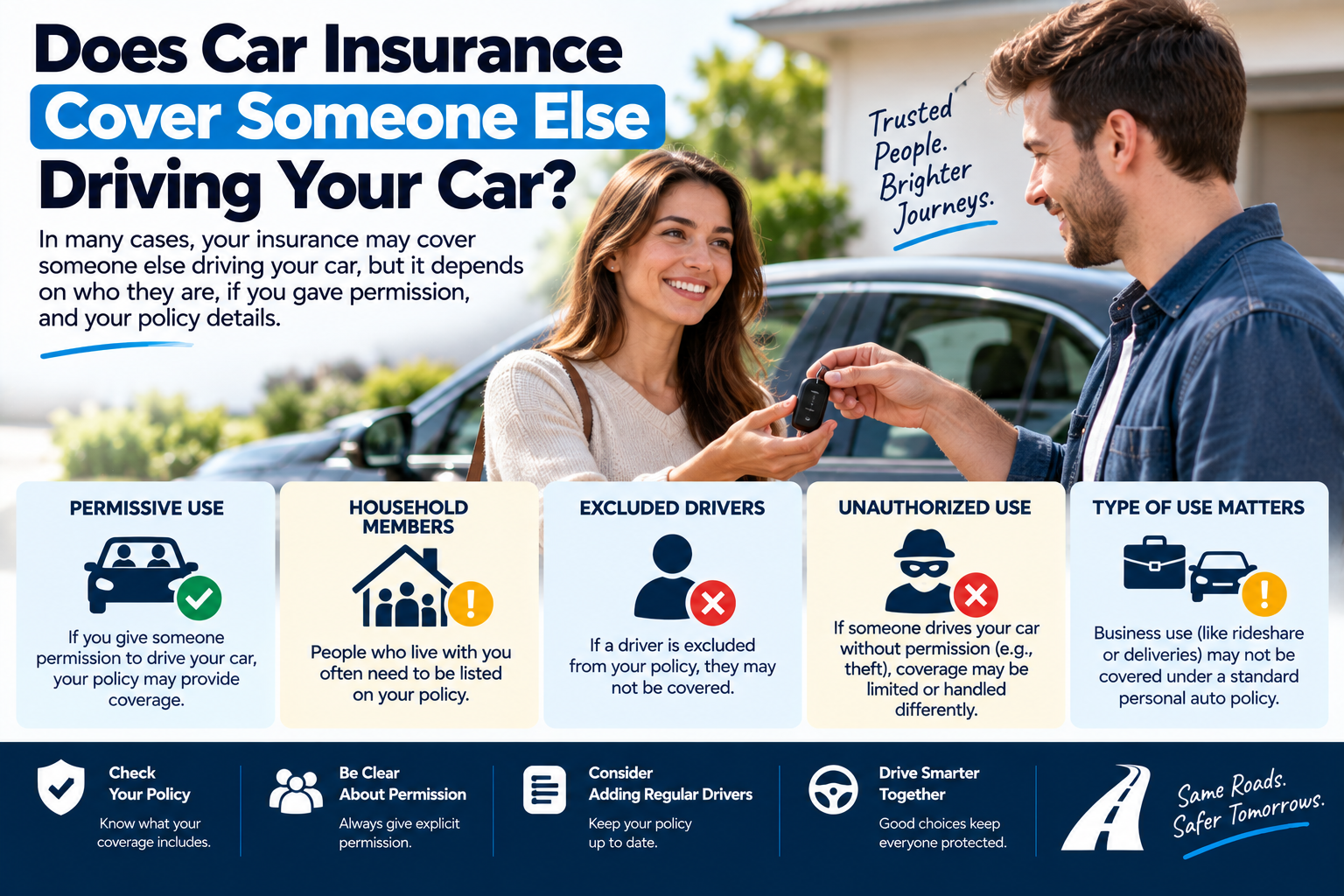
What If Someone Else Is Driving Your Car?
Suppose you lend your vehicle to a friend with permission.
They cause an accident.
Your liability policy may potentially apply depending on:
- Who the driver is
- Whether they had permission
- Policy terms
- Their household status
- Whether they are excluded
- State law
This is why lending a car is also an insurance decision.
For more detail, read Does Car Insurance Cover Someone Else Driving Your Car?
What If the Driver Is Excluded From Your Policy?
An excluded driver can create a very different situation.
Where driver exclusions are permitted, your policy may specifically state that a certain person is not covered when operating the vehicle.
If that person drives anyway and causes serious injuries, coverage may be unavailable or significantly affected.
Never assume an excluded driver becomes covered simply because you gave them permission.
Does Bodily Injury Liability Cover You If You Drive Someone Else’s Car?
It may in some circumstances when you drive another person's vehicle with permission, but the interaction between the vehicle owner's policy and your own insurance can vary.
The owner's insurance may be primary in some situations, with another policy potentially becoming relevant afterward.
Do not rely on a universal “insurance follows the driver” or “insurance follows the car” rule.
Policy wording and state law matter.
Does Bodily Injury Liability Cover Your Own Medical Bills?
Generally, bodily injury liability is designed to cover injuries you cause to other people, not your own medical expenses.
Your own injury expenses may involve:
- Personal Injury Protection
- Medical Payments coverage
- Health insurance
- Uninsured/underinsured motorist coverage
- Another driver's liability insurance
depending on the accident and your state.
This is why bodily injury liability should not be confused with personal medical coverage.
Bodily Injury Liability vs PIP
Personal Injury Protection, commonly called PIP, has a different purpose.
Bodily Injury Liability
Helps with covered injuries you are legally responsible for causing to others.
PIP
Can help with certain injury-related expenses for you and qualifying occupants, depending on state rules and policy terms.
PIP may operate regardless of fault in certain insurance systems.
The two coverages are not substitutes for one another.
Bodily Injury Liability vs Medical Payments Coverage
Medical Payments coverage, often called MedPay, can help pay certain medical expenses for you or passengers after an accident, subject to the policy.
Bodily injury liability deals with your legal responsibility for injuries to others.
Again:
BI liability = liability to others
MedPay = certain medical expenses for insured persons/passengers
The exact rules vary by policy and state.
Bodily Injury Liability vs Uninsured Motorist Coverage
These coverages protect opposite sides of an accident.
Bodily Injury Liability
Protects you financially when you are legally responsible for injuring someone else.
Uninsured Motorist Bodily Injury
Can help protect you when another qualifying driver causes an accident but does not have applicable insurance.
For a complete explanation, read What Is Uninsured Motorist Coverage and Do You Need It?
What If the Other Driver Is Underinsured?
Suppose another driver causes the accident and injures you.
They have bodily injury liability insurance.
But their limit is too low to cover your qualifying losses.
Your own underinsured motorist coverage may potentially become relevant if you purchased it and the claim qualifies.
That is different from your bodily injury liability coverage.
Your liability protects against claims made against you.
UIM can potentially protect you when the other driver's coverage is insufficient.
Does Bodily Injury Liability Cover Pain and Suffering?
A liability claim can potentially include non-economic damages such as pain and suffering where permitted and applicable.
How those damages are determined is not as simple as adding hospital bills.
The circumstances, law, injuries, evidence, and negotiations can all matter.
Your liability coverage still remains subject to its policy limits.
Does Bodily Injury Liability Cover Lost Wages?
It can potentially include qualifying lost-income damages for someone you injure in a covered accident and for whom you are legally responsible.
For example, if an injured person cannot work for six weeks, their liability claim may include income they lost during recovery.
Severe injuries can also potentially involve longer-term income-related damages.
This is another reason injury claims can become expensive quickly.
Does Bodily Injury Liability Cover Legal Fees?
Auto liability policies generally include provisions for defending insured drivers against covered liability claims.
The details of defense costs and how they interact with policy limits depend on policy wording.
If you receive legal documents after an accident, do not ignore them.
Contact your insurer promptly.
Waiting can make the situation more difficult.
Does Bodily Injury Liability Pay for Your Car?
No.
Your own car generally needs other coverage.
If you cause an accident and your vehicle is damaged, collision coverage may help if you purchased it and the claim is covered.
If your vehicle is damaged by theft, hail, flooding, fire, or certain other non-collision events, comprehensive coverage may apply.
Liability coverage is primarily about damage or injuries you legally cause to others.
What If You Only Have Liability Insurance?
A liability-only policy can satisfy legal requirements in some states, depending on the limits.
But it may provide little or no protection for physical damage to your own vehicle.
Imagine you cause an accident.
Your bodily injury and property damage liability may help with qualifying losses you caused to others.
But your own badly damaged vehicle may have no collision coverage.
That is why the cheapest policy should never be evaluated only by its monthly payment.
Understand what you are giving up.
How Much Bodily Injury Liability Coverage Do You Need?
There is no single limit that is right for every driver.
You can begin by considering:
- State minimum requirements
- Your income
- Savings
- Assets
- Household finances
- Risk tolerance
- Cost of higher limits
- Other liability protection
Then ask your insurer for quotes at several limits.
For example, compare:
25/50
50/100
100/300
or other available options.
You may discover that increasing your liability protection costs less than you expected.
Or it may significantly affect the premium.
The important thing is to compare actual numbers.
Should You Buy More Than the Minimum?
It can be worth considering.
The minimum is designed around legal requirements, not necessarily the maximum accident you could ever cause.
Medical costs and lost income after a major injury can quickly exceed low limits.
If you have assets or income you want to protect, higher limits may provide valuable additional protection.
You should choose a level that makes sense for your own finances rather than blindly copying another driver's policy.
What Is a Combined Single Limit?
Not every auto policy uses split limits such as 100/300/100.
Some policies may use a combined single limit, often called CSL.
Instead of having separate bodily injury per-person, bodily injury per-accident, and property-damage limits, a combined single limit provides one overall liability limit that can apply to covered bodily injury and property damage according to the policy.
For example:
A $300,000 combined single limit.
This structure can provide more flexibility in certain accidents.
Availability depends on the insurer.
Split Limits vs Combined Single Limit
Split Limits
Example:
100/300/100
Separate maximums apply to:
- One injured person
- Everyone injured
- Property damage
Combined Single Limit
Example:
$300,000 CSL
One overall liability amount applies to qualifying bodily injury and property damage.
Neither format is automatically best for everyone.
The important thing is understanding how much protection you actually have.
Does a Deductible Apply to Bodily Injury Liability?
Personal auto liability coverage generally does not use the same standard deductible structure commonly associated with collision and comprehensive coverage.
If you have a $500 collision deductible, that does not normally mean you also pay $500 before bodily injury liability begins handling a covered claim.
Different coverages work differently.
For more information about deductibles, read What Is a Car Insurance Deductible and How Does It Work?
Can a Bodily Injury Claim Increase Your Insurance Premium?
It can.
If you cause an accident that results in an injury claim, that accident can affect your insurance profile.
The future premium may depend on:
- Fault
- Claim size
- Previous accidents
- Driving record
- State
- Insurer
- Accident forgiveness
- Discounts
There is no fixed percentage that applies to every driver.
For a full explanation, read Does Filing a Car Insurance Claim Increase Your Premium?
How Long Can an Injury Accident Affect Insurance?
An at-fault accident can remain relevant to insurance pricing for several years.
For many ordinary accidents, three to five years is a useful general reference range, but actual timeframes vary.
Serious violations connected with an accident can have different timelines.
Read How Long Does an Accident Stay on Your Car Insurance Record? for a more detailed explanation.
What Happens After a Bodily Injury Accident?
If an accident causes injuries, take the situation seriously.
Put Safety First
Call emergency services when needed.
Report the Accident
Follow applicable police and state reporting requirements.
Exchange Information
Collect accurate driver and insurance information.
Document the Scene
If it is safe, take photographs and preserve relevant information.
Contact Your Insurer
Report the accident promptly according to your policy.
Do Not Guess About Injuries
Some injuries may not become obvious immediately.
Do Not Ignore Legal Documents
If you later receive a demand letter or lawsuit, send it to your insurer promptly.
Should You Admit Fault at the Accident Scene?
You should provide accurate information and cooperate with appropriate authorities and insurers.
But avoid making speculative statements about legal responsibility when you may not know all the facts.
An accident can involve:
- Traffic laws
- Witnesses
- Vehicle positions
- Video
- Police findings
- Multiple drivers' actions
The insurer and other parties may investigate fault.
Focus on safety and accurate factual information.
What If Several People Are Injured?
This is where the per-accident limit becomes especially important.
Suppose you carry:
100/300 bodily injury limits.
Three people are injured.
Each person may have a maximum of $100,000 available under the per-person limit.
But the total available for all bodily injury claims from the covered accident generally cannot exceed $300,000.
A multi-passenger accident can therefore use liability limits quickly.
What If You Injure a Cyclist or Pedestrian?
Bodily injury liability is not limited only to people sitting inside another vehicle.
If you are legally responsible for injuring a pedestrian, cyclist, motorcyclist, or another person in a covered vehicle-related accident, bodily injury liability may potentially apply.
Again, coverage depends on the policy, facts, and applicable law.
Does Bodily Injury Liability Cover Family Members?
Family-member claims can involve special policy provisions and state laws.
Some policies or jurisdictions may limit or treat certain intra-family liability claims differently.
Do not assume that the general description of bodily injury liability answers every household-member situation.
If you have a specific family-related claim, ask the insurer how the policy applies.
Does Bodily Injury Liability Cover Intentional Harm?
Auto insurance is designed for covered accidents, not intentional injury.
Intentional acts are generally very different from negligent driving accidents and may be excluded.
Never assume liability insurance will protect someone who intentionally uses a vehicle to harm another person.
Can You Increase Your Bodily Injury Limits Later?
Usually, insurers offer several liability-limit options.
You may be able to increase your limits for future coverage.
But an increase cannot normally be applied retroactively to an accident that already happened.
If you currently carry low limits and are considering increasing them, make the decision before you need them.
What Is Umbrella Insurance?
Drivers with significant assets may also consider personal umbrella liability insurance.
An umbrella policy can provide additional liability protection above certain underlying policies when its conditions are met.
For example, it may sit above qualifying auto liability limits.
Umbrella policies typically require you to carry certain minimum underlying liability limits first.
It is separate from ordinary auto insurance and has its own terms and exclusions.
Is Bodily Injury Liability the Same as Full Coverage?
No.
“Full coverage” is a casual phrase often used to describe a policy with liability, collision, and comprehensive insurance.
Bodily injury liability is only one part of that policy.
Also, there is no single universal product officially called full coverage.
Always examine the actual coverage and limits instead of relying on the label.
How to Compare Bodily Injury Coverage Between Insurance Companies
Do not compare prices unless the liability limits are the same.
Suppose:
Company A: $110/month with 25/50 limits.
Company B: $135/month with 100/300 limits.
You cannot simply say Company A is cheaper without noticing that the liability protection is very different.
When comparing quotes, keep the following consistent:
- Bodily injury limits
- Property damage limits
- Uninsured motorist limits
- Collision deductible
- Comprehensive deductible
- Drivers
- Vehicles
Then compare prices.
That gives you a meaningful insurance comparison.
Frequently Asked Questions
What is bodily injury liability coverage?
Bodily injury liability coverage helps protect you financially when you are legally responsible for injuries to other people in a covered auto accident.
What does bodily injury liability cover?
It may help with qualifying medical expenses, lost income, legal defense, and certain other damages associated with injuries you are legally responsible for causing, subject to policy limits and terms.
What does 25/50 bodily injury mean?
It generally means up to $25,000 of bodily injury liability coverage for one person and up to $50,000 total for bodily injuries to all people in one covered accident.
What does 100/300 mean?
It generally means up to $100,000 for one injured person and up to $300,000 for all covered bodily injuries from one accident.
Does bodily injury liability cover my injuries?
Generally, no. Bodily injury liability is primarily designed to cover injuries you cause to other people.
Does bodily injury liability cover my car?
No. Damage to your own vehicle is generally handled through collision or comprehensive coverage when applicable.
Does bodily injury liability have a deductible?
Standard personal auto bodily injury liability generally does not use the same type of deductible associated with collision and comprehensive coverage.
Is bodily injury liability required?
Requirements vary by state. Most states require drivers to demonstrate financial responsibility, commonly through liability insurance, but minimum limits and rules differ.
Is the minimum bodily injury coverage enough?
It may satisfy legal requirements but may not provide enough protection after a serious accident. Consider your finances and potential liability exposure before choosing limits.
Can someone sue me if my bodily injury limit is too low?
If you are legally liable for damages that exceed available insurance coverage, you may potentially face personal financial exposure depending on the circumstances and applicable law.
What Is Bodily Injury Liability Coverage? The Bottom Line
Bodily injury liability coverage is one of the most important financial protections in an auto insurance policy.
It does not primarily protect your car.
It does not primarily pay your own medical bills.
It protects you against certain financial responsibility when you legally cause injuries to other people in a covered accident.
The most important thing to understand is that liability coverage has limits.
A serious accident can create:
Medical expenses.
Lost income.
Legal claims.
Long-term injuries.
And potentially very large financial losses.
The state minimum may make you legal, but it does not automatically mean it is the right amount of protection for your financial situation.
Before choosing your limits:
Check your state's requirements.
Understand the per-person limit.
Understand the per-accident limit.
Compare the cost of higher limits.
Think about your income and assets.
And make sure you are comparing insurance quotes with the same liability protection.
For more information, read What Does Auto Insurance Cover?, What Is Uninsured Motorist Coverage and Do You Need It?, Does Car Insurance Cover Someone Else Driving Your Car?, or explore our Insurance Calculators for additional tools.
https://bestcarandautoinsurance.com/what-happens-if-your-car-is-stolen-without-auto-insurance